
 Laos
LaosLaos Country Bundle: suggestions, stories and tips

Main suggestions, stories and tips about Laos by WorldSupporters
 Laos: Updates & Travel
Travel in Laos
- Laos is the epitome of tranquility, beautiful nature, friendly people and many monks in orange and yellow robes. Although the country is increasingly being discovered by tourists and travellers, it has retained its authentic character for the time being. In Laos you feel like you are back in time and you are quickly absorbed in the relaxed atmosphere that the small villages and temples exude. An absolute must for anyone who wants to experience the real Asia!
- Vang Vieng, 6 hours by bus from Vientiane. Drugs are the main reason that many travellers come to Vang Vieng. Besides using drugs, you can also drink a lot, eat pancakes, watch the TV series Friends and float down the river in a rubber tyre. If this is not what you are looking for, you better skip Vang Vieng.
- Rent a moped and make ‘The loupe at Thae Khaek’. A three-day trip through the Laotian countryside, where you will stay in guesthouses or, with a bit of luck, in people's homes.
- Trek in the mountainous north of Laos and stay with one of the many mountain people.
- Sail for 2 days on the beautiful Mekong by slow boat from Chong Kong in Thailand to Luang Prabang and party with the large numbers of backpackers.
- Visit the impressive evening market in Luang Prabang and shop for souvenirs to take home.
- 35 kilometers outside Lang Prabang are the fairytale waterfalls Kuang Si. This is the ideal place to enjoy the sun or take a dip in the clear blue water.
- Luang Prabang is the former capital of Laos and nowadays a large collection of historical buildings, mostly in the form of ancient temples. Considered the nicest, most pleasant and atmospheric city in Laos.
- A day trip to the Pak Ou caves from Luang Prabang is definitely worth it. In a small canoe you will be taken to these caves where thousands of Buddha statues have been placed (nobody knows by whom).
- The 4,000 islands in the Mekong near the border with Cambodia; there may not be 4,000, but on these many islands you can chill and relax with other backpackers, on some of the islands still without electricity or cars! Choose between a hut with "sunset view" and "sunrise view", try to spot the pink river dolphins and explore the islands by bike. Be quick, because before you know it there will be electricity everywhere and a less high level of relaxation.
- 'Plain of Jars': an enormous plain strewn with jars that are probably more than 2,000 years old. There is a mysterious atmosphere because archaeologists still do not know what these jars were used for. Were they used as urns for the deceased or to store rice wine? There are more than a hundred of these mysterious fields with sandstone vases.
- The hygienic conditions in Laos are not as good as in the Netherlands. Therefore, pay close attention and only eat dishes that are well cooked or fried. Avoid raw products and only drink water from a sealed bottle (always make sure you bring your own water).
- Be very careful with alcohol while tubing in Vang Vieng.
- Prepare well and make sure you have enough cash with you in case of emergency.
Updates Laos
- More about Laos, updates and contributions, see the link below.
Laos highlights, climate and travel times
Laos
Laos is the epitome of tranquility, beautiful nature, friendly people and many monks in orange and yellow robes. Although the country is increasingly being discovered by tourists and travelers alike, it has retained its authentic character for now. You imagine yourself back in time in Laos and you are quickly absorbed in the relaxed atmosphere exuded by the small villages and temples. Highly recommended for anyone who wants to experience the real Asia!
What are the WorldSupporter highlights
- Vang Vieng, 6 hours by bus from Vientiane. Drugs are the main reason many travelers come to Vang Vieng. Besides taking drugs, the main thing you can do there is drink a lot, eat pancakes, watch the TV series Friends and float down the river in a rubber band. If this is not what you are looking for, it is better to skip Vang Vieng.
- Rent a moped or scooter and take "The Loupe at Thae Khaek. A three-day trek through the Lao countryside, staying in guesthouses or, with luck, in people's homes.
- Go trekking in the mountainous north of Laos and stay overnight with one of the many mountain peoples.
- Sail 2 days on the beautiful Mekong by Slow Boat from Chong Kong in Thailand to Luang Prabang and celebrate with the large numbers of backpackers.
- Visit the impressive night market in Luang Prabang and shop souvenirs for home.
What is de climate in Laos?
- Laos has a tropical climate with an average temperature of 30 degrees. If you go into the mountains the temperatures are about five degrees lower. From November to February Laos is best to travel. It is then the dry season and every day about 25 degrees. If you go in the months of March to May you must be able to withstand the heat. It is then every day an average of 40 degrees. The rainy season lasts from May to October. Rainfall is usually limited to a few hours in the afternoon. Keep in mind that it is extremely humid in the rainy season and back roads turn into mud puddles.
What is the best travel time for Laos?
- Laos can be visited year-round, but the best travel time is from November through the end of February. That is the dry period, with temperatures between 20 and 25 degrees. The busiest month in terms of tourists is January, but even then Laos is relatively quiet. It can sometimes be a bit of a search for a hostel if you haven't booked anything.
What is the worst travel time for Laos?
- The rainy season in Laos is from July through October. March, April and May are the hottest months, with an average temperature of 35ºC. They are relatively the worst months, but still doable and definitely not to be advised against.
What are typical Asian habits, food customs and Asian philosophies?

Why this blog about habits and philosophies in Asia
I love Asia. I feel at home in Asia. I am half chinese and half dutch. I feel more at ease in filipino culture than chinese culture. I have a good friend from Japan. Throughout the years, I have tried to be open to everything Asia has to offer. To embrace Asia in my being, in my core and to understand and learn more of this continent in the world. Some of the things that really caught me... Any Asian habits that particulary interest you?
What are the habits in China?
- Don't scoop food in your bowl for yourself, but wait for your host or hostess to do so.
- It is impolite to eat everything in your bowl; leave a small amount as a sign of respect.
- Slurping while eating is not rude in China, but rather a sign that you like the food. Let's slurp.
- Never refuse an offer to have some food or drinks.
- Red is the color of happiness, do not wear it at funerals.
- When you have tea, make sure the teapot points at the other tables, not at a person on your table, that doesn't bring luck.
- Squat toilets, yes they are still widely used all over China.
- Public spitting is still a habit for some people.
- Drinking hot water is normal and considered healthy.
- Early rising is a habit for many chinese people and to practice tai chi.
What are the habits in Indonesia?
- Gotong royong is the spirit of communal cooperation and mutual assistance. It's a deeply ingrained value in Indonesian society and is often seen in neighborhood clean-up efforts or helping neighbors in need.
- When having a meal together it is customary to wait for the host to start eating before you dig in. It is also considered impolite to refuse food that is offered to you. If you are full, you can take a small portion and say thank you.
- Eating together is a time for families and friends to connect and socialize. Rice is a staple food in Indonesia and is usually eaten with every meal without rice it is not considered a meal. It's not uncommon for Indonesians to eat with their hands.
- Life Cycle Ceremonies happen around various stages of life. Tedak Siten, a Javanese ceremony, celebrates a baby's first steps. Metatah, a Balinese ritual, involves the filing of a child's teeth to mark their passage into adulthood.
- Batik - is an Indonesian fabric with cultural significance. Different patterns have different meanings and are worn for different occasions.
What are the habits in Japan?
- Cultural customs: Instead of shaking hands, people in Japan bow. The deeper, the more respectful. Respect for elders and superiors is deeply rooted in Japanese culture. Kawaii means “cute” and is an important part of Japanese culture, especially among young people.
- Social norms & mutual communication: Everything is about respect and harmony. Order, punctuality and cleanliness are key words. There are a number of expressions for this. Kurashi - means “way of life” or “the ideal way to spend our time,” but like many words that get lost in translation, it means more than that. If you have not yet tidied up according to the KonMari Method, focusing on your kurashi will motivate you to start. Kirei - is an activity. You look at all your possessions and decide what you want to keep and what can go. It is an emotional literal clearing and cleaning activity. By cleaning up, you reflect on your past and future.
- Etiquettes & traditions: Onsen are public Japanese baths, there are many rules how to bathe. Like about chanoyu, the Japanese tea ceremony, is full of traditions and etiquettes. It is an art form, a very formal event where every movement and action has a meaning. It is about creating a moment of calm and harmony.
- Eating and drinking habits: Eating with chopsticks is the standard way of eating. There are several etiquette rules associated with using chopsticks. The most important are that you never place your chopsticks upright in the rice (similar to incense sticks at a funeral), or pass things from chopstick to chopstick. This happens at funerals and not in everyday life. In addition, eating on the street or public transportation is not-done among locals. Ramen you may slurp, but don't burp! Fish is often eaten first, and then the rice. If you go to an “izakaya” with friends or colleagues, you often share dishes. Here it is customary to use the back of your chopsticks to place the food from the plates on your own plate, or you use clean chopsticks.
- Bonsai - Japanese people recreate nature in miniature, this specific horticulture is called bonsai.
- Hogejagu - The Japanse art of letting go.
- Ikigai - What is worth living? What is it worth coming out of bed for? What drives you? What inspires you?
- Kintsugi (golden joinery) - is the Japanese art of repairing broken pottery with lacquer dusted or mixed with powdered gold, silver, or platinum, As a philosophy, it treats breakage and repair as part of the history of an object, rather than something to disguise. You can buy Kintsugi kits in the Netherlands, it is in my opinion a very nice way to glue broken things, with golden glue.
- Kirei - is an activity. You look at all your possessions and decide what you want to keep and what can go away. It is an emotional literal clean-up and clean-up action. By cleaning up, you reflect on your past and future.
- Kurashi - translates to “way of life” or “the ideal way of spending our time,” but like many words lost in translation, it means more than that. If you haven’t tidied using the KonMari Method, focusing on your kurashi will motivate you to start.
- Mottainai - (もったいない or 勿体無い) It is a term of Japanese origin that has been used by environmentalists. The term in Japanese conveys a sense of regret over waste; the exclamation "Mottainai!" can translate as "What a waste!" Mottainai is the feeling of sadness you have when something hasn't reached its full potential. Recycle and repair. It's all about the love you have for your old stuff.
- O-hanami - In april are the cherry blossom viewing parties.
- Omikuji - These are slips of paper that tell your fortune, divided into kichi (good luck) and kyo (bad luck). Depending on the shrine there are various grades of good and bad luck in between. One theory says if you read it without showing anyone else and then tie it to the branch of a tree in the shrine grounds before going home, even bad luck is converted into good luck.
- Omoiyari - Omoi is thinking, memories and emotion. Yaru is doing. It is empathy, freely translated, it is on the other hand more ordinary and special. It's just because it's part of everyday life in Japan, not just an empathetic reaction. It is special because it makes compassion a part of the community. How do you master omoi? Start with yourself, focus inwards. If you recognize and understand your own feelings, you can translate that into compassion for others. The essence of omoiyari is that you are aware, of other people in life. You behave in a way that is pleasant for others.
- Shintoism - Shinto is the early religion of Japan. It is a combination of two chinese characters, which means: "The way of the gods." In Shintoism the Kami are being worshipped. Kami are gods of nature. Some kami are bound to be found in certain places, others are united with bigger objects and phenomena. Amaterasu is for example the god of the sun. Marie Kondo the "spark-joy guru of tidying" and her method, the KonMari method, is based on Shintoism. Keeping the house tidy is part of the practice.
- Shinrin-yoku - I have sent my japanese friend once a photo of me snow bathing (in a bathing suit swimming in the snow) and asked her the japanese term for snow bathing. There is no japanese term for it. And I thought there was! The Japanese have a term for forest bathing: Shinrin-yoku. To be in the forest with the trees, will make sure you will be re-energized and that you can feel your own core.
- Sumo, Judo and Karate
- Tea ceremony - The aim of the tea ceremony (in a small space) is to reduce daily life to the barest essentials and idealize form. Behind this idea is to intensify the brief time spent together as a moment to be cherished. Tea utensils, the preparation of tea and the tea ceremony etiquette is all very important. When you will experience a true tea ceremony it is advised to prepare yourself to understand more beforehand of this Japanese ceremony.
- Tenei- It is about patience and respect of the daily things. Try to find harmony in the day to day activities, to be correct and punctual towards others and to be persistent of the things which are important to you, even when it is not easy.
- Tokimeki - As explained by the latest Marie Kondo on Netflix or in her book, do what you like and what you think is important in your life…
- Tsukumogami - According to Shinto animism, some inanimate objects could gain a soul after 100 years of service, a concept know as tsukumogami.
- Omiyage and Temiyage - Omiyage and Temiyage are Japanese names for two kinds of gifts. Omiyage are souvenirs you bring home from a trip. Temiyage are thank-you gifts you bring when you visit someone. Japanese people have the habit of buying plenty of gifts for their friends. As a foreigner it is appreciated when you bring Omiyage and Temiyage.
- Wabisabi 侘 寂 - A lot of things around me are Wabisabi, especially when you try to use things as long as possible. And when you are open to see things in the light they are, and not everything has to be perfect around you. Life in it's imperfection.
- Zakka - is to be grateful for the normal, simple things that make life special. For example your favorite sweater of coffee cup.
What are the habits in Laos?
- Cultural habits: Lao people generally prioritize balance and well-being over material possessions. Lao people are known for their patience and laid-back attitude. Stress in uncommon. This is reflected in their daily lives and business interactions.
- Boh penyang means "never mind". It is a way of life and considers the slow pace the best.
- Social habits & communication: Wai - This is a traditional greeting where people press their palms together in front of their chest and slightly bow their head. The higher the hands, the more respect shown.
- Sabai-dee- A common greeting that translates to "Are you well?" This reflects the Laotian emphasis on well-being and politeness.
- Showing anger or disappointment in public is inappropriate. It causes everyone to lose face, better to keep smiling and keep your voice low, speak softly.
- Pointing and gesturing with hands is frowned upon.
- Lao people are not big on waiting in line. They often push and shove to get to the head of the line.
- Etiquettes & traditions: Spirit worship - Alongside Buddhism, many Lao people also believe in spirits and engage in traditional rituals to honor them.
- Women should avoid touching a monk, the robes and not sit besides a monk. Almsgiving can be done directly in the bowl, not handed directly to the monk.
- Never point your feet or soles towards people, a buddha, a temple or statues. That is considered disrespecfull.
- Eating & drinking habits: Lao people eat with spoon and fork, not with chopsticks. It is common to sit on the floor while eating.
What are the habits in Mongolia?
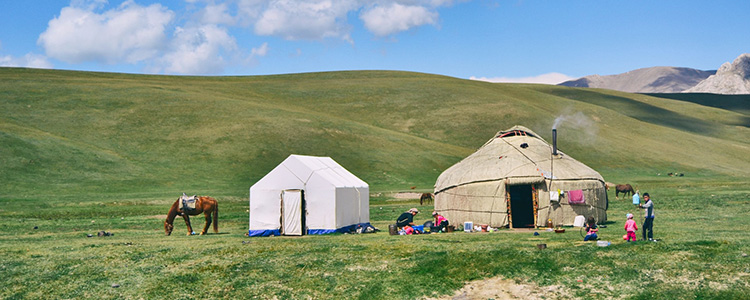
- There are certain habits in the ger, the yurt.
- Sleep - Always sleep with your feet facing the door, never toward the altar.
- Whistling - Whistling in a ger is considered rude.
- Be aware that fire is sacred to Mongolians. Do not throw garbage into the fire.
- Elders - Always let elders lead the way and do not sit with your back or feet to the altar.
- Hospitality - When you are offered food or drink, accept it, even if it is just a little. Use your right hand, with your left hand for support. It is customary to give small gifts to your hosts, such as fruit, candy or alcohol.
- Holding a cup - Hold a cup underneath, not by the rim.
- Say no in an indirect way, that is polite.
- Tsagaan Sar - From late January to mid-February, Mongolians celebrate the New Year. It is the most joyous occasion for the country's nomadic herders because Tsagaan Sar marks the arrival of spring after the long and harsh winter in which hundreds of their animals can freeze to death. Tsagaan Sar has been celebrated for more than 2,000 years. The festival is essentially intertwined with numerous deeply symbolic rituals. The festival is celebrated throughout the country and is still a holiday that Mongolians most look forward to with renewed hope for happiness and prosperity. Around the New Year, families burn candles at the altar, symbolizing Buddhist enlightenment. Mongolians also visit their friends and relatives (at the home of the eldest in the family) on this day and exchange gifts. Many people dress in full Mongolian national costumes.
What are the habits in the Philippines?
- Use of 'face' in communication - Briefly raise eyebrows to confirm or to mean yes to a question and also used as a brief greeting (all silent).
- Indicating direction by pursing lips and turning head in direction, all silent as well.
- Baon - refers to the monetary allowance or food normally provided by the parent to a child who goes to school.
- Bayanihan - When a house is broken, the whole community helps fixing the house. You might have seen the pictures of a group of people carrying a hut, when it needs to be transferred. It is a true community spirit. You talk, you help and protect the people around you. It is team effort, only possible when done with a group. It is truly a beautiful thing.
- Cockfighting is a popular national sport in big and small arenas all over the country. Goal is to gamble (win money) and eat the roosters who lost the game.
- Finding your spot - Recently I was back in the Philippines, taking public transportation. When you would like to take your window seat, be reminded you have to climb over other peoples lap. Squeeze in between the seat in front of you and the seat with the passenger on it. Enough space, a little intimate but do-able, it has something about it.
- Pacquiao - Filipinos adore boxer (and politician) Manny 'Pagman' Pacquiao.
- Pagmamano - Children take your hand, put it on their forehead, as a way of greeting you. It is an act of respect. The child says mamo po, can I have your hand please? Most of the time, they say God bless (you), when put on their forehead.
- Pasalubong -In the Philippines it is common when you have been on a trip, that you bring a token of love back to the people who stayed home. It is a filipino tradition of travellers bringing gifts from their destination to people back home. It can be anything, something to eat or to drink is always a welcoming gift, since filipinos love eating! It is actually not about what you bring, it is something that you have brought, so the other person knows you thought about them while away. The first time, I heard bring pasalubong, from multiple people, and didnt know how to act. When you see souvenir stores in the Philippines, it has the sign pasalubong. So now you are prepared.... just bring something back...
- Noise and music - Filipinos are crazy about high volumes and karaoke (called videoke) and music from the 70s like The Carpenters. There was one big world hit: Anak by Freddie Aguilar in 1978.
- Remedio - Is fixing things, even though you dont know how to fix it. The filipinos use remedio. Remedio used to drive me crazy. It is fixing things with what you have, in a creative way, and if it works again... that will be clear in the near future. You have to be flexible to embrace remedio.
- Squeeze - Squeeze your but, in the jeepney, also when you think it is already full. There will be place, when you squeeze. When you are for example sitting at the window in an airplane and you have two filipinos beside you, you squeeze your body in and out going to the aile. It is not a habit to stand up, when you can squeeze, when used to it, it works perfectly fine.
- Volume - Pump up the jam, pump up the volume. Filipinos love loud music, loud talking, as long as it is lively. The high amounts of volume makes you feel festive and alive, even when there is not a party.
- 'Whitening' products such as soap, make-up, deodorant are very popular, to stimulate white skin.
What are the habits in South Korea?
- In South Korea, and other places I have seen it in Asia, they brush their teeth, three times a day after a meal. People bring portable toothbrushes and you often see people brushing their teeth in the washroom in their office.
- Family is everything and the eldest son carries the responsibility of the family.
- Kimchi is a national dish. People make kimchi at home. In the supermarkets a lot of dark bordeau red buckets can be found, so you don't see the stains of the herbs going to be fermented with the vegetables.
- I personally love banchan. When you order Korean food it is likely you get a lot of different small bowls, (most of the time vegetarian) side dishes. For me as a dutch person, I can do without the maindish, since banchan is so delicious.
What are the habits in Taiwan?
- Politeness - Taiwanese people are very polite and respectful. It is customary to bow when greeting someone and to say “thank you” and “please.”
- Respectfulness - Taking off shoes when entering a house: In Taiwan, it is customary to take off your shoes before entering someone's house. This is done as a sign of respect and to keep the house clean.
- Respect for elders is considered vital, as is loyalty toward the family.
- Leave some food on your plate - It shows appreciation for the amount of food served and is considered polite.
- Cleanliness - Using toilet paper with the right hand: In Taiwan, toilet paper is used with the right hand, while the left hand is considered unclean.
- Bubble tea is a Taiwanese invention, same like stinky tofu. That stinks.
- KTV – Karaoke is a popular waste of time or night.
- Convenience stores – Open 24/7, with a variety of food, drinks and everyday items available.
- Gifts – Knives and scissors are not appreciated and will be seen as severing a relationship. Clocks and handkerchiefs are best avoided, that will be connected to death and funerals. Check the label: made in Taiwan is not an interesting gift and the recipient from Taiwan already has (all) things made in Taiwan.
What are the habits in Thailand?
- Thai people will talk about architecture, dance, festivals and food when you ask about their culture.
- Sanuk is a term to express that everything should have something sanuk. Something which is worth doing. The sense or approach with a little playfulness. Even work can be sanuk, singing while working, cracking jokes in combination with the thai smile.
- Saving face is important as is in many Asian countries. The habit is to avoid confrontation, and not to embarrass yourself or others.
- Social rank plays an important part in society. It goes with obligations, obedience, caring for, respect, sharing of wealth. The "big person or senior" pays the bill when dining or entertaining. The person with the most social rank pays for everyone.
Did you know that....
Asia is the biggest continent in the world. It is huge, this is the list of most Asian countries (including the Middle East)
- Afghanistan - Armenia - Azerbaijan - Bangladesh - Bhutan - Brunei - Cambodia - China - Hong Kong - India - Indonesia - Japan - Kazakhstan - Kyrgyzstan - Laos - Macau - Malaysia - Maldives - Mongolia - Myanmar - Nepal - North Korea - Oman - Pakistan - Palestinian Territories - Papua New Guinea - Philippines - Singapore - South Korea - Sri Lanka - Taiwan - Tajikistan - Thailand - Timor-Leste - Turkmenistan - Uzbekistan - Vietnam
- Abu Dhabi, Dubai & United Arab Emirates - Bahrain - Iran - Iraq - Israel - Jordan - Kuwait - Lebanon - Oman - Qatar - Saudi Arabia - Syria - Turkey - Yemen
How does healthcare work in Laos, and what travel insurance, health insurance or expat insurance do you need?
- How does the healthcare system work in Laos?
- How does the public healthcare system work in Laos?
- How is the GP arranged in Laos?
- How is the dentist arranged in Laos?
- How is the prenatal- and pregnancy care arranged in Laos?
- How safe or unsafe is a trip or stay in Laos?
- Which work and travel insurance policies are suitable for short and long stays in Laos?
- What emigration and expat insurance can you take out for Laos if you are going to live there for a while?
How does the healthcare system work in Laos?
- Laos is one of the poorest countries in the region, this is reflected in the healthcare system. Healthcare is being worked on, but in general it is not of good quality and very limited, both for expats and locals. Facilities for medical emergencies are few.
- Healthcare in Laos also varies greatly in quality between urban areas like Vientiane and rural areas, where care is limited.
- There is no universal healthcare system, but the government of Laos has set up several different health care systems, for different groups of workers. For example, you have Health Equity Funds (HEFs), Community-based Health Insurance (CBHI), the Social Security Office (SSO) and the State Authority for Social Security (SASS). Unfortunately, only a small portion of the population is covered by these insurances and, in most cases, expatriates are not covered by them.
- As expats, it is wise to consider purchasing international health insurance because healthcare can leave much to be desired and medical evacuation is necessary in emergencies.
- Pharmacies are usually well stocked and medicines are generally inexpensive. Like other countries in the region, Laos does, however, struggle with counterfeit medicines. So it is important to find a good pharmacy.
- In case of a medical emergency, you can call 1195. If you are near the border with northeast Thailand, you can also call medical facilities in Thailand.
How does the public healthcare system work in Laos?
- Public healthcare in Laos is provided through state hospitals and health centers. It is affordable, but the quality is often inadequate due to a lack of resources, trained staff and modern equipment. They also provide mostly basic care and often do not speak English.
- Medications are not always available, and patients sometimes have to bring their own medical supplies.
- Public care is cheap, but for serious medical problems patients are often referred to neighboring countries such as Thailand or Vietnam, as facilities in Laos are thus inadequate.
- In rural areas, expect poor access to healthcare due to long distances and poor roads.
How does the private healthcare system work in Laos?
- Because of poor public care, private hospitals and clinics have been set up.
- Private clinics in Vientiane and other major cities offer better care than the public sector. These clinics often cater to expats and wealthy Laotians. You'll find more English-speaking doctors and higher standards here.
- Private care is considerably more expensive, but still affordable compared to Western standards. Payment must often be made immediately, and insurance coverage must be arranged in advance.
- For serious cases, medical evacuation to Thailand (Bangkok) or Singapore is still often necessary. Indeed, private hospitals there are better than in Laos. This makes good international health insurance essential.
How is the GP arranged in Laos?
- People generally seek immediate help from experts in hospitals or clinics when something is wrong.
- For minor medical problems you can go to private clinics, where you will usually find general doctors.
How is the dentist arranged in Laos?
- Dental care is on the rise in Laos, especially in Vientiane, where English-speaking dentists and modern clinics are available.
- Dental care is affordable, and the quality in urban areas is reasonably good. Still, many emigrants choose to go to neighboring Thailand for more complex problems.
How is the prenatal- and pregnancy care arranged in Laos?
- Maternal mortality is high in Laos due to limited access to care, especially in rural areas. Expats are therefore advised to plan carefully and consult with other expats around them.
- Maternity care in public hospitals is inexpensive but often of low quality. The lack of trained staff and hygienic conditions can be a problem.
- Many expats therefore choose to give birth in Thailand, where facilities and care are better.
How safe or unsafe is a trip or stay in Laos?
What should you pay attention to in terms of safely in Laos?
- In general, Laos is reasonably safe, but you should watch out for pickpocketing and bag theft (often from scooters) in tourist areas.
- Armed robberies are also sometimes committed in major cities. It is advised not to carry expensive items openly.
- In addition, it is important to be careful with local alcohol, liquor and food “spiking” (where drugs are put into your food or drink) occurs.
- Beware of scooter rental scams where your scooter is deliberately damaged or stolen.
- During the rainy season, floods, typhoons and landslides are common.
- Beware of landmines and other unexploded weapons, avoid areas where they may occur.
What should you look out for in terms of diseases in Laos?
- Several mosquito-borne diseases, including malaria and dengue fever, are a risk in Laos.
- Tap water is definitely not drinkable. Also avoid raw and uncooked food.
- Other (tropical) diseases are also prevalent in the country. It is wise to check with a vaccination doctor to see what vaccinations you need.
What should you pay attention to when it comes to traffic in Laos?
- With the exception of the China-Laos expressway, the roads in Laos are usually of poor quality and means of transportation are often not well maintained.
- Thus, driving in the dark is also dangerous because many cars do not have lights.
- Another traffic problem is the amount of stray livestock on the roads, make sure you are prepared for this when you are driving around.
- If you are part of an accident, you have to help pay for damages to third parties, whether you are the guilty party or not. In addition, the police are usually on the side of Laotians.
Which work and travel insurance policies are suitable for short and long stays in Laos?
- Is the trip to Laos and your return sufficiently covered? Are you sufficiently covered before, during and after your activities? Which insurance best suits your trip and your activity? Read more about insurances for abroad on JoHoinsurances.org.
What emigration and expat insurance can you take out for Laos if you are going to live there for a while?
- In the case that local insurance is mandatory, it is recommended that you also take out private insurance. The care is free, but so limited that for bigger problems it is better to seek help abroad. Read more about insurances for abroad on Expatinsurances.org.
Packing list for Laos, travel insurance for Laos, and taking your belongings
To pack and bring to Laos
What to take with you to Laos: spotlighted
Essentials:
- Documents: passport valid for at least 6 months upon arrival. An online and/or offline copy of your passport is also always useful.
- Money: US dollars and Thai baht both work well for buying a visa, the first few days and for emergencies. You can then exchange them for Laotian kip (the money!! Not real kip). You can also use your debit or credit card to withdraw money in the big cities.
- Care: high factor sunscreen. Harder to find there and often whitening.
- Outdoor and conveniences: good sunglasses and a hat.
- Clothing: light clothing for warm conditions, so cotton or linen. Covering clothing is also useful for temple visits. A warm layer for the mountains.
- Shoes: hiking boots, because the paths are not always that good.
- Protection: a mosquito net, because many budget accommodations do not have them. Rain gear and rain covers if you go in the rainy season. Medicines and travel kit: a small first aid kit with plasters, painkillers, disinfectant, anti-diarrhea and ORS (dehydration is a thing). Mosquito repellent.
- Safety: it is relatively safe, but a money belt is still recommended.
- Technology and equipment: Laos uses almost all the electrical sockets in the world, so a world plug is handy. A flashlight and power bank are also nice in case of a power outage.
- Women: tampons, which are hard to come by.
What are some other options for packing as well:
- Reusable water bottle with filter, so you can drink water everywhere.
- Toilet paper for the public toilets.
- A quick-drying towel for when you go on a swimming adventure.
- A sarong for temple visits.
What should you know when you bring your stuff with you to Laos?
- Knowledge of Buddhist and cultural practices and what clothing is appropriate when.
- How to deal with your waste - there are few options for waste disposal. What you can bring into the country, including any medication you are taking.
Are there mosquitoes in Laos?
- There are many mosquitoes in Laos and dengue is a problem all year round.
- Numbers increase in the warmer and wetter months, usually between May and October.
- Malaria is less common than dengue, but is found in the south of the country in Attapeu, Sekong, Savannakhet, Champasak, Khamouane and Salavan.
Are there sandflies in Laos?
- There are many sand flies, spread throughout Laos.
- They are less common in higher and colder regions.
- They can bother you at any time, but you are most at risk during sunrise and sunset.
Can you buy DEET, or other mosquito repellents, in Laos?
- Mosquito repellents are available in the cities of Laos. You won't find them in the countryside.
- The options are limited though. Strong DEET or Picaridin, for example, are hard to find.
Can you buy a joint or weed in Laos, or take it with you to Laos?
- Cannabis is illegal and Laos has very strict laws.
- It is strangely enough available in many places, but using it can lead to a very long prison sentence. And, although it has not been implemented since 1989, even the death penalty is an option if you bring drugs into the country!
 Laos: selection of contributions by WorldSupporters - Bundle
Main suggestions, stories and tips about Laos shared by WorldSupporters
Laos: selectie van blogs en bijdragen van Wereldsupporters - Bundel
Selectie van blogs en bijdragen van WereldSupporters over Laos
- Login of registreer om te kunnen reageren
- 1185 keer gelezen