Watching wildlife abroad

Checklists, Organizations, Projects, Skills, Tips & Vacancies

Image

Page layout: Watching wildlife abroad

Image

Intro

Watching wildlife abroad and observing wild animals while traveling

Contents a.o.
Wildlife abroad and while traveling: Aquatic and Sea Animals

Wildlife abroad and while traveling: Aquatic and Sea Animals

Dolphins abroad and while traveling: are they dangerous, where do you encounter them, where can you see them?

Dolphins abroad and while traveling: are they dangerous, where do you encounter them, where can you see them?

What are dolphins?

  • Dolphins, they swim in the water, but they are not fish! Dolphins are marine mammals that belong to the same group as whales.
  • Dolphins can live almost as long as humans, they live between 55 and 60 years.
  • The dolphins in the sea are the most well-known, but there are also four species of dolphins living in fresh water.
  • They are highly intelligent animals. Like elephants, dolphins can form strong bonds and feel sadness. They are also among the few animals that have passed the mirror test (recognizing themselves in a mirror).
  • Not only do dolphins help members of their group when they have problems or are injured, there are also known cases where dolphins helped other animals and even people.
  • Dolphin populations are also threatened by human influences all over the world. The biggest problems are that they end up as bycatch in fishing nets and pollution of their habitats.

Where to see dolphins in the wild abroad?

  • You can see dolphins in so many places all over the world. Make sure you go on an animal-friendly tour that follows clear guidelines. Here are some well-known places:
    • Australia: including Daintree in Queensland and Monkey Mia in Western Australia
    • Canada: Vancouver Island
    • Ecuador: Galapagos Islands and Isla de la Plata
    • Egypt: Marsa Alam
    • Indonesia: Bali
    • Mozambique: Inhaca, Pemba or Bazaruto
    • New Zealand: including Kaikoura
    • Portugal: Azores and Madeira
    • Norway: Lofoten and Vesterålen
    • Seychelles
    • Spain: Tenerife
    • Sri Lanka: Kalpitiya
    • USA: Hawaii, San Juan Islands (Washington)
    • South Africa: including Durban
    • Freshwater dolphins can be found in the Amazon and Orinoco rivers in South America and in the Ganges, Indus and Irrawaddy river systems.

Where is the best place to swim with dolphins abroad?

  • Australia: Bunburry and Ningaloo Reef in Western Australia Monkey Mia
  • Bahamas
  • Brazil: Fernando De Noronha
  • Curacao
  • Ecuador: Galapagos Islands
  • Egypt: Marsa Alam
  • Indonesia: Bali and Raja Ampat
  • Mexico: Socorro Island
  • New Zealand: Kaikoura
  • USA: Hawaii (Kona)

Are dolphins dangerous?

  • Dolphins are usually not dangerous, unless you disrespect the space and behavior of the wild animal.
  • In that case, dolphins can be a danger. Dolphins are very smart, strong and are quite similar to humans in terms of social behavior. There are even indications that dolphins can commit murder (and not for food, or to defend themselves).
  • Fortunately, this does not seem to be aimed at humans. Collisions between humans and wild dolphins certainly do occur, but are usually not that serious. There have been cases of broken ribs and bites by dolphins, among other things.

What are the most dangerous species of dolphins and why?

  • Orcas! Yes, orcas are also dolphins. They are the largest dolphin species and can therefore do the most damage, if they wanted to.
  • Because in general, wild orcas are not aggressive towards people. However, orcas in captivity have attacked people several times, but what do you expect when you lead such a stressful, unhealthy and boring life.
  • There are also known cases of bottlenose dolphins where they felt threatened and showed aggressive behavior.

What to do if you encounter a dolphin in the wild?

  • Always keep sufficient distance (about 45 meters) and never approach the dolphin yourself, but let the dolphin come to you.
  • Do not touch dolphins, but watch them with your eyes!
  • Do not feed them either, no matter how tempting it is, because this can disrupt their natural behavior and affect their health.

What to do when a dolphin attacks you?

  • Then try to get away quickly…

Can you volunteer or intern with dolphins?

  • You certainly can! Most opportunities are found on research boats, but there are also some dolphin sanctuaries.
  • For example, you can help with research (data collection), education and conservation.

What should you do if you are going to work with dolphins during your volunteer work, internship or study.

  • Make sure you find a good, ethical organization. Some organizations are more focused on tourism and not good for the animals.
  • For example, you can pay attention to whether the animals live in captivity or whether the organization focuses on wild animals, and for example whether they are education-oriented.

Where is the best place to work with dolphins?

  • Australia: Bunburry
  • Curacao
  • Spain: Canary Islands
  • Tanzania: Zanzibar
Fish abroad and while traveling: are they dangerous, where do you encounter them, where can you see them?

Fish abroad and while traveling: are they dangerous, where do you encounter them, where can you see them?

What should you do if you encounter poisonous fish?

  • Only a few species of fish are poisonous to the touch. The teeth and spines that fish have are more dangerous.
  • However, if you keep your distance, fish, sharks, rays and other small swimming beauties will not cause any problems.
  • If you go swimming without anything on your feet, you run the risk of stepping on one of the spiky or even poisonous fish. The chance that you will step on one is not very big, but it certainly happens regularly in a coral-rich environment.

What should you do if you are stung or bitten by a poisonous fish?

  • Depending on the species, a quick visit to the doctor is recommended.
  • Since this is not always a reasonable alternative, water shoes / flippers / sandals are therefore very important.
  • On the Mediterranean and North Sea beaches, many bathers are stung every year by the small weever, which burrows into the sand. This fish can cause you a lot of pain for weeks if you do not quickly put your foot in water hotter than forty degrees after the sting (the proteins in the poison break down).

How dangerous are rays?

  • Stingrays can also sting (very) meanly.
  • They often lie buried in the bottom waiting for prey, if you then step off your surfboard, the ray can sting out of fear.
  • Depending on the exact species and the exact place where you are stung, you may need to see a doctor quickly.

Where are good places to spot fish abroad?

  • The best places to spot many different species of fish are the tropical and sub-tropical coral reefs
  • These coral reefs offer plenty of space for marine life and juvenile fish, which in turn attracts many larger and super-sized fish
  • Many coral reefs and underwater ecosystems are threatened by climate change, over-fertilisation (especially near estuaries), over-fishing and tourist activities. Before booking a trip it can be important to check the current fish and reef status.
  • Regions and countries where the value of marine life has long been endorsed, for example through the establishment of nature reserves often have the most beautiful coral reefs to visit
  • Check also snorkelling and diving destinations abroad
Jellyfish abroad and while traveling: are they dangerous, where do you encounter them, where can you see them?

Jellyfish abroad and while traveling: are they dangerous, where do you encounter them, where can you see them?

What are jellyfish?

  • Jellyfish are simple, jelly-like marine animals. They often have tentacles, but no brain, heart or other organs like many other animals.
  • Jellyfish can swim, but often go with the flow of the current.
  • They mainly eat plankton and other small marine animals.
  • Jellyfish are very special because of their simple, but effective structure. There is even a jellyfish that is described as immortal - the Turritopsis dohrnii. This jellyfish can revert the cells to a younger form when it is in danger and thus "restart" life.

Where to see jellyfish in the wild abroad?

  • Jellyfish are found in all seas and oceans, both on the coast and in the deep sea. Some species that are closely related to jellyfish also occur in fresh water.
  • Especially with offshore winds, there is a good chance that jellyfish will come near the coast due to the undercurrent.

How dangerous are jellyfish?

  • You don't have to worry about jellyfish coming at you, because they have no interest in people. What usually happens is that someone accidentally swims into one or steps on a dead jellyfish on the beach.
  • Some jellyfish are hardly dangerous, other jellyfish can be fatal in severe cases. Fortunately, most jellyfish fall into the first group.
  • In most jellyfish, only the tentacles are equipped with stinging stinging cells. These many stinging cells release poison when touched, which usually causes itching and a burning rash.
  • The tentacles of a dead jellyfish on the beach can still sting.

What are the most dangerous types of jellyfish and why?

  • The 16 species of Irukandji jellyfish are the most poisonous group of jellyfish. With a mostly almost transparent body and a body of only one centimeter in size, these nasty creatures are easy to miss while swimming, snorkeling or diving. The jellyfish group is found around Indonesia, the Philippines and around the Great Barrier Reef.
  • Stings from the Irukandji can be fatal and there is no antidote.
  • Around Australia you have the box jellyfish (one of the Irukandji jellyfish), also called the Australian sea wasp. A not-so-nice friend with tentacles that can grow to three meters long.
  • Watch out for the infamous "Portuguese man-of-war" (found in many places around the world!). An enormous jellyfish-like creature that can cause excruciating pain (go to the hospital!). The fact that this animal is actually a fascinating colony of clones of itself and not a jellyfish, will probably not matter to you after a sting.

What should you do if you are stung by a jellyfish abroad?

  • Most jellyfish species only cause somewhat painful stings that can be somewhat combated with vinegar, Azaron or painkillers.
  • Rinse the stung area with seawater or hot water. Cold tap water, on the other hand, seems to make the reaction worse.
  • Remove the tentacles from your skin as soon as possible after the sting. Scrape the remaining stinging cells from your skin with a credit card, for example, to stop the skin reaction.
  • Seek medical attention, especially in areas where dangerous jellyfish species live or when the symptoms are worse than mild pain and red skin.
  • There is also water-repellent sunscreen that offers protection against jellyfish stings, even those from the "Portuguese man-of-war".
  • The idea that urinating on a jellyfish sting helps is based on a myth, but it can give someone mental peace... the choice is yours.

What diseases can you get from jellyfish?

  • Jellyfish are not long-term diseases, but some consequences of jellyfish stings are:
  • pain and irritation of the skin.
  • swollen welts on the skin.
  • a delayed reaction that can cause blisters and a rash.
  • less common, but serious is anaphylaxis - a severe allergic reaction.
  • Irukandji syndrome when you are stung by certain box jellyfish. You may experience severe pain, muscle cramps and heart problems.
  • You may get a wound infection if the sting penetrates the skin.
  • If you start sweating profusely, have chest or abdominal pain, or have difficulty breathing, seek immediate medical attention.

Can you volunteer or intern with Jellyfish?

  • You might not expect it, but it is possible to do an internship or volunteer work with jellyfish. This involves, for example, research projects where you can help with observations from the beach, or volunteer work in the lab.
  • During marine conservation projects you also might encounter jellyfish


Manatees and dugongs abroad and while traveling: are they dangerous, where do you encounter them, where can you see them?

Manatees and dugongs abroad and while traveling: are they dangerous, where do you encounter them, where can you see them?

What are manatees?

  • This special animal group of manatees consists of 3 species of manatees and the dugong (Dugongs).
  • Manatees are true herbivores and related to elephants.
  • They grow between 2.5 and 4 meters and can weigh up to 1500 kg!
  • Unfortunately, the manatee populations are vulnerable to extinction. The greatest dangers to manatees are habitat loss and hunting.

Where do manatees (manatees) live?

  • Manatees live in Latin America from Brazil to Florida.
  • The West African manatee lives in shallow waters of West Africa.
  • Abroad, people often talk about Manatees (or manatí in Spanish)

Where do dugongs live?

  • The dugong can be admired in the waters of Northern Australia, Southern Asia, the coastal strips of the Middle East and East Africa.
  • The dugong lives on sea grass and only in salt water.
  • The dugong is also called the Indian sea cow.

Are manatees dangerous?

  • Dugongs are often shy and timid, manatees are more curious. In general, manatees are not dangerous to humans.
  • However, humans are dangerous to the manatee. People can cause a lot of stress and with the good memory of manatees, this can linger for a long time.
  • In most places in the world, the survival of the manatee is seriously threatened.

What to do if you encounter a manatee in the wild?

  • It is always important to keep sufficient distance (50m), especially from a mother with her young.
  • Never swim towards them, but let them come to you.
  • Stay calm! They won't come to them quickly with a lot of noise, fast movements and throwing water.
  • Just watch! Feeding, touching or approaching them in any other way is not good for the animals.

What to do if a manatee attacks you?

  • In general, the animals are very calm, but if they do come to you, it is best to move away calmly. Do not make sudden noises or movements.

Can you do volunteer work or an internship with manatees, manatees and dugongs?

  • There are a number of organisations in Australia, Costa Rica, Thailand and Belize, among others, that accept volunteers. These are usually research projects or nature conservation organisations.
Sea turtles abroad and while traveling: are they dangerous, where do you encounter them, where can you see them?

Sea turtles abroad and while traveling: are they dangerous, where do you encounter them, where can you see them?

What are sea turtles?

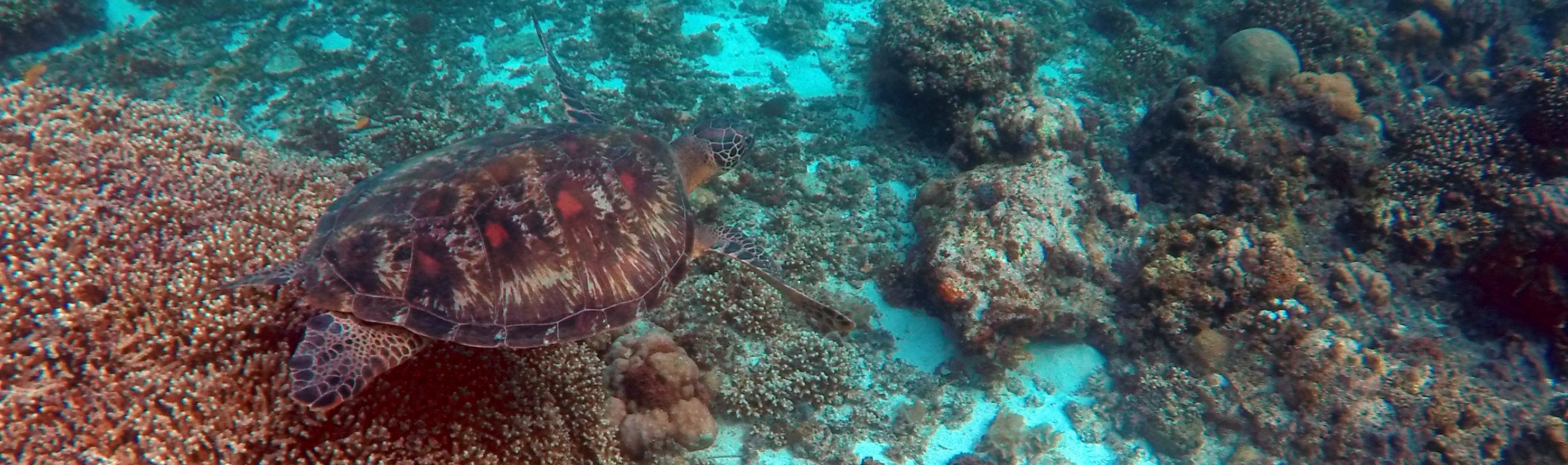
  • Sea turtles are large marine reptiles. They have an impressive shell, a good sense of smell and good underwater vision.
  • They live mainly in the water, only the females that lay eggs and the newly hatched baby turtles can be found on land, and very occasionally a turtle that is just sunbathing!
  • There are seven main species of marine turtles.
    • Flatback Sea Turtle
    • Green Sea Turtle
    • Hawksbill Sea Turtle
    • Kemp's Ridley Sea Turtle / Kemp's sea turtle
    • Leatherback Sea Turtle
    • Loggerhead sea turtle / Loggerhead sea turtle
    • Olive Ridley Sea Turtle / Dwarf Sea Turtle (Warana)
  • Turtles can live a long time. It takes 15-30 years for them to reproduce, and then they can live for over a hundred years!
  • Unfortunately, sea turtle populations are threatened by hunting for their eggs, meat, skin and shell. They are also often bycatch in fisheries. Climate change also has a strong influence on turtle populations. Because the temperatures in the sand change, the sexes of the baby turtles in the eggs also change.

Where can you encounter sea turtles in the wild when traveling and abroad?

  • Sea turtles can be found in almost all oceans, except for the very cold areas and the polar regions.
  • They are usually found in the shallow coastal areas around coral reefs, seagrass beds, lagoons and estuaries. There is a lot of food for them here.
  • The best places to snorkel or dive with them include:
  • Australia: at the Great Barrier Reef or Cook Island
  • Costa Rica: at Tortuguero National Park
  • Ecuador: at the Galapagos Islands
  • Egypt: in the south at Marsa Alam
  • Hawaii: a.o. at Maui
  • Indonesia: near Bunaken. Pulau Weh or Raja Ampat
  • Maldives: at various islands
  • Malaysia: at Sipidan or the Perhantians
  • Mexico: near Playa del Carmen
  • Nicaragua: at the La Flor reserve
  • Oman: at the Daymaniyat Islands

Are sea turtles dangerous?

  • Although sea turtles can bite, they usually do not bite people. They are gentle creatures that rarely show aggression.
  • However, with their exceptionally powerful jaws they can cause damage. Sea turtles do not have teeth, but on the inside of a sea turtle's mouth there are backward-facing cartilaginous barbs.
  • They defend themselves when threatened. If you try to pick up a sea turtle, for example, it may bite you in self-defense.

What to do if you encounter a sea turtle while snorkeling?

  • If you see a sea turtle in the wild, try not to get too close, do not disturb the turtle and certainly do not try to pick the turtle up.
  • During egg laying, you should always stay far away. Do not touch the turtle or stand in its field of vision. This can seriously disrupt the egg laying and have major consequences for the population.
  • Especially with baby sea turtles, touching can cause harm. They can become disoriented, they can injure their shell (which is still soft) and eventually they can die.

What to do in case of a turtle bite?

  • Wash the wound thoroughly with soap and water to prevent infection.
  • Put antiseptic on the wound and keep an eye on it to make sure it doesn't get infected. 

What diseases can you get from sea turtles?

  • Sea turtles can carry bacteria and diseases that can be harmful to humans.
  • Eating sea turtle meat is not safe. Salmonella and chelonitoxism (a type of food poisoning) are a major risk.

Can you do volunteer work or an internship with sea turtles? Or help protect sea turtles?

  • You certainly can! There are many great projects to help protect sea turtles.
  • For example, you can help with projects that protect the eggs. Here you contribute to the
    • protection of eggs by placing fences
    • counting and locating eggs
    • building breeding sites
    • collecting of data, for example by patrolling the beach during the egg-laying period.
  • You can also help care for injured turtles.
  • Research is another sector that sometimes needs help. For example, there are sometimes projects from universities that need volunteers or interns to carry out research tasks.
  • Read more about: Protecting sea turtles: what is it, where can you do it and are you insured?

Why should you protect sea turtles abroad?

  • You can have a wonderful time with other passionate individuals.
  • All seven species of sea turtles are (seriously) endangered: the Flatback sea turtle, Green sea turtle, Hawksbill sea turtle, Kemp's sea turtle, Leatherback sea turtle, Loggerhead sea turtle and Dwarf sea turtle can use your help.
  • Knowledge of a special group of animals.
  • Images of sometimes thousands of small turtles.
  • What do you need to protect sea turtles abroad?
  • A love of nature and animals in general and marine life in particular.
  • A flexible sleep schedule.
  • Limited sensitivity to less pleasant odors.
  • In some cases, a lot of stamina (the nesting sites are sometimes a bit further away on remote beaches).
  • If you have experience working with animals or medical care of animals, you can be deployed in more diverse activities of a project.

What is the best place to work with sea turtles?

Sea urchins abroad and while traveling: are they dangerous, where do you encounter them, where can you see them?

Sea urchins abroad and while traveling: are they dangerous, where do you encounter them, where can you see them?

What are sea urchins?

  • Many people have seen the black sea urchin, but did you know that sea urchins come in all shapes and sizes? There are almost 1,000 known species of sea urchins.
  • General characteristics are that they are spiny and invertebrate and, of course, live in the sea. They often have hard, coloured spines.
  • Sea urchins mainly eat algae, seaweed and other organic material. They are important for healthy coral reefs, because they help maintain the balance between algae and coral.
  • Sea urchins can live for hundreds of years!
  • In Japan people eat sea urchins. The fleshy sexual organs are often eaten raw. This seafood is also a traditional delicacy in, for example, Italy, New Zealand, Chile and the Philippines.

Where to see sea urchins in the wild abroad?

  • Sea urchins can be found in all oceans. Most are found on the coast, but they also occur in the deep sea up to at least 7,000 meters!
  • They like to cling to things, such as reefs, rocky shores and other hard objects.

How dangerous are sea urchins?

  • The vast majority of sea urchins are not poisonous to humans. However, a sea urchin spine in your foot can be an unpleasant experience.
  • If you step on a sea urchin, you should first try to remove the needles completely with tweezers. If the whole thing becomes infected, a visit to the doctor is essential.
  • Some sea urchins also have poison in their spines. This can cause symptoms such as nausea, vomiting and difficulty breathing, but this is very rare.
  • Wearing water shoes can prevent a lot of disaster.

What are the most dangerous types of sea urchins and why?

  • It looks beautiful, but the Flower Urchin is also the most poisonous sea urchin. It is found in coral reefs, between sea grass and on rocky and sandy bottoms, especially in the tropical Indo-West Pacific Ocean.

What to do if you encounter a sea urchin in the wild?

  • It is best to maintain sufficient distance!
  • Sea urchins are slow and don't go after you, but accidentally stepping on it can be a nasty experience

Which diseases can humans get from a sea urchin?

  • The most common risk is that you get an infection at the place where the needles have entered your body.
  • You can also suffer from a feeling of weakness, shock, pain in your muscles and even in exceptional cases, paralysis.
  • In most cases, the pain goes away after a few days. Are you worried? Then it is best to visit a pharmacy or doctor.

What should you do if you are stung by a sea urchin?

  • First try to remove the needles. Do this very carefully, because they break off very easily. Then wash the area thoroughly with soap and water.
  • If you still feel pain after several days, if it seems to be getting infected, if you have weakness or pain in your muscles, paralysis or extreme fatigue, then you should definitely see a doctor.
Seals and sea lions abroad and while traveling: are they dangerous, where do you encounter them, where can you see them?

Seals and sea lions abroad and while traveling: are they dangerous, where do you encounter them, where can you see them?

What are seals?

  • A seal is a marine mammal that belongs to the carnivores. Seals have fin-like forelimbs with which they propel themselves in the water, somewhat less flexible hind legs, a soft coat and an excellent ability to dive. Seals do not have protruding auricles (they do have ears...).
  • There are different types of seals that vary in size and color. Most species have a somewhat spotted coat.
  • Seals usually eat fish, shellfish and other marine animals.
  • Seals are often found in somewhat colder water, but they can also survive well in warmer temperatures.
  • Seals are also called sea seals
  • Elephant seals, leopard seals and the hooded seal are also species within the seal family.

What is a sea lion?

  • A sea lion is also a marine mammal that belongs to the carnivores. Sea lions are somewhat larger, slimmer, faster, noisier and somewhat more aggressive than seals. Sea lions also have external ears. The sea lion is a social animal that often lives in large colonies.
  • Sea lions, together with the fur seals, form the group of eared seals.
  • Sea lions and fur seals live in the United States, the South American coast, Australia, New Zealand, North-East Asia and the waters around Antarctica.

Where can you see seals and sea lions when traveling?

  • Argentina: large colonies of sea lions can be seen in Patagonia.
  • Australia: swimming and snorkeling with the sea lions at, for example, Hamelin Bay or Ningaloo Reef. (Western Australia)
  • Greenland and Spitsbergen: walruses, hooded seals and seals
  • Ecuador: on the Galapagos Islands you will find the fur seal that you can see up close
  • Mexico: in Baja California you can swim with sea lions
  • New Zealand: sea lions at Kaikoura on the South Island
  • Namibia: ...beaches full of sea lions
  • Spain: on the Canary Islands La Graciosa and El Hierro you can see sea lions well
  • United States: along the Californian coast
  • South Africa: the coastal strip near Cape Town
  • In the Netherlands and Belgium you can mainly encounter the common seal and the gray seal on the beach

Are seals dangerous?

  • In general, seals are not dangerous to people, and rather shy and very calm. While surfing you can sometimes come across a sudden, curious seal, but it will quickly disappear when you try to approach it.
  • If they feel threatened and you are close by, they can bite viciously. There are also known cases of seals and sea lions pulling people and dogs into the water. This is often due to confusion because people feed the animals.
  • Sick and injured seals can also react unpredictably.

Are sea lions dangerous?

  • A sea lion is generally not dangerous to people.
  • In places where sea lions are often fed by tourists or local fishermen, they can sometimes become a bit pushy.
  • If a sea lion is threatened, or if you enter their territory, you should be careful. Sea lions are quite large and powerful, with their length of 2 to 3 meters.
  • They can behave aggressively if they feel unsafe or if they want to protect their young.

What to do if you encounter a seal or sea lion in the wild?

  • The best thing, as with all other animals, is to keep your distance (20-30m) and not to interact.
  • Never approach the animals yourself. You can wait and see if they come to you (but don't feed them!). Enjoy the moment and relax, stay calm and move slowly so you don't scare them away.
  • You sometimes see videos of people swimming with seals. It looks fun, but they can suddenly bite and then you have a big wound.
  • If you have a dog with you, make sure it is on a leash. That is better for the dog and for the seal or sea lion.
  • Make sure the escape route for the animal (the open sea) is always clear. Never surround an animal.

What to do if a seal or sea lion attacks you?

  • Try not to get pulled under and get out of the water if you can, that's what seals are good at and where it gets really dangerous.
  • If you get pulled in, try kicking them on the head. Hopefully they'll let go. Or call your friends to hold on.

What to do if you get bitten by a seal or sea lion?

  • Wash the wound and get medical help.

What diseases can you get from seals and sea lions?

  • There are several diseases that you can get from the saliva, feces or a bite from seals and sea lions:
  • Toxoplasmosis
  • Tuberculosis.
  • Brucella
  • Q fever - Rare, but possible by inhaling contaminated dust from feces.
  • Spekkfinger - an infection that can occur after a bite or scratch. 

Can you volunteer or intern with seals and sea lions?

  • There are several organizations around the world that focus on sea lions and seals. They are often research organizations or non-profits that take in injured or sick animals. Sometimes they are also temporary projects that you can contribute to.
  • So you can do an internship or volunteer work in the research corner, animal care or nature conservation projects.

What should you do if you are going to work with seals or sea lions during your volunteer work, internship or study?

  • Most sanctuaries avoid human contact to keep the animals wild. Therefore, it is unlikely that you will have direct contact with the animals, unless they are babies that need to be fed or you have been specifically trained for this.
  • Follow the instructions and safety training protocols.
  • Avoid unnecessary actions.

What are the best places to work with seals and sea lions?

  • Popular countries are the Netherlands with several sanctuaries, Ireland, South Africa, New Zealand and Australia.
Sharks abroad and while traveling: are they dangerous, where do you encounter them, where can you see them?

Sharks abroad and while traveling: are they dangerous, where do you encounter them, where can you see them?

What are sharks?

  • Sharks are large cartilaginous fish. Thanks to many films and horror stories, sharks have a bad name, but they are really not as scary as people always make them out to be and there are only a few species that are sometimes dangerous.
  • Sharks are on average 1 to 2 metres long. The smallest sharks are less than 20 cm long, the largest sharks can be longer than 12 metres.
  • Sharks are found worldwide in all seas and oceans, except at the North and South Poles.
  • Sharks have been on earth for hundreds of millions of years. Today there are more than 400 species of sharks.

What is a great white shark?

  • A white shark can be recognised by a black or dark grey upper side and a white underside.
  • There are black spots on the underside of the pectoral fins and a conspicuous black spot at the attachment to the body. They prefer cold waters near the coast, but can also be found at depths of over a thousand metres.
  • They are very social animals and often swim in groups of ten or more sharks.
  • The white shark is semi-warm-blooded, which means that it can swim very fast, but also that it has poor endurance.
  • In response to this, the white shark uses different swimming and behavioural patterns to investigate its potential prey.

Where can you see sharks from a boat?

  • South Africa: at Cape Town and Gansbaai you can take tours to see the great white shark (from a boat or in a cage).
  • England: basking sharks can be seen from a boat in Scotland and southern England.

Where can you see sharks well when snorkelling?

  • Bahamas: at Bimini you can snorkel with hammerheads and reef sharks, and at Cat Island with the harmless but very curious whitetip shark. Cuba: at Jardines de la Reina National Park you can swim with ten different shark species in a protected area.
  • England: near Cornwall and in Scotland, you can swim with basking sharks and blue sharks in the summer.
  • Philippines: on Cebu you can snorkel with whale sharks... and with half of Japan.
  • French Polynesia: on Moorea Island you can swim with the blacktip reef shark, whitetip reef shark, the gray shark and even the tiger shark.
  • Maldives: for example at the South Ari, Huvadhoo or the Thaa Atoll for whale sharks, or at Alimatha Island for fairly tame nurse sharks.
  • Malaysia: if you are lucky enough to snorkel at Sipadan, you will see the sharks and turtles swimming back and forth at the edge of the reef. Mexico: at Isla Mujeres you can snorkel with the whale sharks, at Guadalupe Island you can snorkel with yourself in a cage while the great white shark curiously comes to see on the other side of the bars whether the bars are thick enough.
  • Mozambique: at Inhambane you can see whale sharks if you are at this beautiful place in the right season.
  • Seychelles: whale sharks at South Mahe.
  • Tanzania: whale sharks at Mafia Island.
  • South Africa: at Cape Point you can snorkel with blue and mako sharks, at Seal Island with the spotted sevengill shark.

Where is the best place to dive with sharks?

  • Australia: at Fish Rock Cave in New South Wales for many gray nurse sharks.
  • Bahamas: at Tiger Beach for the tiger shark, Cat Islands for the reef sharks.
  • Belize: on the Belize Barrier Reef.
  • Costa Rica: hammerhead sharks at Cocos Island.
  • Ecuador: the Galapagos Islands for viewing hundreds of hammerhead sharks.
  • Fiji: Beqa Lagoon for mainly bull sharks, but there are also nurse sharks, lemon sharks, whitetip and blacktip reef sharks, grey sharks and the occasional tiger shark.
  • Philippines: at Monad Shoal on Malapascua for the thresher shark.
  • French Polynesia
    • at Moorea for the blacktip reef shark.
    • at Rangiroa for the large hammerhead sharks and grey reef sharks.
  • Indonesia: Raja Ampat (Cenderawasih Bay) near West Papau for the whale shark, among others.
  • Maldives: Maaya Thila for hammerhead sharks and many reef sharks.
  • Malaysia: Sipidan for reef sharks and hundreds of barracudas, and the Perhentians for sand sharks and reef sharks.
  • Palau: almost all tropical shark species can be found around Palau. United States of America: including blue sharks near Rhode Island.

What are the most dangerous types of sharks?

  • Most sharks are not dangerous to humans! The most dangerous sharks are the white shark, tiger shark and bull shark, but even attacks from these species are rare.

How dangerous is the great white shark?

  • The great white shark is known as one of the most dangerous shark species. The white shark generally bites people only because it is curious and explores terrain in this way. Unfortunately, this method of research sometimes leads to a fatal end for the research subject…
  • The prey they prefer depends on several things, such as the season and their size. Small white sharks mainly feed on fish, while the larger ones can devour a seal or even a small whale.

When does a shark become dangerous and should you be careful?

  • If a shark rolls its eyes, the shark follows an object with its eyes, without moving its head or body; you have been spotted!
  • If you notice that a shark lowers its pectoral fins or opens its mouth without protruding its front jaw and holds this position for a fraction or several seconds, it should be considered dangerous.
  • If the shark protrudes its upper jaw, the shark makes a biting movement; If you are bleeding yourself, you don't necessarily have to worry anymore, sharks don't react to human blood or your scent.
  • Divers who are spearfishing and have struggling and bleeding fish on their spears are at greater risk.
  • What should you do if you are going to swim or dive in an area where sharks are present?
  • Find out about the type of sharks and the behavior of the sharks in the area. Most locals can tell you in which season and which sharks you should watch out for.
  • Do not swim or dive in an area where the river flows out, that is the shark's hunting ground.
  • Dive, swim and surf in groups as much as possible.
  • Wear dark clothing, and no white, yellow or neon swimwear, this is more noticeable to sharks because of the way they look.
  • Do take a snorkel or diving mask with you and preferably fins as well.
  • Stay alert, show that you can see everything. Sharks wait until they see a weak spot in an animal before they approach, and are slower to approach if they think the other is alert or also a predator.
  • Realize that there are thousands of sharks per day that come near a diver, surfer or swimmer every day, without giving them a second glance. However, if you do come across that one shark that does seem interested in you, stick to the most important rules of the game.
  • Most rules apply more to divers and snorkelers than to swimmers and surfers.

What should you do if you encounter a shark in the water?

  • Remain as calm as possible and behave as much as possible like a predator and not like a prey.
  • Try to hide your fear, sharks can feel fear and prey can feel fear.
  • Keep looking at the shark. As is often the case with other predators, sharks then assume that you are probably a predator too. Only other predators dare to enter into a confrontation. So keep looking at the shark with the same stern look you put on when you go to your mother-in-law.
  • Do not hit the shark when it comes close, do not splash, only weak and injured animals do that.
  • Do not chase a shark or swim towards a shark.
  • Do not try to swim away quickly, but swim calmly backwards towards a reef or boat. Swim as regularly as possible.
  • Stay as vertical as possible in the water.
  • Keep space between you and the shark, use your fins to 'push' water towards the shark, this can cause them to turn away. If you want to push a shark away, do so with your fin, camera or an aluminum shark stick.

Where can you work, volunteer or do an internship with sharks?

  • Volunteer or Internship with Great White Shark: South Africa (Cape Town)
  • Volunteer or Internship with Whale Shark: Belize, England, Indonesia (Raja Ampa), Madagascar, Mozambique, and Tanzania (Mafia Island)
  • Volunteer or Internship with Reef Sharks: Malaysia (Perhentians)
  • Other shark conservation projects can be found in the Seychelles and Fiji
  • During projects that focus on whales and sea turtles, you often have the chance to see sharks or help protect them.
Starfish abroad and while traveling: are they dangerous, where do you encounter them, where can you see them?

Starfish abroad and while traveling: are they dangerous, where do you encounter them, where can you see them?

What are starfish?

  • Starfish are marine invertebrates, animals without a backbone just like sea urchins and sea cucumbers.
  • So they are not fish, despite the fact that they are called starfish in English.
  • Starfish have no brain and not even blood. They eat by filtering seawater with their nervous system.
  • Starfish can live up to 35 years! So do not disturb them, so that they can reach their old age.
  • The 5-armed stars are the most well-known, but some starfish grow up to 40 arms!
  • If a piece of their arm breaks off, they can simply grow it back themselves. But this does take a lot of time and energy.

Where can you encounter starfish in the wild while travelling and abroad?

  • The more than 1,900 species of starfish are found in seas and oceans worldwide.
  • At low tide you can often find starfish on rocky coasts in tidal pools
  • With strong wind or heatwaves starfish are sometimes found washed ashore in large numbers

Are starfish dangerous?

  • Starfish are rarely dangerous if you step on them or if you touch them. Exceptions are mainly the specimens with large spines, such as the crown-of-thorns.
  • Some starfish species are poisonous if you want to eat them. Since starfish are hard and calcareous and have no fleshy parts, there are only a few cultures in the world that include starfish in their diet.

What to do if you encounter a starfish in the wild?

  • Above all, let the starfish continue to live in peace, observe it and go your own way.

Where can you work with starfish and protect coral reefs?

  • Some starfish species are seen as pests, especially on coral reefs. Large groups of starfish can completely destroy a coral reef and thus threaten the local ecosystem.
  • The North Atlantic starfish and the crown-of-thorns are, for example, being combated by conservationists on the Australian great barrier reef.
  • Removing large numbers of starfish is very labor-intensive and can only be done by divers. Volunteers are often used for this.
Walruses abroad and while traveling: are they dangerous, where do you encounter them, where can you see them?

Walruses abroad and while traveling: are they dangerous, where do you encounter them, where can you see them?

What are walruses?

  • A walrus is related to the seal and sea lion and is recognizable by its large, downward-facing tusks.
  • A walrus can grow to over 3 meters in length, making it one of the largest marine predators.
  • Walruses spend a lot of time on the ice or on beaches and rocky shores, where they rest, feed and even socialize.

Where to see a walrus in the wild abroad?

  • If you want to see a walrus in the wild, you can travel to the Arctic regions of Alaska or Canada, for example, where ecotourism and walrus expeditions sometimes offer opportunities to spot walruses.
  • Russia: Northern Russia (Pacific walrus) and on the northern coast of Siberia (Siberian walrus)
  • Greenland: West coast (Atlantic walrus)
  • Canada: on the Arctic islands (Atlantic walrus)
  • Norway: Spitsbergen (Atlantic walrus)
  • United States: thousands of walruses gather in Northern Alaska in the summer (Pacific walrus)

Is a walrus dangerous?

  • It is best not to get too close to a walrus in the wild.
  • A walrus is normally not dangerous. They are marine predators that might look dangerous, but they are actually bad hunters and mainly eat shellfish.
  • A walrus can be dangerous, however, if it feels threatened or is protecting its young.
  • They remain strong animals that can also react aggressively. With their large tusks, they are able to defend themselves well and injure you. Walruses have also attacked and killed people in the past who came too close in a kayak. 

What to do if you encounter a walrus in the wild?

  • So stay away if you encounter a walrus and stay calm. Try not to talk or make any noise. They can be quite unpredictable and territorial.
  • Walruses react strongly to sounds, smells and things they see. This usually causes them to flee. Try not to disturb them, because a flight response can cause young to be trampled.
  • Smoking can also cause disturbance.

What to do if a walrus attacks you?

  • While it is rare, walruses mainly attack people in boats. An attack can also occur on land/ice.
  • If a walrus attacks you, you better get away. They are very strong, so there is not much you can do.

Can you do volunteer work or an internship with walruses?

  • You can, but there is not much choice of projects. One of the most famous projects is “walrus detectives”, where people can look at satellite images to map walruses. Everyone around the world can participate.
Whales abroad and while traveling: are they dangerous, where do you encounter them, where can you see them?

Whales abroad and while traveling: are they dangerous, where do you encounter them, where can you see them?

What are whales?

  • When people go whale watching in nature, they usually mean the so-called baleen whales (from fin whale, the 'pirates', to the pygmy whale).
  • Well-known whale species are the Blue whale, the Northern and Southern Right whale, the Greenland whale and the Humpback whale.
  • Whales often live in the open sea, because they have baleen instead of teeth, they only eat plankton and small crustaceans.
  • The whale shark is not a whale but a shark, which resembles a baleen whale in its way of eating.
  • The different whale species often live in the open sea, but in certain periods they come closer to the coast or have their young in shallow coastal zones. These are the moments when many travellers try to spot a whale from the coast or from a boat.

Where can you encounter whales in the wild while travelling and abroad?

Argentina

  • Puerto Madryn: September and October in particular are fantastic for seeing Southern Right Whales.

Canada

  • Vancouver:
    • in the long summer you can see blue whales (fin whale), humpback whales (humpback whale), minke whales (minke whales), orcas (killer whales).
    • in the spring 10 to 20,000 gray whales pass by every year.
  • Québec: in the somewhat shorter summer you can see blue whales, humpback whales, minke whales, right whales, orcas and white dolphins (belugas).

Colombia

  • Places like Nuqui, Solano and Málaga are on the route of the annual humpback whale migration.
  • Dominica (island in the Caribbean).
  • Sperm whales (winter), humpback whales (spring), false killer whales.

Greenland

  • Humpback whales at Disko Bay.

Iceland

  • Reijkjavík and especially Húsavík: humpback whales, minke whales, pilot whales, orcas, sperm whales and fin whales in various species.

Mexico

  • Baja California Sure and Bahia De Banderas: in spring you can see humpback whales, blue whales, humpback whales, minke whales and sperm whales.

New Zealand

  • South Island: humpback whales (in summer), orcas (winter), sperm whales (all year).

Portugal

  • In the Azores, in the nutrient-rich waters in spring and early summer, blue whales (fin whale), humpback whales (humpback whales), minke whales (minke whales), orcas (killer whales) and sperm whales all year round.

Scotland

  • In West Scotland you can encounter a whale all year round, but during the migration in the long summer you have the best chance on humpback whales, sperm whales, orcas at the Shetland Islands and minke whales at the Hebrides.

Sri Lanka

  • In the south of Sri Lanka you can spot blue whales, humpback whales and sperm whales in early spring.

South Africa

  • Western Cape: at Hermanius is a humpback paradise where you can see humpback whales from May to December.

Are whales dangerous?

  • Fortunately, there are few accidents with whales, but whales can be dangerous.
  • This is especially the case if you get close to the whale or its calf and it does not feel like it or feels threatened. They can then hit with their gigantic tail, or even bite.
  • There is also a small chance that you will get diseases and parasites if you come into contact with whale saliva or urine.
  • Conversely, people are also a danger to whales. For example, the chemicals in sunscreen are bad for whales and other marine life. Disruption by overly enthusiastic tour guides still occurs regularly

Where can you work, volunteer or intern with whales abroad?

  • Counting, observing and protecting whales is a possibility to work with whales as an intern researcher or volunteer abroad.
  • There are opportunities in Canada, Australia and Scotland, among others.
Marine and aquatic animals abroad and when travelling: are they dangerous, where do you encounter them, where can you see them?

Marine and aquatic animals abroad and when travelling: are they dangerous, where do you encounter them, where can you see them?

What kind of animals can be found in freshwater and in the ocean? 

There are of course too many to mention, but some popular and well-known animals are:

  • Dolphins
  • Sharks
  • Jellyfish
  • All kinds of fish
  • Whales
  • Sea urchins
  • Manatees
  • Sea turtles
  • Seals, sea lions and walrusses
  • Starfish
  • Crocodiles and alligators
  • Manatees, dugongs and manatees

Are freshwater and marine animals dangerous?

  • Marine and freshwater animals can be extremely dangerous, and even deadly.
  • Some animals only cause some discomfort or pain, such as certain jellyfish, sea urchins or some fish.
  • Other animals are mainly dangerous because of their (biting) power, such as crocodiles, hippos and sharks.
  • And in some species, poison or electricity is a major problem.

What to do if you encounter freshwater and marine animals in the wild?

  • As with any other animal, it is important to keep your distance and not to provoke.
  • The best thing to do varies greatly per animal, see the specific animal pages for this.
  • Sometimes you don't see animals, especially in water. It can help to be aware of the risks you run in the area where you are.

What to do when an animal attacks you in the water?

  • Check the specific animal pages to get an answer.

What to do in case of a bite or scratch by freshwater and marine animals?

  • This also varies greatly per animal, but in general you should get out of the water as soon as possible and seek medical help. It is even better if you can find a lifeguard right away. They usually know what to do.
  • Sometimes you have to wash the wound, or if it bleeds badly, apply pressure to the wound. In other cases you have to use hot water or apply pressure bandages.

What are the most dangerous freshwater and marine animal species and why?

  • Some of the most dangerous marine animals are:
    • Australian sea wasp (box jellyfish)
    • White shark
    • Stonefish
    • Sea snake
    • Lionfish
    • Blue-ringed octopus
    • Portuguese man-of-war
    • cone snail (yes, a snail. So don't pick up that beautiful shell in Australia, because it could mean the end!)
  • In freshwater you mainly encounter strong animals such as:
    • Bull shark - which sometimes swims into river areas from the sea
    • Electric eel - yes, really shocking
    • Goliath tigerfish. This African fish can grow to 70 kg!
    • Nile crocodile
    • Hippopotamus
    • Piranha
    • Saltwater crocodile

Which diseases can humans get from freshwater and marine animals?

  • There are all kinds of diseases that you can get from animals in fresh water and sea water. Bacterial infections, parasites, poison and even death.

Can you volunteer or intern with freshwater and marine animals?

  • There are opportunities all over the world to do volunteer work or an internship with water animals. Mostly it concerns animals that live in the sea, but there are also projects with freshwater animals here and there.
  • Popular projects are often projects focused on dolphins, sea turtles, whales, or coral reefs.

What should you do if you are going to work with freshwater and marine animals during your volunteer work, internship or study.

  • Read up on the animal species you are going to work with.
  • Ask for safety protocols, because working on/in the water is very different from working on land.
  • Always follow the instructions of the organization and supervisors carefully.
  • Respect the animal and the ecosystem.
Wildlife abroad and while traveling: Monkeys and Apes

Wildlife abroad and while traveling: Monkeys and Apes

Baboons abroad and while traveling: are they dangerous, where do you encounter them, where can you see them?

Baboons abroad and while traveling: are they dangerous, where do you encounter them, where can you see them?

What are baboons?

  • Baboons are fairly large, social monkeys that live mainly on the ground, in steppes and savannahs.
  • The six species of baboons mainly eat plants, but if they get the chance they also eat insects, meat and eggs.
  • Baboons live in Africa south of the Sahara, and in Yemen.

Are baboons dangerous?

  • Baboons are, in principle, not dangerous, but can be very cheeky and react unpredictably.
  • Their mood can quickly change to aggressive when they are frightened or threatened
  • They are quite strong, can scratch and bite viciously with their sharp canines
  • Because they live in groups, they can also attack together or cause a nuisance

Where to see baboons in the wild abroad?

  • Baboons can be seen in Africa, South of the Sahara and in Yemen. 

What to do if you encounter a baboon in the wild?

  • Leave baboons alone when they are looking for food and you are near food. If you let them take your food, they will leave you alone.
  • If there’s a baboon in your hotel room, don't go in, but get help from someone who has experience with that specific group of baboons.
  • See elsewhere on the page for general rules on what to do if you encounter a monkey or if a monkey attacks you.

What to do if a baboon attacks you?

  • Baboons are strong and intelligent. They can become aggressive if they feel threatened, if they protect their group, or even if they associate humans with food. 
  • If a baboon tries attacks you, don’t run, don’t make direct eye contact, back away slowly and make yourself appear large. 
  • When a baboon grabs you, do not resist with aggression. If it’s because of food, simply drop it and walk away. 
  • To scare the baboon off you can try making loud noises, clapping or waving a stick. This can help if done early. 

What to do in case of a bite or scratch by a baboon?

  • A bite by a baboon is no fun. They can be deep, painful and prone to infection. Wash the wound immediately with soap and running water for at least 5-10 minutes. Disinfect the wound, control the bleeding and find a doctor immediately for further treatment. 
  • Check for the risk of rabies (how is the baboon behaving?) and monitor for general infections. 

Which diseases can humans get from a baboon?

  • Baboons can transmit several diseases such as rabies (but rarely), tuberculosis, herpesvirus and hepatitis B. 
  • Bites and scratches can also cause bacterial infections and baboons can carry parasites. 

Can you volunteer or intern with baboons?

  • There are limited options for volunteering or internships with baboons.
  • The most well-known organization is probably Primate C.A.R.E. in South Africa.

Where is the best place to work with baboons?

  • There are several sanctuaries, conservation projects and research centres that work with baboons in ethical and responsible ways. You can, for example, check out C.A.R.E., Limpopo Baboon Project and SanWild Wildlife Sanctuary in South Africa. 
Bonobos abroad and while traveling: are they dangerous, where do you encounter them, where can you see them?

Bonobos abroad and while traveling: are they dangerous, where do you encounter them, where can you see them?

What are bonobos?

  • Bonobos (Pan paniscus) are one of our closest relatives, sharing about 98.7% of their DNA with humans. They are often called the "hippie apes" because they are known for their peaceful and cooperative behavior. Unlike chimpanzees, bonobos have matriarchal societies, meaning females lead the groups.
  • They are endangered due to habitat loss and poaching.

Are bonobos dangerous?

  • Bonobos are not considered dangerous to humans in the same way that chimpanzees can be. They are gentler, more playful, and rely on social bonding rather than aggression to resolve conflicts. However, they are still wild animals and should be treated with respect.
  • In captivity, they can show aggression if they feel threatened or if their social structure is disturbed. Direct contact is usually not allowed for volunteers or researchers to prevent disease transmission.

Where to see bonobos in the wild abroad?

  • Bonobos live only in the Democratic Republic of the Congo (DRC), in dense rainforests south of the Congo River. They are endangered due to habitat loss and poaching.
  • Best Places to See Wild Bonobos:
    • Lomako-Yokokala Faunal Reserve – One of the best places for bonobo tracking.
    • Salonga National Park – A UNESCO World Heritage Site, but difficult to access.
    • Kokolopori Bonobo Reserve – Community-run and focused on conservation.

What to do if you encounter a bonobo in the wild?

  • If you encounter a bonobo in the wild, follow these guidelines:
  • Keep Your Distance – Bonobos are generally not aggressive, but they are still wild animals. Stay at least 7 meters (23 feet) away to avoid disturbing them.
  • Stay Calm and Quiet – Sudden movements or loud noises can startle them. Observe from a distance without interfering.
  • Do Not Make Direct Eye Contact – Like many primates, bonobos may interpret direct staring as a threat.
  • Follow Local Guides' Instructions – If you’re on a guided trek, listen to your guide. They know how to safely observe bonobos.
  • Do Not Feed or Approach Them – Feeding wild animals can change their natural behaviors and make them dependent on humans.
  • Respect Their Habitat – Stay on designated paths and avoid damaging the forest.
  • If a bonobo gets too close, stay still and avoid sudden movements. Unlike chimpanzees, bonobos are not aggressive towards humans, but respect is key.

What to do when a bonobo attacks you?

  • If a bonobo shows aggression, stay calm, avoid direct eye contact and do not show fear. Slowly back away. If it attacks, do not run, do not fight back but curl into a ball and protect your face, neck and vital organs. 

What to do in case of a bite or scratch by a bonobo?

  • Bonobos have sharp teeth and strong jaws, so even a small bite can cause deep wounds. Scratches can also lead to infections.
  • Wash the wound, disinfect the area and control the bleeding. Seek medical attention as soon as possible to prevent a serious infection.

Which diseases can humans get from a bonobo?

  • Rabies – Though rare in bonobos, rabies is fatal if untreated. Immediate post-exposure vaccination is needed after any bite.
  • Herpes B Virus – A virus that can cause severe brain infection in humans.
  • Tuberculosis (TB) – Bonobos can carry human strains of TB, which can be transmitted back to people.
  • Hepatitis B – Some wild bonobos carry hepatitis B, which can be transmitted through bites.
  • Parasites & Bacterial Infections – Including Salmonella, Shigella, and Giardia, which cause severe digestive problems.

Can you volunteer or intern with bonobos?

  • Yes! There are opportunities to volunteer or intern with bonobo conservation projects, but these positions are limited due to the bonobo’s endangered status. Most programs focus on habitat protection, research, and rehabilitation rather than direct contact with the animals.

Where is the best place to work with bonobos?

  • Lola ya Bonobo Sanctuary (DRC) – The only bonobo sanctuary in the world. Rescues orphaned bonobos and reintroduces them into the wild.
  • Friends of Bonobos (DRC & Global) – Offers research and conservation internships.
  • Max Planck Institute (Germany & Field Research in DRC) – Focuses on bonobo behavior research.


Chimpanzees abroad and while traveling: are they dangerous, where do you encounter them, where can you see them?

Chimpanzees abroad and while traveling: are they dangerous, where do you encounter them, where can you see them?

What are chimpanzees?

  • Chimpanzees (Pan troglodytes) are great apes native to Central and West Africa. They are humans' closest living relatives, sharing about 98% of our DNA. Chimpanzees are highly intelligent, social animals known for their complex behaviors, tool use, and communication skills.
  • They are omnivorous – they mainly eat fruits, leaves, seeds, insects, and occasionally meat. 

Are chimpanzees dangerous?

  • Chimpanzees are not dangerous under normal conditions. However, when food is scarce or their habitat is taken away, they can carry out group attacks. 
  • Chimpanzees in captivity are known to be quite unpredictable, and the strength of their claws and jaws should not be underestimated.

Where to see chimpanzees in the wild abroad?

  • Chimpanzees live in Central and West Africa, in a variety of forested and savanna-like landscapes. Some of the best places to see them in the wild include Uganda, Tanzania and Rwanda. 
  • Chimpanzee tracking requires a permit, and many national parks have strict rules to protect the primates and their habitat.

What to do if you encounter a chimpanzee in the wild?

  • Chimpanzees are strong, intelligent, and social animals, and encounters in the wild can be exciting but should be handled with caution.
  • Keep Your Distance – Stay at least 7-10 meters (23-33 feet) away to avoid disturbing them.
  • Stay Calm & Quiet – Avoid sudden movements or loud noises that could startle them.
  • Observe Without Direct Eye Contact – Staring can be seen as a sign of aggression.
  • Follow Local Guide Instructions – If you’re on a chimpanzee trek, your guide knows the best way to keep you and the chimps safe.
  • Do Not Run – If a chimpanzee feels threatened, running may trigger a chase response. Instead, stay still and avoid eye contact.
  • If attacked, protect your face and vital areas (chimpanzees are incredibly strong).

What to do when a chimpanzee attacks you?

  • The most important thing is to protect your face and vital organs. Cover yourself with whatever you can, avoid eye contact and try to retreat slowly. 
  • Do not fight back, the Chimpanzee will definitely be much stronger.. 
  • Make yourself big and make loud noises to appear threatening. 

What to do in case of a bite or scratch by a chimpanzee?

  • Clean immediately and thoroughly with soap and water for at least five-ten minutes and seek medical attention to check the risk of potential diseases. 

Which diseases can humans get from a chimpanzee?

  • Chimps can pass on several zoonotic diseases such as HIV, Ebola and Simian Foamy Virus (SFV). 
  • You can also get bacterial infections or parasites from working with Chimpanzees. 

Can you volunteer or intern with chimpanzees?

  • Yes, you can volunteer or intern with chimpanzees, but opportunities are usually limited to sanctuaries, research projects, and conservation programs. Most organizations do not allow direct contact with chimpanzees due to safety concerns and the risk of disease transmission.

Where is the best place to volunteer, intern or work with chimpanzees?

  • The best places to work with chimpanzees include sanctuaries, research centers, and conservation projects. Some well-known ones are the Jane Goodall Institute sanctuaries, Chimp Haven (USA), Tacugama Chimpanzee Sanctuary in Sierra Leone and Lwiro Primate Rehabilitation Center in DR Congo. Kibale National Park (Uganda), Gombe Stream National Park (Tanzania) en Mahale Mountains National Park (Tanzania) are also hot spots for chimps. 
  • There are several shelters in the United States that host volunteers, the chimpanzees are most of the time former pets and circus animals.
Gibbons abroad and while traveling: are they dangerous, where do you encounter them, where can you see them?

Gibbons abroad and while traveling: are they dangerous, where do you encounter them, where can you see them?

What are gibbons?

  • Gibbons are social apes of which there are 17 species.
  • The main characteristics of the gibbon are the long swinging arms and the many types of sounds they can make.

Are gibbons dangerous?

  • If you encounter a gibbon in the wild they are not dangerous
  • In captivity it is best to keep your hands to yourself to avoid a nasty bite or scratch.

Where to see gibbons in the wild abroad?

  • All species of gibbons are only found in Southeast Asia. Gibbons prefer to live in rainforests and jungles. Due to the cutting down of these tropical forests, all species of gibbons are threatened in their existence.
  • You can find Gibbons in Thailand, Indonesia, Malaysia, Vietnam, Cambodia, Laos and China. 

What to do if you encounter a gibbon in the wild?

  • Keep your distance, stay quiet and calm and avoid eye contact. 
  • Don’t feed gibbons as this disrupts their natural behaviour and can make them aggressive. 

What to do when a gibbon attacks you?

  • In the rare case a gibbon attacks you it is best not to run, as sudden movements can make the situation worse. Avoid eye contact and back away slowly. If already under attack, curl into a ball and protect yourself. 

What to do in case of a bite or scratch by a gibbon?

  • Clean the wound immediately with soap and water for at least 5-10 minutes. Disinfect it, control the bleeding if necessary and seek medical attention ASAP for further treatment. 

Which diseases can humans get from a gibbon?

  • Gibbons can carry several zoonotic diseases such as rabies (but rarely), hepatitis B, tuberculosis and herpes. 
  • They can also cause bacterial infections in the wounds, or host intestinal parasites. 

Can you volunteer or intern with gibbons?

  • Yes, you can! There are several sanctuaries, research projects and rehabilitation centers that offer opportunities to work with gibbons. You can, for example, help with observing their behaviour and creating enrichment activities, help with habitat restoration or participate in educational programs and community outreach. 

Where is the best place to work with gibbons?

  • You can go to a sanctuary, research station or national park that focusses on rehabilitation and conservation. For example the Gibbon Rehabilitation Project in Thailand, the Kalaweit Gibbon Conservation project in Indonesia, the Wildlife Alliance in Cambodia and the Borneo Nature Foundation (Indonesia). 
Gorillas abroad and when travelling: are they dangerous, where do you encounter them, where can you see them?

Gorillas abroad and when travelling: are they dangerous, where do you encounter them, where can you see them?

What are gorillas?

  • Gorillas are the largest primates in the world. They can grow up to 1.80 m, just like humans, but manage to produce a lot more muscle mass and weigh up to 270 kg.
  • Gorillas are apes, apes that are therefore closely related to humans.
  • There are two types of gorillas: the Eastern gorilla and the Western gorilla.
  • Gorillas mainly follow a plant-based diet of fruits and plants and here and there a few insects. So they will not be very interested in you.
  • Unfortunately, gorillas, like many other animals, are an endangered species. This is mainly due to habitat loss and hunting.

Where to see gorillas in the wild abroad?

  • The eastern species lives in the rainforest of Congo Kinshasa (subspecies: Eastern lowland gorilla) and the Virunga Mountains (subspecies: mountain gorilla) that spreads over parts of Congo, Rwanda and Uganda.
  • The western species is found in forested parts of West Africa, such as Gabon, Congo, Cameroon and northern Angola.

Are gorillas dangerous?

  • A gorilla is essentially a gentle herbivore, and they are hardly dangerous in the wild.
  • You have to work really hard to get a male to actually attack you. An attack can be fatal, however.
  • In captivity, you will have to treat these extremely strong apes with respect and patience.
  • Gorillas make a difference in their dealings with people on an individual level. If the animal knows you as a 'good' one, the animal will respond kindly. Are you that vet who gave a painful treatment last time? Then you better watch out.

What to do if you encounter a gorilla in the wild?

  • You will probably be quite impressed if you encounter a gorilla in the wild, but always try to stay calm.
  • There is a good chance that you are out with a guide. Listen carefully to the do's and don'ts and always follow their advice. They often have a lot of experience and know best what to do.
  • A number of general things that are good to know:
  • Do not make eye contact, this can be seen as challenging.
  • Make yourself small and stay at a good distance (at least 7 meters) so that you do not come across as threatening.

What to do when a gorilla attacks you?

  • If you do manage to get attacked, do not run away. The gorilla will definitely run away from you and the consequences will be unimaginable.
  • In the beginning you can try to make yourself small and stay calm, so that the gorilla experiences less threat. Usually the gorilla will then withdraw, because they do not feel like a fight themselves.
  • This doesn’t work? Then, without turning your back on the gorilla, slowly walk backwards. Do not make any sudden movements.
  • If it still does not work, you can try to drop yourself to the ground and no longer show any interest in the gorilla.
  • As a last resort, when the gorilla cannot be escaped, you should try to impress. Make yourself big, show your teeth, shout and beat your chest.

What to do in case of a bite or scratch by a gorilla?

  • Of course, that depends very much on the incident.
  • Gorilla attacks can be quite serious because of their strength. So it does not have to remain a bite or scratch, but you can also have internal injuries.
  • Follow the advice of the guide, follow a first aid protocol and seek medical help.

Which diseases can humans get from a gorilla?

  • Because we are so similar as species, people can get diseases from gorillas. However, that chance is very small and it is more likely to be the other way around - gorillas get diseases from humans or domesticated animals.
  • Some of the "diseases" that can be transmitted between humans and gorillas (so they can also get it from us) are parasites, ebola and respiratory diseases.

Can you volunteer or intern with gorillas?

  • Volunteering or doing an internship with gorillas is definitely possible! There are several organizations in Africa that work with gorillas.
  • For example, you can work as an assistant caregiver, veterinarian, communications advisor or researcher.

What should you do if you are going to work with gorillas during your volunteer work, internship or study.

  • Most sanctuaries avoid human contact in order to keep the animals wild. Therefore, it is unlikely that you will have direct contact with the animals, unless they are babies or you have been specifically trained for it.
  • Follow the instructions and safety training protocols.
  • Avoid unnecessary actions. If you are going into the wilderness, you will probably need quite a few vaccinations.

Where is the best place to work with gorillas?

  • Uganda, Rwanda, Cameroon, Nigeria and Gabon are interesting places to volunteer with gorillas.
Macaques abroad and while traveling: are they dangerous, where do you encounter them, where can you see them?

Macaques abroad and while traveling: are they dangerous, where do you encounter them, where can you see them?

What are macaques?

  • Macaques are medium-sized monkeys that can survive in many types of nature and even in cities due to their intelligence and opportunistic lifestyle.
  • There are 23 species of macaques and they can be found in various habitats in Europe, North Africa and Asia.
  • Some well-known macaques are the Japanese macaques that chill in hot water baths, the macaques that wander through the streets of cities in India and the Gibraltar macaque - the only European monkey.
  • Macaques mainly eat fruit, roots, shoots and seeds, although you can see them eating and drinking all kinds of things in the city.

Where to see macaques in the wild abroad?

  • Macaques have, after humans, the largest geographical distribution of all primates.
  • They can be found in the mountains of Japan, Nepal, China and Morocco, in the rainforests of Southeast Asia, India and Sri Lanka and in the droughts of Pakistan and Afghanistan. Macaques are also present in America, but this population was introduced by humans.

Are macaques dangerous?

  • That varies greatly per group and species. In some places, especially where they are fed and are used to people, they can become aggressive and bite. In the wild, they will rarely bother you.

What are the most dangerous macaques species and why?

  • Rhesus macaques are seen as the most aggressive species. They are very territorial and will therefore attack more quickly.

What to do if you encounter a macaque in the wild?

  • Keep your distance and respect the animal.
  • Do not look a macaque in the eye and do not show your teeth, this is seen as challenging.
  • Make sure that all your food and loose items are properly stored. Macaques are very handy and fast, so you can easily lose your phone or your tasty lunch. Never feed macaques, this can make them more aggressive towards people.

What to do when a macaque attacks you?

  • If a macaque looks at you with big eyes and raised eyebrows, that is a warning to stay away.
  • In that case, make sure you move back calmly, do not stare at the monkey and do not run away.
  • If the macaque continues to threaten and calmly walking back does not work, then the other option is to make yourself big, make a lot of noise and keep walking away (still without staring at the monkey).
  • If a monkey has taken your stuff, it is best to let it go and wait. If you try to get it back, there is a greater chance that you will be bitten, which has all kinds of other consequences.
  • Another option is to try to exchange the object for something else (for example, something to eat, or your interesting stress ball).

What to do in case of a bite or scratch by a macaque?

  • Unfortunately, it is still common for people to be bitten by macaques in tourist areas.
  • Did this happen to you? Make sure you wash the wound thoroughly with soap and water as soon as possible and seek medical help. There is a chance of getting rabies.

Which diseases can humans get from a macaque?

  • Getting rabies is one of the risks you run when you are bitten, but it is not the only risk.
  • Macaques can also transmit diseases such as the Herpes B virus, Simian Immunodeficiency Virus (SIV) and tuberculosis.

Can you volunteer or intern with macaques?

  • Volunteer work and internships with macaques can be found in several places, but it is often combined with care for other animals.
  • You can go to wildlife rescue centres, nature conservation projects or special shelters for primates.
  • Here you can help with research, care, cleaning and tours for guests.

What should you do if you are going to work with macaques during your volunteer work, internship or study.

  • Most sanctuaries avoid human contact to keep the animals wild. Therefore, it is unlikely that you will have direct contact with the animals, unless they are babies or you have been specifically trained to do so.
  • Even if you are going to work with macaques in the wild, keeping your distance and respecting their natural behaviour is very important.
  • Follow instructions and safety protocols.
  • Avoid unnecessary actions.

Where is the best place to work with macaques?

  • The best places are places where the monkeys are native such as Indonesia, Thailand, wildlife centres in South America and sanctuaries or research centres in Africa.
Primates abroad and while traveling: are they dangerous, where do you encounter them, where can you see them?

Primates abroad and while traveling: are they dangerous, where do you encounter them, where can you see them?

What are primates?

  • Primates are mammals with relatively large brains, good vision (but often less sense of smell than other animals), opposable thumbs (not all though) and relatively complex social structures. 
  • Primates consists of strepsirrhini such as lemurs and lorises, and haplorhines such as monkeys and apes. 
  • They can all climb trees, although some, such as humans, gorillas and baboons, prefer to stay on the ground. 
  • They are very social animals that have interesting and complicated group structures and interactions. Primates are also the most cognitive advanced group of animals. 
  • Unfortunately around 60% of primate species are threatened with extinction, mainly due to habitat destruction, forest fragmentation, primate hunting and monkey drives (when monkeys are killed in large numbers to protect crops). 

Are primates dangerous?

  • Primates can definitely be dangerous. Not only can they transfer diseases, but they can also cause harm due to protectiveness/aggression/physical harm. 
  • While it doesn’t happen often in normal circumstances, in touristy places and places where monkeys and humans live in close proximity, it does happen a lot. Bites by monkeys account for 2-21% of animal bite injuries according to the World Health organisation. 
  • Monkey bites are especially a risk among travellers. Quite often travellers think of monkeys as cute, and want to touch them. According to a study done in the UK, people are very bad at reading monkey expressions, and often think they are the opposite of what the monkey actually tries to communicate. 
  • Just make sure to keep your distance from monkeys, don’t feed them and don’t look them in the eyes. There are differences between the aggressiveness of different primate species, but this is the general advice. And if you’re going to look for primates in the wild forest, make sure to have a good guide! 
  • Most common injuries are bites. 

Where to see primates in the wild abroad?

  • There are many places to see primates in the world. You can find primates in Africa, South and Southeast Asia, South and Central America and even the most northern living primates in Japan, the Japanese macaques. 
  • Primates generally live in forests, but you can also find them in other habitats such as savannas, wetlands, rocky areas and grasslands. 
  • Orangutan: You can find Orangutans in the jungles of Borneo (Kalimatan, Sabah), on Sumatra and around the shelters. You can often see at the shelters how they are being prepared for an independent life in the wild.
  • Chimpanzees: You can see chimpanzees in the wild in West and Central Africa, mainly in rainforests.
  • Gorillas: You can see gorillas in the wild in the mountain forests of Rwanda, Uganda and the Democratic Republic of Congo.
  • Loris: The great slow loris (+/- 30/40 cm) can be seen in the wild in the jungles of Indonesia and Malaysia (Borneo).
  • The small slow loris (+/ 25 cm) can be spotted in the wild in Cambodia, Laos or the south of Vietnam.
  • Baboons: You can see baboons in the wild in most countries in Africa and partly in the Middle East. You can find them in the savannahs, forests, and at the table at your safari lodge. Some specimens enjoy redecorating your hotel room.
  • Macaques:
    • Rhesus macaque (rhesus monkey): Rhesus monkeys are common in South Asia, especially in India, Nepal, and Thailand.
    • Berber macaques (Barbary macaque); The Barbary macaque is found in North Africa, especially in Morocco and Algeria. It is the only macaque that lives outside Asia, and the only monkey species that lives in the wild in Europe (Gibraltar).
    • Japanese macaques: The Japanese macaque can be seen in the wild in Japan in mountainous areas and at hot springs.
  • Langurs: Langurs can be seen in Southeast Asia (India, Thailand and Malaysia).
  • Proboscis monkeys (proboscis monkey): The proboscis monkey can be seen playing quite close in Borneo, both on the Malay part (Sabah) and on the Indonesian part (Kalimantan).
  • Yellow-green vervets (green monkey): The vervet can be seen in the wild in West Africa (from Senegal and Gambia to the Volta River) and on some Caribbean islands (St. Kitts, Nevis, Barbados, St. Maarten and Tortola).
  • Vervets, South African green vervets or blue monkeys: The vervets can be found everywhere on the east coast of Africa from South Africa to Ethiopia.
  • Mandrills: Mandrills can be seen in the jungles and forests of West and Central Africa.

What to do if you encounter primates in the wild?

  • Monkeys can be very cheeky. They are not only after food, but also take other things. Shiny items such as a phone or camera are very popular and difficult to get back. If you run the risk of having to deal with monkeys while traveling or abroad, check the basic rules below.

Pay attention

  • Pay attention to your belongings and put your belongings in a bag as much as possible.
  • If you are in an environment with many monkeys, adjust your clothing and appearance. Keep it simple, no glitter, watches, piercings, bracelets, etc.
  • If you have long hair and want to avoid a hair pulling contest, it is better to put your hair up.
  • Be careful with selfies, monkeys that see themselves on your screen can react aggressively.

Keep at a distance

  • Monkeys can seem very sweet and sometimes tame, but be careful, they remain unpredictable wild animals!
  • Monkeys are much, much stronger than humans and can bite dangerously.
  • Monkeys regularly carry rabies; this is still very dangerous for humans.

Pay attention to your behavior

  • Learning a little monkey language can help a bit
  • Try to avoid smiling or showing your teeth, that is a sign of aggression for a monkey.
  • Try not to shout or make a threatening movement, let alone tease.
  • Do not feed, if a monkey attacks you, the presence of food is usually the reason.
  • Monkeys that get used to feeding can attack if you, or someone else, refuses to feed them. Preventing this habituation is important.

Remember

  • Do not do to a monkey what you would not do to another, but keep in mind that the other person does not always realize this... just like your fellow human being.

What to do if a primate attacks you?

  • If a primate attacks you, the general advice is not to run. Just stay calm, move away slowly without turning your back. 
  • You can also try to crouch down, to make yourself appear less threatening. 
  • If you can, using an object as a barrier is very useful. You can use a backpack or a jacket for example. 
  • If a monkey takes your stuff, don't fight it, the chance that it will let it go again a little later is much greater than if you fight over it.
  • If you have food in your hands, throw it towards the monkey and show your empty hands.

What are the most dangerous primate species and why?

  • Humans: Yes, you read that right! We are actually the most violent primate species. 
  • Loris: The Slow Loris is one of the cutest, but also the most dangerous monkey in the world. It is the only monkey that is poisonous. A bite from the loris can be so powerful that it goes through your bone. If you are bitten by a loris, you can go into shock and need help very quickly.
  • Gorillas: Gorillas are the enlightened despots of the monkey world. They are normally very calm, as long as you behave the way they want you to. If they get the feeling that you are doing something they don't like, they can feel attacked. They can become very aggressive and dangerous and can easily kill a human with their strength.
  • Mandrills: Mandrills not only look dangerous, but with sharp front teeth and strong jaws they are also really dangerous. They often display aggressive behavior when they feel threatened and suffer from territorial instincts.
  • Baboons: Baboons are the football fans among the monkeys. They are known for their aggressive behavior, attacking in large groups and being destructive when it comes to your belongings,
  • Rhesus macaques (Rhesus monkey): Rhesus monkeys are notorious for their unwanted behavior with people and transmitting diseases (including the herpes B virus). They can become aggressive, especially when they go hunting for food or feel threatened. Rhesus macaques express their aggression by biting, scratching or pulling bags or hair.
  • Barbary macaques (Barbary macaque): Barbary monkeys are known for their biting behavior and limited fear of people. They can transmit the herpes B virus, cause infections and carry rabies.
  • Japanese macaques: The Japanese macaque is an excited creature that often makes the news with an attack on a visitor to one of the many beautiful Japanese gardens or attractions. Many of these attacks result in quite serious injuries to the visitors.
  • Chimpanzees: Chimpanzees are extremely strong and can become very aggressive if they feel threatened.
  • Orangutans: Male orangutans can become dangerous if they come into conflict with humans. The tricky part is that you don't always realize that you are in conflict with them. They are just like people. The orangutan is only a lot stronger and more powerful than the average person. If you go on a trip through the jungle in search of orangutans, then nothing will probably happen. But if your guide decides to run away... run after them hard.
  • Capuchin monkeys: Capuchin monkeys look innocent but can be very destructive and territorial. They are quite intelligent and do not only bite and scratch you. There are several known cases where they try to eliminate their opponent by inflicting serious injuries.
  • Langurs: Langurs can react aggressively if they are protecting their territory, want food or feel threatened.

What diseases can you get from primates?

  • Since primates are genetically very close to humans, it’s easier to pass diseases. Some of the pathogens that can be transferred are viruses, fungi, bacteria and parasites and this can happen through biting, scratching, handling animals but also through airborne transmission. Transmission of zoonotic diseases is rare, but it can happen and especially people working with animals are at risk. Some of the more well know diseases are: 
  • Herpes B virus: B virus is a type of herpes that macaque species can carry and transfer to humans through bites, scratches or contamination of a wound. Without proper treatment, infection with the herpes B virus has a mortality rate of about 80% in humans.
  • Ebola: this disease is carried by gorillas, chimps and other great apes and can be transferred to humans through contact with primates’ blood, secretions or contaminated objects. The virus can cause a high fever, hemorrhaging and organ failure. 
  • Tuberculosis: this respiratory disease is carried by many primate species (including humans) and can be transferred from non-human primate to human and vice versa. It happens through breathing in respiratory droplets. The symptoms are a chronic cough, weight loss and fatigue. 
  • Wound infections: bites can seriously get infected. A wound should be properly cleaned with soap and water and assessed by a health authority to see if you need further treatment. 
  • Rabies: primates can carry and transmit rabies, but it’s quite rare compared to other mammals such as dogs, raccoons and bats. Wild primates rarely carry the disease, but they can get infected by other animals. Rabies can be transferred through a bite, scratch or mucosal contact and is almost always fatal once the symptoms appear. To avoid this, make sure you’re vaccinated before working with primates, and take the necessary steps (wash the wound, apply antiseptic, seek medical attention immediately and get your vaccines) ASAP. 
  • Leptospirosis: Leptospirosis is a bacterial disease that affects humans and animals. It is spread through the urine of infected animals and occurs worldwide, but mostly in tropical and subtropical regions. The disease comes with many different symptoms, so it’s quite difficult to diagnose and is often misdiagnosed. 
  • Rare diseases such as the Marburg and Ebola viruses are only found in a limited number of countries in Central and West Africa.

Can you work, volunteer or intern with primates?

  • There are many possibilities to volunteer or intern with wild primates. There are several research programs throughout the world for which biology/veterinary students can usually apply. They are often internships of several months/a year since you might have to get to know and recognise the wild group of primates. 
  • There are also many volunteer programs throughout the regions in which primates live. Activities range from rescue and rehabilitation to following monkeys in the wild for research purposes.
  • Read more about working with monkeys and primates abroad: what is it, why would you do it, and where is the best place to go?
Wildlife abroad and while traveling: Marsupials

Wildlife abroad and while traveling: Marsupials

Kangaroos abroad and while traveling: are they dangerous, where do you encounter them, where can you see them?

Kangaroos abroad and while traveling: are they dangerous, where do you encounter them, where can you see them?

Why “kangaroo"?

  • There is a funny, but untrue, myth surrounding the word kangaroo. You may have heard the embarrassing story about James Cook and the naming of the animal. According to a story from 1888, which is still widely told, James Cook asked a local man in northern Queensland what kind of animal he saw. The man replied "kangaroo", which according to the story means something like "who knows/I don’t know". James Cook supposedly copied the word without further ado. Well, it turns out that none of this is true. In the local language of the Guugu Yimithirr people, gangurru was the word for a large grey species of kangaroo. So it is more likely that the name comes from this native language.

What are kangaroos and wallabies?

  • The 54 species of kangaroos are marsupials that stand out because of their large feet and the use of their tails as a kind of support when they are standing still.
  • The best-known kangaroos are probably the giant kangaroo and the wallaby. The wallaby is actually a group of 30 species of somewhat smaller kangaroos.
  • Tree kangaroos, quokkas and pademelons are less well-known animals, but when you come across them you immediately recognize them as family of 'the kangaroo'.

Are kangaroos dangerous?

  • Kangaroos are not dangerous unless you provoke or threaten them.
  • Injured or sick kangaroos can feel threatened when you think you are helping them, this miscommunication can cost you a nasty blow, scratch or bite.
  • The larger kangaroos in particular regularly cause collisions when they cross the road (or actually the motorist who drives through their habitat). These collisions are often fatal for the kangaroo but can also be dangerous for the occupants of a vehicle.

Where to see kangaroos in the wild abroad?

  • Although kangaroos are found in Australia and New Guinea, Australia is the hotspot for spotting kangaroos in the wild.
  • These animals are easiest to spot in open areas: grasslands, savannah and steppe landscapes and even in parts of the desert or on beaches you can encounter kangaroos. The species that live in the forests require a bit more effort, but with tips from locals you can add to your species score list.
  • Near Perth: Yanchep National Park
  • Near Canberra: Tidbinbilla Nature Reserve
  • In South Australia: Kangaroo Island
  • In Tasmania: Bonorong Wildlife Sanctuary
  • In the state of New South Wales: Mungo National Park and the Southern Highlands

What to do when you encounter a kangaroo in the wild?

  • Try to keep your distance. Stay at least 20-30 meters away and enjoy the huge animals from afar!
  • Pay attention to their posture. If a kangaroo stands tall, leans back, or raises its front paws, it may feel threatened.
  • Do not feed them. This can make them dependent on humans and more aggressive.
  • Be mindful of your behavior. Avoid sudden movements, loud noises, or direct eye contact, which can be seen as a challenge.

What to do when a kangaroo attacks you?

  • Do not panic or run! Running may trigger their instincts to chase you. 
  • Use a deep and calm voice. Don’t shout. 
  • Stay sideways and back away slowly, because this makes you look less threatening. 
  • If you’re already under attack, curl into a ball and protect your head and vital organs from the powerful leg kicks. 

What to do in case of a bite or scratch from a kangaroo?

  • In case of a bite or scratch - Wash the wound with soap and water. 
  • Apply antiseptic and seek medical attention if necessary. 
  • Monitor for infections. 

What are the most dangerous kangaroo species and why?

  • Red Kangaroo (Macropus rufus) – The largest species, up to 2 meters tall, with strong kicks and punches.
  • Eastern Grey Kangaroo (Macropus giganteus) – Generally docile but can become aggressive if cornered.
  • Western Grey Kangaroo (Macropus fuliginosus) – Smaller but still capable of causing injury if provoked.

What diseases can you get from a kangaroo?

  • Toxoplasmosis – A parasitic infection transmitted through kangaroo feces.
  • Salmonella – Can be contracted through handling the animals/feces or contaminated meat.
  • Leptospirosis – Spread through urine in wet environments.
  • Q fever – Rare, but possible through inhaling contaminated dust from droppings.

Can you volunteer or intern with kangaroos?

  • In Australia you can also volunteer with kangaroos, there are also internships available in shelters.

What should you do if you are going to work with kangaroos during your volunteer work, internship or study?

  • Most sanctuaries will avoid human contact to keep the animals wild. Therefore it is unlikely that you will be in direct contact with the animals unless they are babies or you are specifically trained for it. 
  • Follow the instructions and safety training protocols. 
  • Avoid unnecessary handling. 

Where is the best place to work with kangaroos?

  • Australian Wildlife sanctuaries (e.g., Kangaroo Island Wildlife Park, Lone Pine Koala Sanctuary), Rescue and rehabilitation centers (e.g., WIRES Wildlife Rescue, Australia Zoo Wildlife Hospital) and National parks with conservation programs.
Koalas abroad and while traveling: are they dangerous, where do you encounter them, where can you see them?

Koalas abroad and while traveling: are they dangerous, where do you encounter them, where can you see them?

What are koalas?

  • Koalas are marsupials with the appearance of a cuddly bear with a striking broad nose.
  • Because koalas live on hard-to-digest tree leaves, they spend a large part of the day resting in eucalyptus trees.
  • The slowness in combination with a well-insulated, soft coat made the animals susceptible to hunting. Even though they enjoy better protection from hunting now, wildfires and habitat destruction in particular have become a major danger to koalas.

Are koalas dangerous?

  • Koalas are not dangerous unless you provoke or threaten them. Injured or sick koalas can feel threatened when you think you are helping them, this miscommunication can cost you a nasty blow, scratch or bite.
  • Koalas are often carriers of the chlamydia bacteria, this is especially dangerous for people who work in a koala shelter, for example.

Where to see koalas in the wild abroad?

  • Koalas live mainly in a strip along the south and east coast of Australia. If you come across a forested area with eucalyptus trees in the states of New South Wales, Queensland, Victoria and South Australia, there is a good chance that koalas live there.
  • To see koalas while they are resting, you need a trained eye. Koalas are only slightly active for a few hours a day (often in the same tree where they have been sleeping all day....) and this is usually only after sunset.
  • Some hotspots for koala spotting: Mikkira Station (near Port Lincoln), Yanchep National Park (Western Australia), Port Macquarie (New South Wales) and Bimbi Park (Victoria).

What to do if you encounter a koala in the wild?

  • If you meet a koala in the wild, chill and watch! Don’t try to approach it, simply observe it from a distance and let it enjoy its day. 
  • In case the koala seems injured or in distress, contact a local wildlife authority or rescue group. Don’t try to rescue the wild koala yourself, since it might cause you some serious harm. 
  • If you are with a dog, make sure the dog is on the leash and under control when you see a koala. 
  • If you’re going to hike in koala territory (thick eucalyptus trees), it might be wise to wear thick clothing in case they decided to jump you.  

What to do if a koala attacks you?

  • Give the koala space, at least 10 meters, because they can attack if they are scared. Don’t make loud noises, because it can contribute to their stress. 
  • If you do get too close, they might attack you with all they’ve got. They can bite, scratch and even pee on you. And yes, even their pee can be dangerous. 
  • Once a koala bites, it won’t easily let go. You have to try to pry its mouth open.
  • Don’t let them pee on you, as it can give you a serious chlamydia infection. 
  • If a koala bites or scratches you, immediately clean the wound with soap and water and apply antiseptic. Seek medical attention at the nearest facility, especially if the wound is deep. 

What are the most dangerous koala species and why?

  • The most dangerous is definitely the drop bear. This predatory and carnivorous version of the koala attacks unsuspecting people by dropping onto their heads - in folklore that is ;). It is actually a hoax and often used to scare tourists. 

What diseases can you get from a koala?

  • Koalas can carry bacteria in their mouth that can, in rare cases, cause complications. One of those bacteria is Lonepinella for which you’ll probably have to be treated after a bite. 
  • Chlamydia can be transferred (although it is quite rare) to humans that are in close contact with infected animals. It can cause mild respiratory infections, conjunctivitis, or flu-like symptoms (very rare).
  • Cryptococcosis can be transferred to humans by inhalation of fungal spores found in feces and urine. It can cause lung infections and pneumonia-like symptoms. In severe cases it can even spread to the brain. 
  • Leptospirosis is another one of those fun, urine-spread bacterias. It can cause fever, muscle aches and vomiting among other things. 

Can you volunteer or intern with koalas?

  • In Australia you can volunteer with koalas, sometimes there are also internships available.
  • At nature conservation and forest restoration projects in Australia, you can help koalas indirectly

What should you do if you are going to work with koalas during your volunteer work, internship or study?

  • In most cases your volunteer duties will include cleaning, scrubbing and ensuring fresh leaf and water. Other, more research focused, volunteer duties might be weighting scat and observing behaviour. When required, volunteers sometimes have to feed formula. 
  • You usually have to work hard for several hours in a row, for which you will need a good level of fitness. 
  • Other duties might include maintenance of cages and buildings and general repairs, or working at koala food tree plantations. 
  • You’ll usually receive training that is appropriate to the role you applied for. Its important to listen to the instructions and always follow the protocol of the place you work for. 
  • It might be fun to read up on koalas and their specific behaviours and ecology before starting your volunteer work or internship. 

Where is the best place to work with koalas?

  • Australia, for sure! Find a koala sanctuary and help safeguard them and their natural environments. Most are found in southeastern and eastern Australia. 


Wombats abroad and when travelling: are they dangerous, where do you encounter them, where can you see them?

Wombats abroad and when travelling: are they dangerous, where do you encounter them, where can you see them?

What are wombats?

  • Wombats, you can find them rocking on a stage in Liverpool, or digging in the ground on the other side of the world.
  • Wombats, like kangaroos and koalas, are marsupials. Not just any marsupials, but animals with special characteristics that you don't often see in other animals.
  • In terms of genes, they are most similar to koalas. They also have, like koalas, inverted pouches so that no soil gets into their pouch when they are digging.
  • They can weigh up to 20 kg and grow to 85 cm.
  • The babies (joeys) live in the pouch for 6 months, but must stay with their mother for 18 months.
  • A few more special facts:
    • You could easily confuse wombats' poop with a Minecraft block - square!
    • When they feel threatened, they run to their burrow and block the entrance with their large behinds. They can run as fast as humans - up to 40 km/h.

Where to see wombats in the wild abroad?

  • Wombats are mainly found in Tasmania and the south coast of Australia.
  • Some well-known places to see wombats are:
    • Cradle Mountain in Tasmania
    • Maria Island in Tasmania
    • The south coast of NSW - such as Bournda National Park and Kangaroo Valley.
    • Namadgi National Park in Canberra
    • Wilsons Promontory National Park in Victoria
    • Or one of the “open range wildlife parks”

Are wombats dangerous?

  • Wombats are not dangerous to your life in principle, but they can attack if you do not treat them respectfully.
  • They can display aggressive behaviour, especially if they feel threatened, have a young one, are stressed or have mange.
  • For example, they can attack with considerable force or use their sharp incisors and powerful claws. This can cause painful injuries.

What to do if you encounter a wombat in the wild?

  • Keep your distance from the animal and avoid interaction. Just watch from a distance, that will make both of you happiest.
  • If you see a baby wombat, leave it alone. The mother will return after a while.
  • It is illegal to touch wombats without a permit! They are a protected species.
  • If the wombat is injured, contact a local animal welfare organization. Often you will have to remove the wombat from a danger zone, such as the road, yourself, but do so carefully.

What to do when a wombat attacks you?

  • If a wombat comes running towards you, walk away calmly, without turning around, and leave the wombat alone. Make sure you are safe and the wombat is too.
  • Try to find a place where you cannot be attacked further. For example in a car or building. 

What to do in case of a bite or scratch by a wombat?

  • Wombats have sharp teeth and claws and can cause serious wounds with them. The biggest risk is that the wound will become infected.
  • Wash the wound with soap and water.
  • Disinfect the wound and seek medical help.
  • Watch for signs of infection.

Which diseases can humans get from a wombat?

  • Wombats suffer greatly from scabies. When you touch a wombat, you as a human also run the risk of getting scabies. Unfortunately, many wombats suffer from these mites that bury themselves in the skin.
  • Another danger is a bacterial infection after a bite or scratch.

Can you volunteer or intern with wombats?

  • There are certainly opportunities to do volunteer work or an internship with wombats.
  • There are many organisations in Australia that work with wombats and other wildlife. Just Google “wombats” and “volunteering” and you’ll have a laundry list to choose from.

What should you do if you are going to work with wombats during your volunteer work, internship or study.

  • Always think about what’s best for the animal. Many wildlife organizations opt for a hands-off policy. With koalas, you may have to hold them to feed them and help with medical care.
  • It’s useful to read up on how wombats live, what they eat and what health problems they can have.
  • Always make sure you get good guidance and training in advance.

Where is the best place to work with wombats?

  • Australia is by far the best place! If you find one outside of Australia you’ll probably have a lot of work to do… 
Marsupials abroad and while traveling: are they dangerous, where do you encounter them, where can you see them?

Marsupials abroad and while traveling: are they dangerous, where do you encounter them, where can you see them?

What are marsupials?

  • Although the name suggests that these animals all have a pouch, this is not the case.
  • All marsupials do have two wombs and babies are born when they are still only partially developed.
  • After birth, they are completely dependent on their mother for some time and live glued to their belly, usually in a pouch.
  • Most male marsupials have a split penis, which is practical because females have two vaginas.

Are marsupials dangerous?

  • Most marsupials are too small to be dangerous to humans. Although the name 'Tasmanian devil' is appealing, this marsupial is also harmless to humans, unless people try to catch or pet it. Wombats, kangaroos and koalas can bite and scratch viciously when threatened.
  • Perhaps the least threatening marsupial is the quokka, also considered the “happiest” animal in the world with its cute smile. 

Where to see marsupials in the wild abroad?

  • Kangaroos can be found in Australia and New Guinea.
  • Koalas and wombats are only found in Australia.
  • The wombat can be found mainly in the Australian state of Victoria and on Tasmania.
  • The Tasmanian devil is now only found on Tasmania.
  • The quokka can be found mostly in the south west region of Western Australia
  • In South, Central and North America you mainly find a few opossum species, for example in Mexico, Costa Rica and Brazil. 

What to do if you encounter a marsupial in the wild?

  • Although most marsupials are not dangerous to humans, there are some things to keep in mind when you encounter one in the wild. 
  • Observe from a distance and avoid feeding them. Don’t try to pick them up either. Koala’s, for example, have sharp claws and may scratch, wombats can bite and charge if they feel cornered. 
  • If an animal seems aggressive, do not make sudden movements. Back away slowly without turning your back. 
  • If you see an injured marsupial, contact the local wildlife rescue services, they might be able to help!  

What to do if a marsupial attacks you?

  • If attacked, do not run, but back away slowly while protecting your face and torso. It can help to get behind an obstacle like a tree, to create a barrier between you and the animal. 
  • Do not fight back. While the general advice is to curl yourself into a ball to protect yourself and make yourself seem less threatening (especially to kangaroos), it depends on the kind of marsupial you encounter. 
  • If bitten or scratched, clean the wound immediately and seek medical attention. Some marsupials can transfer diseases to humans. 

What are the most dangerous marsupials species and why?

  • Tasmanian Devil: While they don’t typically attack humans, the Tasmanian Devil is considered one of the most dangerous marsupials because of its bite force and aggressive nature. The animal has the world’s deadliest bite, relative to its body weight! But this also has a positive side, as there’s the potential that the Tasmanian Devil could help control non-native fox and cat populations if they are reintroduced to mainland Australia. 
  • Red Kangaroo: Have you ever seen pictures of a muscular, huge kangaroo? That was probably the red kangaroo. It’s the largest living marsupial and it can do some serious damage with their powerful hind legs. Make sure you stay far away from them during mating season, and don’t go into their territory! 
  • Wombats: While wombats can be cute and curious, they can also be dangerous. Wombats can reach up to 40 km/h, they love to bite and can defend themselves when they feel threatened. You can’t outrun them, so best to avoid a situation in which you’re invading their space. 

What diseases can you get from marsupials?

  • Leptospirosis (from urine-contaminated water).
  • Lyssavirus (related to rabies, found in some bats and possibly other marsupials).
  • Salmonella (from handling or being scratched).

Can you volunteer or intern with marsupials?

  • There are several volunteer and internship opportunities for working with kangaroos and koalas. For other marsupials, it may be harder to find something, but there are some specific programs, most of them in Australia, that may allow volunteers.
  • At general wildlife rescue centers in Australia it is quite common that marsupials of all kinds are brought in.

What should you do if you are going to work with marsupials during your volunteer work, internship or study?

  • This depends a lot on your role and experience. You might have direct contact if you are a biologist, wildlife vet or experienced animal handler, but general volunteers usually stick to feeding and cleaning enclosures. 
  • Make sure to pay attention during the training and listen to the instructions. 
  • Do not attempt to pick up or restrain an animal unless trained.
  • Respect the animal’s space and natural behavior.

Where is the best place to work with species marsupials?

  • Australia: Kangaroo and koala sanctuaries, wildlife rescue centers.
  • Tasmania: Conservation programs for Tasmanian devils.
  • Costa Rica and Brazil: Rescue centers that include opossums.

Image

Related topics and terms to: Watching wildlife abroad

Relations of the topic: Watching wildlife abroad

Image ACTIVITIES

Search a course, internship, job, project, suggestion or tips within the topic: 'Watching wildlife abroad'

CHECK ACTIVITIES

Make a selection, to find more tips than you see below

Image Watching the great animal migrations abroad: what is it, why should you do it and where should you go?
Watching the great animal migrations abroad What are large animal migrations? Where and when can you encounter large animal migrations abroad? Back to top What are large...
Image Wil je helpen de wildlife van Kenia te beschermen? Doe mee aan onderzoek naar walvissen, dolfijnen en apen
Wil je helpen de wildlife van Kenia te beschermen? Doe mee aan onderzoek naar walvissen, dolfijnen en apen, en help de bevolking met het beschermen van haar leefomgeving.
Image Support a wildlife recovery center in Costa Rica by preparing food, cleaning or assisting in educational community projects
Support a wildlife recovery center by preparing food, cleaning or assisting in educational community projects in Costa Rica. Wildlife at the centre differs over time but...
Image Join a diving trip in Belize focused on the lionfish and contribute to marine conservation research at the diving base
Take a 7- or 9-day diving trip in Belize focused on the lionfish, and at the same time contribute to the marine conservation research being conducted at the diving base...
Image Do you love animals? Volunteer at a wildlife rescue centre in Sulawesi!
Do you love animals? Volunteer at a wildlife rescue centre in Sulawesi! Care for rescued animals and help with educational programs. The center is home to a wide variety...
Image Ecovolunteer in the Colombian cloud forests near Bogota
Volunteer in the Colombian cloud forests near Bogota. Within the project you can focus on nature education or nature conservation. Activities are diverse but may include...
Image Work at a wildlife rescue centre in Malawi and help with taking care of the animals or assist in a research project focused on elephants
Work at a wildlife rescue centre and help with taking care of the animals or assist in a research project focused on elephants in Malawi.
Image Combineer Duiken, onderzoek naar haaien met een beach clean up in Costa Rica
Ga aan de slag als vrijwillige onderzoeker in het mooie Costa Rica. Mision Tiburon doet onderzoek naar met name hamerhaaien en combineert dit onder andere met educatieve...
Image Overnacht in één van de meest fotogenieke safarilodges tussen de olifanten en giraffen!
Overdag ga je op safari, of bezoek je de lokale dorpen, en 's avonds lopen de olifanten vlak voor je veranda, op weg naar de bomen waar je ze hun voedsel vandaan halen...
Image Spot beren, walvissen, orka's en andere wilde dieren of ga paardrijden in de ruige wildernis van Canada
Spot beren, walvissen, orka's en andere wilde dieren of ga paardrijden in de ruige wildernis van Canada.
Activities abroad: home bundle

Main content and contributions for activities abroad

,,,accommodations, adventure activities, courses, internships, jobs and volunteer projects

...to help another, travel with care, work together , learn

........Read more
Activities abroad: home page

Activities abroad: home page

From language courses to gap year abroad, from work experience to volunteering abroad, from paid work to internship abroad, from mountaineering to diving and from backpacking to travel around the world

    What social activities can you do abroad?

    • Opportunities are found in the areas of helping, learning or studying. You can get involved to volunteer in a social project at a school in Africa, Asia or Latin America. You can get involved in nature, in a project with animals or cleaning the sea or beaches. Those who want to learn more can choose for example a language course in Latin America, Spain or South Africa.

    What work related activities can you do abroad?

    • If you want to gain work experience, and/or also earn money, go and work abroad. You can combine backpacking in Australia with temporary work. You can work on campsites in Europe or bush camps in Africa. You can pretty much go all over the world to work in the hospitality industry, hotels and hostels, in the healthcare sector or for example at a diving school.

    What sports activities to do abroad?

    • Have you ever thought of mountain biking, rafting (going down a wild river on a raft or rubber dinghy, climbing or canoeing), survival (which involves building rafts, climbing or canoeing), abseiling (descending a rock face while secured to ropes), zip-lining (whizzing down a cable), canyoning (starting at the top of a river and then climbing, swimming, diving down the bed) or caving (scrambling, wriggling and crawling through caves and crevices)?
    • Maybe you feel more comfortable on a bodyboard (on a half-wave surfboard, you surf the high waves lying down-with flippers), on a hang glider or while paragliding (with a parachute you float down a mountain or dune), hydrospeeding (on a bodyboard with flippers and a wetsuit on you go down a wild river via rapids) or Tiefschneeskiing (racing down through powder snow)?

    Check the pages below for more activities and inspiration and where to go and how to arrange it

      Activities abroad: for gap year, sports, travel and outdoor abroad

      Activities abroad: for gap year, sports, travel and outdoor abroad

      Bundled content for gap year, sports, travel and outdoor abroad

      Access: 
      Public

      Image SUMMARIES

      Check or search summaries, tests and study assistance within topic: 'Watching wildlife abroad'

      CHECK SUMMARIES

      No results found.

      Summaries: home bundle

      Content and contributions related to summaries, study assistance and study skills

      ...to help another, travel with care, work together, learn to share and inspire with your experience

      Summaries: home page

      Summaries: home page

      Home page for the use of summaries on WorldSupporter

      What is this page about?

      • Contents: information about using and finding summaries of study books, scientific articles, academic concepts and practice exams on WorldSupporter
      • Study areas: Business, Education, Health, Psychology, Law, Nature, Society and more
      • Languages: English, Dutch
      • Access: Public

      Where to go next?

      What to find below?

      • Summaries per study and study field
      • Summaries per type and form
        • How to use and find summaries, study notes en practice exams on JoHo WorldSupporter?
        • How and why would you use summaries?
        • Finding summaries practice exams on JoHo WorldSupporter
        • Quicklinks to fields of study for summaries and study assistance
      • Main theme pages for learn and study
      • FAQ: questions and answers about summaries
      Access: 
      Public
      Summaries: per type and form

      Summaries: per type and form

      Home page for summaries by type and form

      • Summary sort: Study books, Scientific articles, Academic Concepts
      • Areas: Business, Education, Health, Psychology, Law, Nature, Society and more
      • Languages: English, Dutch
      • Access: This study guide contains exclusive and publicly available study materials
      Access: 
      Public
      Exams: home page for exams, exam tips and study tips

      Exams: home page for exams, exam tips and study tips

      Taking and passing exams, using study tips and learning to study

      What is this page about?

      • Contents: information for exams, exam tips and study tips on WorldSupporter
      • Study areas: Business, Education, Health, Psychology, Law, Nature, Society and more
      • Languages: English, Dutch
      • Access: Public, Exclusive

      Where to go next?

      What to find below?

      • Highlighted content concerning exams, exam tips and study tips
      Access: 
      Public

      Image STORIES

      Check blogs, experiences and information related to: 'Watching wildlife abroad'

      CHECK MORE STORIES

      Make a selection, to find more blogs and contributions than you see below

      Image Horses abroad and while traveling: are they dangerous, where do you encounter them, where can you see them?
      Horses abroad and while traveling Are horses dangerous? What should you pay attention to when you are going to care for horses abroad? What should you pay attention to...
      Image Goats abroad and while traveling: are they dangerous, where do you encounter them, where can you see them?
      What are goats? Where can you encounter wild goats in the wild when travelling and abroad? Are (wild) goats dangerous? What to do if you encounter a goat in the wild?...
      Image Marsupials abroad and while traveling: are they dangerous, where do you encounter them, where can you see them?
      Marsupials What are marsupials? Are marsupials dangerous? Where to see marsupials in the wild abroad? What to do if you encounter a marsupial in the wild? What to do if...
      Image Sea turtles abroad and while traveling: are they dangerous, where do you encounter them, where can you see them?
      What are sea turtles? Where can you encounter sea turtles in the wild when traveling and abroad? Are sea turtles dangerous ? What to do if you encounter a sea turtle...
      Image Wild dogs, dingoes, and coyotes abroad and while traveling: are they dangerous, where do you encounter them, where can you see them?
      What are wild dogs? What are African wild dogs? What are dholes, or Asian wild dogs? What are dingoes? What are Coyotes? What are Tanukis, or Raccoon Dogs? Where can you...

      Image ORGANIZATIONS

      Check all organizations related to: 'Watching wildlife abroad'

      CHECK ORGANIZATIONS

      Make a selection, to find more or other organizations than you see below

      Image Central African Republic Travel and Tours
      Take a tour with this agency for river tours, day trips and multi-day nature tours. Discover wildlife from Bangui with local guides. This agency also assists...
      Image Track & Trail River Camp in Zambia
      Track and Trail Rivercamp is a unique safari lodge on the banks of the Luangwa River in Zambia. The lodge has been run for many years by Dutch adventurers Kirsten and...
      Image African Horse Safaris
      African Horse Safaris offers safaris and other horseback riding tours in various African countries, including South Africa, Kenya, Morocco, Botswana, Namibia, and Uganda...
      Image Bushwise
      Bushwise is an organization in South Africa that offers various programs, such as courses to become a field guide or safari guide, and internship and hospitality...
      Image Organizations: for tour guidance and adventure tours abroad
      Adventure tour operators, sustainable tour operators, and group tour organizers
      Image Kiboko Safaris & Hotels
      Established in 1998, Kiboko Safaris offers safaris and accommodations in Malawi and Zambia.
      Image Eshi Eco Travel
      Voor individuele rondreizen door Ethiopië kan je terecht bij Eshi Eco Travel. Bezoek Ethiopië met een duurzame reisorganisatie die het land kent, maar via de Nederlandse...

      Image Explore Namibia
      Explore Namibia is een organisatie in Namibia, opgericht in 2006 door een Nederlands stel. Ze bieden tours, informatie en routebeschrijvingen aan en verhuren auto's met...

      Image Waterproof Tours Suriname
      Waterproof Tours Suriname organiseert rondreizen op maat, voor ieder wat wils. Denk aan dagtrips, meerdaagse trips of accommodatiemogelijkheden verspreid over de kust en...
      Image Amalinda Safari Collection
      Amalinda Safari Collection consists of four eco-friendly safari lodges in Zimbabwe in privately owned wildlife reserves: Amalinda Lodge Khulu Bush Camp Ivory Lodge Sable...
      Organizations & Services: home bundle

      Bundled content, suggestions, stories and tips about organizations and their products and services

      ...to help another, travel with care, work together, learn to share and inspire with

      ........Read more
      Organizations: home page
      Organizations: for administrative, tax and legal work and consulting
      Organizations: for agriculture, grape picking, farming and vineyards
      Organizations: for animal protection, animal care and working with wildlife abroad
      Organizations: for au pairs, youth work and child care abroad
      Organizations: for bush camping and working at a campsite abroad
      Organizations: for catering, hospitality and entertainment abroad
      Organizations: for civil society and social work abroad
      Organizations: for corporate business services
      Organizations: for customer services abroad and help desks
      Organizations: for diving, snorkeling and water sports abroad
      Organizations: for education and schools abroad
      Organizations: for expatriate insurances, travel insurances, and emergency call centers
      Organizations: for gap year activities abroad and sabbaticals
      Organizations: for internship placement abroad
      Organizations: for insurances and finance abroad
      Organizations: for IT, engineering and construction
      Organizations: for language travel and language teaching abroad
      Organizations: for marketing, communication and PR
      Organizations: for mediation in au pairs, childcare and elderly care in the Netherlands
      Organizations: for moving, international relocation and transport abroad
      Organizations: for nature conservation, environmental protection and working in nature abroad
      Organizations: for nonprofit projects, development work and international cooperation
      Organizations: for online work as digital nomad, freelancer, or independent entrepreneur from abroad
      Organizations: for outdoor activities and sports
      Organizations: for providing accommodation and hospitality work in hotels, guesthouses, ecolodges and hostels abroad
      Organizations: for providing healthcare and working in medical care abroad
      Organizations: for psychological assistance and mental health care abroad
      Organizations: for real estate, brokerage abroad and property rental abroad
      Organizations: for research and scientific work abroad
      Organizations: for student support and student associations
      Organizations: for tour guidance and adventure tours abroad
      Organizations: for tourism and organized travel and leisure work abroad
      Organizations: for voluntary work mediation and project placement abroad
      Organizations: for yacht and shipping crew and working on a cruise ship abroad

      Image

      SPOTLIGHT & FAVORITES

      FAVORITES
      Image

      Heyy all! I had never heard of the Japanese giant flying squirrel before I went to Picchio Wildlife Research Center in Japan. But when I heard about them, I immediately looked up some pictures and of course...... they are just as cute as everything in Japan.  The Japanese flying squirrel is one...

      Kiboko Safaris & Hotels

      Established in 1998, Kiboko Safaris offers safaris and accommodations in Malawi and Zambia.

      Image ALL CONTENT OF TOPIC

      Search all related content within topic: 'Watching wildlife abroad'

      ALL CONTENT OF TOPIC

      Select any filter and click on Apply to see results

      Crossroad: spotlight pages
      Cikananga Wildlife Center Indonesia

      Cikananga Wildlife Center (Yayasan Cikananga Konservasi Terpadu) is a non-governmental and non-profit organization dedicated to the conservation of Indonesian wildlife. They have three main programs

      • Cikananga Wildlife Rescue Center: providing facilities and manpower to c...

      Page topic

      Watching wildlife abroad and observing wild animals while traveling

      Submenu & Search

      Search only via club, country, goal, study, topic or sector