Travel to South Korea to backpack, study, intern, volunteer, work, or live as a digital nomad, expat or emigrant?

Image

Image

Image  South Korea

Intro

Backpacking in South Korea?

  • Not a real backpacking destination for many, but all the nicer for some because of that.
  • Features: modern yet super Asian, street food, parties, Kpop, beautiful nature and temples.

Traveling in South Korea?

  • Known for Korean dramas, K-Pop and Gangnam Style, but Korea is much more than that. Travel comfortably to beautiful nature, hikes, islands and enjoy delicious food. Plan your visit especially in spring or autumn, go to Gyeongjum, Jeonju or Jeju Island (hike the Jeju Olle trail, for example).
  • City spotting: Seoul, Busan, Jeonju, Gyeongju, Incheon, Andong. 
  • Activities spotting: Visit Korean style palaces, visit Seoul Tower for one of the best viewpoints in South Korea, walk around in traditional clothing (hanbok), visit fish markets, eat street food, see temples, stay overnight in a traditional Korean house (Hanok), visit Kpop museums and climb mountains. 
  • Nature spotting: Jeju Island (highest mountain in South Korea), Seoraksan National Park, Jirisan National Park, DMZ (demilitarized zone), Suncheon Bay Wetland Reserve, Boseon Green Tea Fields. 
  • Animal spotting: including Korean water lion, Amur leopard, Korean squirrel, maternity birds, mandarin duck, fire-bellied toad, gray dolphin.

Studying in South Korea?

  • Education in South Korea: South Korea is known for its high academic standards and top universities such as Seoul National University and KAIST. Language: Korean, but English-language programs are now available. 
  • Studies: huge choice, but popular fields of study are engineering, ICT, IT, biotech, business. South Korea is also known for entertainment and media, so studies in these directions can also be very interesting. 
  • Study cities: Seoul, Busan, Daegu, Daejeon. 
  • Study culture: the study culture is competitive and intense, with a strong focus on academic achievement and extracurricular activities. Students often come to classes in neat clothing - dress to impress. Language learning: You can learn Korean at language centers such as the Yonsei Korean Language Institute, universities, and through numerous online platforms.

Internship in South Korea?

  • Internship opportunities: there are many internship opportunities in South Korea, although the language can be a barrier. The most popular internships can be found in the fields of tech and IT, business, marketing and programming, as well as hospitality, banking and tourism. Furthermore, you can find internships in education such as teaching English or helping with after-school activities. 
  • Internship cities: Seoul, Busan, Daejoen. 
  • Characteristics: high workload with the expectation that you work many (overtime) hours during the week, trust, respect and strong personal and business relationships are important. The harder you work, the more likely you are to become a permanent employee. Internships last at least a few months, but often rather a year.  
  • Competencies: dedication, Korean language skills, cultural awareness, teamwork, discipline and perseverance.

Volunteering in South Korea?

  • In South Korea, you can volunteer both part-time and full-time. For example, there are options for working on farms, hostel work, teaching English, including to North Korean refugees, and supervising after-school programs. 
  • Animal/Nature projects: particularly helping stray animals.
  • Characteristics: both one week to several months possible, and both part-time and full-time. 

Working in South Korea?

  • Jobs: South Korea offers a wide range of employment opportunities in sectors such as technology, automotive, education, fashion, entertainment (K-Pop and K-Drama), finance, and medical care. Especially in large cities such as Seoul and Busan, English-speaking positions are available, especially in education (English teachers), technology, and international companies. Most foreigners go for jobs as English teachers.
  • Work Culture: The work culture in South Korea is hierarchical and respects seniority, with a strong emphasis on long hours and dedication. Cooperation and team harmony are important, with social activities such as company dinners often organized to strengthen group dynamics. It is common to notice subtle nonverbal cues (nunchi) and adapt accordingly.
  • Characteristics: Korean language skills can be important and open many doors, hard work, not a good work-life balance, large companies often offer support to foreigners. 

Working as a digital nomad in South Korea?

  • South Korea is gaining popularity among digital nomads, mainly due to its excellent infrastructure, high-speed Internet connections, and vibrant urban environments. Seoul, in particular, offers an array of coworking spaces, modern cafés, and a useful public transportation network. The Korean people's friendly attitude toward foreigners and growing expat communities also contribute to its appeal.
  • Favorite locations: Seoul, Busan, Jeju island, Gyeongju, Chuncheon. 
  • Characteristics: good facilities, visa available (provided you earn a lot), nice nightlife, many meetups, and apart from accommodation, most is fine to pay. 

Living in South Korea?

  • Living in South Korea offers a modern lifestyle with access to excellent infrastructure and amenities, but requires adapting to a unique cultural and social context.
  • Quality of life: quality of life is high, with modern amenities, safe neighborhoods, and an efficient public transportation system. However, the cost of living can be significant, especially with regard to accommodation in large cities such as Seoul. Otherwise, there is plenty to do and experience, and you can easily visit surrounding countries such as Japan and Taiwan. 
  • Culture: Koreans value respect, hierarchy, and group harmony. Social norms include politeness and a formal form of address, and it is important to respect local customs and etiquette, such as removing shoes inside and showing respect to elders.
  • Characteristics: hard work, not very many expats, difficult language, conservative, expensive, very "livable," lots of nice things and good, modern amenities, super duper safe. 
  • Health care: health care in South Korea is high quality, with access to modern medical facilities and well-trained professionals. Do arrange your own (international) health insurance well.


Image

Preparation & Packing

Packing list for South Korea, travel insurance for South Korea, and taking your belongings

Packing list for South Korea, travel insurance for South Korea, and taking your belongings

What to take to South Korea: brief

To pack and check
  • Documents: a passport valid for the duration of your stay and, if necessary, a K-ETA or other travel document depending on your nationality. The online Q-code form.
  • Money: South Korean Won (KRW). Card payments are possible almost everywhere, but some cash can be handy for markets and smaller businesses. A T-Money card (available for purchase at the airport upon arrival) is also very useful.
  • Clothing: South Korea experiences hot, humid summers and cold winters. The season largely determines what you need. For women, revealing tops (unlike short skirts) are still considered provocative.
  • Shoes: comfortable shoes. Koreans walk a lot, and cities like Seoul are surprisingly hilly.
  • Personal Care: sunscreen, lip balm, and possibly your favorite deodorant. Deodorant is extremely scarce and expensive in South Korea.
  • Outdoors and Handy Items: umbrella, sunglasses, and a reusable water bottle. Medicines and travel first-aid kit: basic first-aid kit, ORS, and personal medication.
  • Technology and equipment: Google Maps barely works, so it might be useful to download other navigation apps before departure. Furthermore, they have type C and F power outlets (like in the Netherlands and Belgium).
To consider
  • International driving license for car rental.
  • There are hardly any trash cans in South Korea, so a small, reusable plastic bag to put your waste in is handy.
  • Tattoo covers (skin-colored stickers) for swimming pools and hot springs.
  • Power bank; your phone will likely become your navigation, payment, and transportation device.
  • Particulate masks for the spring, as heavy smog sometimes occurs then.
  • Hiking boots if you visit national parks.
  • Extra space in your luggage for skincare products, snacks, and other souvenir purchases.

What knowledge comes in handy when you go to South Korea?

  • South Korea has four distinct seasons. Summers are hot and humid, while winters can be surprisingly cold with snow and sub-zero temperatures. Knowing which season you are traveling in is helpful for your packing list.
  • During the summer months, heavy rainfall and typhoons can occur. It is especially wise to be prepared for wet weather between June and September.
  • South Korea is one of the most connected countries in the world. Virtually everything is done digitally, from navigation to payments and reservations.
  • Etiquette and local culture. For example, it is socially unacceptable to make loud phone calls or talk on the metro or bus.

Are there mosquitoes in South Korea?

  • Mosquitoes are common during the hot summer months, particularly around the Han River and in rural areas.
  • There is a risk of a specific form of malaria in the Demilitarized Zone (DMZ) during the summer months.
  • More about protection against mosquitoes and insects.

Are there sandflies in South Korea?

  • Sandflies are virtually non-existent in South Korea and therefore pose no health risk whatsoever to visitors.
  • More about sandflies and sand fleas.

Can you buy DEET, or other mosquito repellents in South Korea?

  • Yes. Mosquito repellents are readily available at drugstores, supermarkets, and convenience stores.

Can you buy a joint or weed in South Korea, or bring it to South Korea?

  • South Korea has very strict cannabis laws. Use, possession, and import are prohibited.
  • Even South Koreans who use cannabis legally abroad could theoretically face problems with it at home. Citizens are regularly tested for drug use at the airport.
  • For travelers, the rule is simply: do not bring it in and do not use it, in any form whatsoever.

Health, Insurance & Safety

How does healthcare work in South Korea, and what travel insurance, health insurance or expat insurance do you need?

How does healthcare work in South Korea, and what travel insurance, health insurance or expat insurance do you need?

What is the quality of healthcare in South Korea?

  • South Korea has one of the most efficient and well-organized health care systems in the world. The country is known for modern facilities, advanced technology, and affordable healthcare.
  • This is also reflected in the ever-increasing life expectancy, which is already around 90 years old!
  • The country also happens to be the leading country in facial care and treatments. You can see that when you walk among the people there!
  • You'll find a mix of public and private institutions, hospitals, clinics and pharmacies. The difference between private and public care is not as clear as in some other countries. Hospitals often serve people with public insurance as well as those with private insurance.
  • In hospitals, you generally find very modern facilities and good specialists. Clinics are smaller and often focus on specific fields such as dermatology and dental care, or sometimes traditional Korean medicine. Pharmacies are found everywhere and provide advice on minor health problems.
  • In Korean culture, respect is essential. So is toward medical personnel. It is customary to bow towards your doctors or caregivers. It is important to arrive on time and remain polite and patient.
  • What is related to this is that it is not common to ask a lot of questions or question your doctor's conclusions. Do you want to have that freedom? Then it is wise to find a doctor who has a lot of experience with expats.
  • There can be quite a language barrier. Look for an English-speaking doctor, bring a Korean-speaking person with you or make sure you have a good translation app!
  • Traditional Korean medicine plays a big role in the health care system. It is very common to be recommended things like acupuncture, natural medicines and moxibustion (a type of heat treatment).
  • Call 119 if you need an ambulance. The ambulance service is fast and good.
  • Mental health care is emerging in South Korea. There are more and more international clinics where you can see a therapist/psychologist as an expat.

How does the public healthcare system work in South Korea?

  • South Korea has a national healthcare system, the National Health Insurance (NHI), which is mandatory and covers almost everyone, including expats with visas longer than six months.
  • Premiums are income-based and are often shared between employee and employer. For the self-employed, it is calculated based on income and assets. Treatments through the NHI are partially reimbursed, with small co-payments.
  • You pay between 20 and 50% of the cost yourself, depending on the type of care you receive.
  • The waiting times on the day itself can be long, though. So be sure to schedule an appointment in advance. 
  • To enroll, you must go to a local National Health Insurance Service (NHIS) office. Here you show your passport, registration card and work contract, then fill out an application form and receive your health care card.
  • Public healthcare is of very high quality. Urban hospitals have modern facilities, while in rural areas the options may be fewer.

How does the private healthcare system work in South Korea?

  • Private healthcare is found almost exclusively in cities.
  • Private care is more expensive but offers shorter wait times.
  • South Korea attracts many medical tourists, especially for cosmetic surgery and specialized treatments such as cancer therapy and orthopedics.

How is the family doctor or general practitioner arranged in South Korea arranged?

  • Most South Koreans go to the hospital when they have problems. Here you can visit outpatient clinics without an appointment.

How is the dental care and dentist arranged in South Korea?

  • Dentistry is mainly provided by private practices. Most treatments such as checkups and fillings are not covered by the NHI, but are relatively affordable.
  • Dental care is modern and comparable to Western standards.
  • Orthodontics and aesthetic dentistry are popular in South Korea and also attract medical tourists.

How is pregnancy and maternity care arranged in South Korea?

  • In South Korea, you found very specific, perhaps crazy to us, customs regarding pregnancy and birth that have mostly disappeared. One that has stuck around, however, is that it is unusual to make noise during pregnancy; that way, you may even be shushed by your doctor.
  • There is a lot of care available for pregnant women. There are good hospitals, birthing centers, doulas, midwives, etc.
  • Cesarean sections are very common in South Korea, as are enemas and episiotomies. So discuss carefully with your doctor what you want and don't want.
  • Breastfeeding in public is not seen as much as in the West, but it does happen. However, mothers do often cover themselves to be “considerate of others.” Also, breastfeeding rooms can be found everywhere.

How safe or unsafe is a trip or stay in South Korea?

What should you pay attention to in terms of safety in South Korea?

  • South Korea is an incredibly safe country. Street crime is rare, and violence against foreigners is virtually non-existent.
  • Political protests are generally peaceful.
  • South Korea is also a safe country for women.
  • However, beware of "drink spiking" (when something is put in your drink) and other safety hazards in entertainment areas.
  • The risk of natural disasters is not very high in South Korea. Although typhoons in summer and the rainy season can cause inconvenience.

What should you watch out for in terms of diseases in South Korea?

  • You will find virtually no tropical diseases in South Korea.
  • Tap water is safe to drink.
  • Food hygiene is excellent in South Korea. You need not fear food poisoning anytime soon!

What should you pay attention to in terms of traffic in South Korea?

  • The roads are good, public transport is efficient, reliable, and affordable, and cabs are available everywhere. What more could you want?
  • If you have an accident, you as a car or motorcyclist will be seen as at fault if cyclists or walkers are involved. Also, regardless of whether guilt is proven, hefty penalties can follow.
  • Traffic lights are generally arranged horizontally with four lights: red, yellow, green, and a green arrow.
  • At most gas stations, you will be helped to refuel.
  • When you see four traffic lights next to each other, you are not allowed to turn left unless you see a green arrow. So traffic lights can be confusing.

What are the best insurance options for backpacking, traveling, doing an internship, studying, volunteering, or working in South Korea?

What types of insurance should you get if you're planning to emigrate, work as an expat, or live in South Korea?

What insurance can you choose as backpacker, emigrant, expat, intern, nomad, student, volunteer or traveler abroad?

What are the main international insurances through JoHo and WorldSupporter for activities, backpacking or travel to or from South Korea

Advice and decision support
Insurance

What are the main international insurances through JoHo and WorldSupporter for emigrants, expats and nomads in South Korea

Advice and decision support
Insurance
Why get specific insurance when going abroad: per activity abroad
What is travel insurance, and why take out specific insurance when you go on a trip or vacation?

What is travel insurance, and why take out specific insurance when you go on a trip or vacation?

What is travel insurance to insure your trip or vacation?

  • Travel insurance is insurance that provides coverage for risks during a trip or vacation abroad. This mainly concerns loss of or damage to your luggage, medical assistance in the event of accidents, for example, or repatriation costs if you need to be transported back to your home country urgently. In some cases, travel insurance coverage also applies in your home country.
  • With continuous travel insurance, you are insured for all your trips throughout the year.
  • With temporary travel insurance, you take out insurance for each trip for the duration of the trip.
  • Cancellation insurance reimburses (all or part of) the travel sum, cancellation or accommodation costs if you have to cancel or interrupt your vacation.

Why should you take out travel insurance for a short trip, vacation, or long-distance trip?

  • Travel insurance can provide coverage in the event of an accident or emergency while you are away.
  • Travel insurance can provide coverage for damage and accidents during the adventurous or sporting activities you are going to do.
  • Travel insurance can continue to provide coverage if your Dutch basic health insurance no longer provides coverage, or if the damage is only reimbursed at Dutch cost price.
  • Travel insurance can provide coverage in the event of damage, loss, or theft of your luggage.
  • Travel insurance can provide coverage if you are held liable for damage you cause to other people or their property.
  • Travel insurance can provide coverage if you have to return home early because something has happened to you or your immediate family.

What is important to insure when you are going to travel?

  • That you have insurance that is valid in the countries where you are going to travel and possible work.
  • That you are adequately insured for the sports and activities you are going to participate in during your full period abroad
  • That you are insured for emergency assistance and early return if something happens to you or your immediate family.
  • That your medical expenses are insured up to the actual cost and not just for the standard costs. The costs per medical treatment vary greatly between countries.
  • That you insure your luggage and take sufficient precautions against theft or damage.
  • That you are well insured against personal liability.
  • That you are well insured in case of accidents.
  • That you only insure yourself for legal assistance if there is an immediate reason to do so, unless coverage is already automatically included in the insurance.
  • That you pay close attention to choosing the right coverage when performing work or voluntary work during your world trip.

What insurance do you need for a trip or vacation?


What is round the world travel insurance or long-term travel insurance, and why take out specific insurance when you go abroad?

What is round the world travel insurance or long-term travel insurance, and why take out specific insurance when you go abroad?

What is round the world travel insurance or long-term travel insurance?

  • Round the world travel insurance means that you take out insurance that continues to provide coverage during all your activities abroad, and which is specifically intended for those who travel for long periods of time, such as world travelers, globetrotters, and nomads.

Why should you take out specialized travel insurance for a long trip abroad?

  • Round the world travel insurance provides coverage for a much longer trip than regular travel insurance.
  • World travel insurance is specifically intended for longer trips, whereas regular travel insurance may offer coverage on paper, but in practice handles it differently.
  • World travel insurance is suitable for many types of activities, ranging from high-altitude trekking to more risky sports.
  • World travel insurance continues to provide coverage if you start working during your trip, whether planned or unplanned. If you did not take out insurance before departure that allows you to work, there is no guarantee that you will be able to take out insurance that provides coverage while abroad.
  • Long-term travel insurance continues to provide coverage when your home country's health insurance no longer does.
  • Worldwide travel insurance also covers your medical expenses up to the actual cost, and not just for the standard costs. The costs per medical treatment vary greatly between countries.
  • Worldwide travel insurance can also continue to provide coverage if negative travel advice is issued.

What is important to insure when you are going to travel around the world?

  • That you have insurance that is valid in the countries where you are going to travel and possibly work.
  • That you are adequately insured for the sports and activities you are going to participate in during your full period abroad
  • That you are insured for emergency assistance and early return if something happens to you or your immediate family.
  • That your medical expenses are insured up to the actual cost and not just for the standard costs. The costs per medical treatment vary greatly between countries.
  • That you insure your luggage and take sufficient precautions against theft or damage.
  • That you are well insured against personal liability.
  • That you are well insured in case of accidents.
  • That you only insure yourself for legal assistance if there is an immediate reason to do so, unless coverage is already automatically included in the insurance.
  • That you pay close attention to choosing the right coverage when performing work or voluntary work during your world trip.

What insurance do you need when backpacking abroad?

What is backpack insurance, and why take out specific insurance when you go backpacking abroad?

What is backpack insurance, and why take out specific insurance when you go backpacking abroad?

What is backpacking insurance and travel insurance for backpackers?

  • Backpacking insurance for backpackers means that you take out insurance that continues to provide coverage during all your activities abroad and is specifically intended for those who are traveling for a long time, traveling independently, or making frequent use of local transportation.

Why should you take out travel insurance specifically for backpacking?

  • Travel insurance for backpacking can provide coverage in the event of an accident or emergency while backpacking.
  • Travel insurance for backpacking can provide coverage for damage and accidents during your adventurous or sporting activities.
  • Travel insurance for backpacking can continue to provide coverage if your Dutch basic health insurance no longer provides coverage, or if the damage is only reimbursed at Dutch cost price.
  • Travel insurance for backpacking can provide coverage in the event of damage, loss, or theft of your luggage while backpacking.
  • Travel insurance for backpacking can provide coverage if you are held liable for damage you cause to other people or their property.
  • Travel insurance for backpacking can provide coverage if you have to return home early because something has happened to you or your immediate family while backpacking.

What aspects are important to insure when backpacking abroad?

  • The duration of your trip: so that you are also covered during a very long backpacking trip, or can extend your coverage if you want to stay longer
  • The activities during your trip: so that you can also participate in all kinds of sports and adventure activities that are excluded from travel insurance
  • Coverage of your medical expenses during your trip: so that you are always covered, even if you go to work or if the costs in the event of an accident are higher than the Dutch rate
  • Coverage for natural disasters and war during your trip: so that you don't have to return home immediately with your tail between your legs every time the Dutch government issues negative travel advice
  • Your insurer's specialization: so that your insurer specializes in backpacking trips or long stays abroad, and doesn't treat you like an “all-inclusive sunglasses claimant.”

What insurance do you need when backpacking abroad?

What is insurance for working abroad, and why do you need specific insurance if you are going to do paid work?

What is insurance for working abroad, and why do you need specific insurance if you are going to do paid work?

What is insurance for working abroad?

  • Insuring yourself for working abroad means taking out insurance that continues to provide coverage during your paid work abroad.

Why take out insurance, and when is normal travel insurance no longer sufficient?

  • There may be several reasons why you need separate insurance for paid work abroad.
  • During your work, local employers generally offer no or limited insurance that does not provide sufficient coverage.
  • The risk of accidents is sometimes greater during your work, for example because you are doing work with which you have little experience or because of the nature of the work.
  • During specific work abroad, additional requirements may apply as soon as you start performing work that involves additional risks. Only special insurance policies offer coverage during this type of work.
  • During work, internships, or volunteer work abroad where you receive a salary or compensation (for example, food or housing), your local health insurance coverage will normally lapse. You will then need special insurance to remain insured for illness and accidents.
  • Standard travel insurance policies generally do not provide sufficient coverage to apply for a work visa or working holiday visa.
  • Standard travel insurance policies generally only cover stays abroad for a limited number of days. If your trip or stay abroad exceeds the maximum number of days, this generally means that there will be no coverage for the entire travel period.
  • Standard travel insurance policies generally only provide coverage for recreational travel without study, internship, or work. If you engage in activities other than recreational activities, this generally means that you will no longer be covered for the entire travel period.

What should you pay attention to in your insurance policy if you are going to work abroad?

  • Make sure you have insurance that is valid in the area where you will be traveling and working.
  • Make sure you are adequately insured for the sports and activities you will be participating in.
  • That you are insured for emergency assistance and early return if something happens to you or your immediate family.
  • That your medical expenses are insured up to the actual cost and not just for the standard costs. The costs per medical treatment vary greatly between countries.
  • That you insure your luggage and take sufficient precautions against theft or damage.
  • That you are well insured against personal liability.
  • That you are well insured in case of accidents.
  • That you insure yourself for legal assistance if there is an immediate reason to do so, unless the coverage is already automatically included in the insurance.
  • That you take care to choose the right coverage when working in healthcare, with wild animals, and with dangerous machinery.

What insurance do you need to work abroad?

What is insurance for working with animals abroad, and why do you need specific insurance for jobs, internships, and volunteer work abroad?

What is insurance for working with animals abroad, and why do you need specific insurance for jobs, internships, and volunteer work abroad?

What is insurance for working with animals abroad?

  • Insuring yourself for working abroad with animals means taking out insurance that continues to provide coverage during your paid, unpaid, or internship work abroad, where minor or major risks are involved.

Why take out insurance, and when is normal travel insurance no longer sufficient?

  • There may be several reasons why you need separate insurance for work abroad.
  • During specific work abroad, additional requirements may apply as soon as you start performing work that involves additional risks. Only special insurance policies offer coverage during this type of work. Almost all standard insurers exclude working with animals from coverage.
  • The risk of accidents is sometimes greater during your work, for example because you are doing work with which you have little experience or because of the nature of the work. All over the world, there are reserves, rescue centers, and zoos where you can roll up your sleeves as a veterinarian, intern, or volunteer. Working with animals or wildlife is not without danger. No matter how cute they may look, or how tame they may behave. All animals can suddenly bite viciously or lash out with a claw or beak. Not only can this result in nasty injuries, but it can also transmit diseases that you would rather not have, and certainly not abroad.
  • During work, internships, or volunteer work abroad where you receive a salary or compensation (for example, food or housing), your local health insurance coverage will normally lapse. You will then need special insurance to remain insured for illness and accidents.
  • During your work, local employers generally offer no or limited insurance that does not provide sufficient coverage.

What should you pay attention to in your insurance policy if you are going to work abroad?

  • Make sure you have insurance that is valid in the area where you will be traveling and working.
  • That you have insurance that provides sufficient coverage for the work you will be performing.
  • Make sure you are adequately insured for the sports and activities you will be participating in.
  • That you are insured for emergency assistance and early return if something happens to you or your immediate family.
  • That your medical expenses are insured up to the actual cost and not just for the standard costs. The costs per medical treatment vary greatly between countries.
  • That you insure your luggage and take sufficient precautions against theft or damage.
  • That you are well insured against personal liability.
  • That you are well insured in case of accidents.
  • That you insure yourself for legal assistance if there is an immediate reason to do so, unless the coverage is already automatically included in the insurance.

Which insurance do you need for working, an internship, or volunteering with animals abroad?

What is volunteer insurance, and why should you take out specific insurance if you are going to do volunteer work?

What is volunteer insurance, and why should you take out specific insurance if you are going to do volunteer work?

What is insurance for volunteering abroad?

  • Insuring volunteer work abroad means taking out insurance that continues to provide coverage while you are working as a volunteer abroad

Why should you take out specialized travel insurance for voluntary work abroad?

  • There may be several reasons why you need separate insurance when volunteering abroad.
  • During specific activities abroad, additional requirements may apply if your work involves extra risks. Only specific insurance policies offer coverage during these activities.
  • The risk of accidents is sometimes higher during your work, for example because you are doing work you have little experience with or because of the nature of the work.
  • Local projects or employers generally offer no or limited insurance that provides insufficient coverage during your work.
  • When volunteering abroad and receiving minor financial compensation (or, for example, food or housing), your home country's health insurance coverage will potentially lapse. You will then need special insurance to remain insured for illness and accidents.
  • Regular travel insurance policies generally provide coverage for trips of a limited number of days. If your trip or stay abroad exceeds the maximum number of days, this generally means that for the entire travel period, you will not be covered.
  • Regular travel insurance policies generally only provide coverage for recreational travel without voluntary work activities. If you engage in activities other than recreational activities (such as volunteer work), this generally means that for the entire travel period, you will not be covered.

What is important to insure when you are going to work as a volunteer abroad?

  • That you have insurance that is valid in the country or countries where you are going to travel and volunteer.
  • That you are adequately insured for the sports and activities you are going to participate in during your period abroad
  • That you are insured for emergency assistance and early return if something happens to you or your immediate family.
  • That your medical expenses are insured up to the actual cost and not just for the standard costs. The costs per medical treatment vary greatly between countries.
  • That you insure your luggage and take sufficient precautions against theft or damage.
  • That you are well insured against personal liability.
  • That you are well insured in case of accidents.
  • That you only insure yourself for legal assistance if there is an immediate reason to do so, unless coverage is already automatically included in the insurance.
  • That when performing work in healthcare, with wild animals, and with dangerous (agricultural) machinery, you take care to choose the right coverage.

What insurance do you need when volunteering abroad?

Why should you take out specialized travel insurance for an internship abroad?

Why should you take out specialized travel insurance for an internship abroad?

What is insurance for an internship abroad?

  • Insuring an internship abroad means taking out insurance that continues to provide coverage during your internship abroad
  • Insurance for internships abroad are also referred to as internship insurance. This internship insurance is specifically for when you go abroad for a long period of time to work as an intern, take courses, or conduct research abroad.

Why should you take out specialized travel insurance for an internship abroad?

  • There may be several reasons why you need separate insurance for an internship abroad.
  • During internship activities abroad, additional requirements may apply as soon as you start performing work that involves additional risks. Only specific insurance policies offer coverage during these activities.
  • During your internship, the risk of accidents is sometimes greater, for example because you are doing work with which you have little experience or because of the nature of the work.
  • During your internship, local employers generally do not offer insurance, or offer limited insurance that does not provide sufficient coverage.
  • During an internship abroad where you receive financial compensation (or, for example, food or accommodation), your home country's health insurance coverage will potentially lapse. You will then need special insurance to remain insured for illness and accidents.
  • Regular travel insurance policies generally provide coverage for trips of a limited number of days. If your trip or stay abroad exceeds the maximum number of days, this generally means that for the entire travel period, you will not be covered.
  • Regular travel insurance policies generally only provide coverage for recreational trips without work activities.

What is important to insure when you are going to be an intern abroad?

  • That you have insurance that is valid in the area where you will be traveling and doing your internship.
  • That you are adequately insured for the sports and activities you will be participating in.
  • That you are insured for emergency assistance and early return in case something happens to you or your immediate family.
  • That your medical expenses are insured up to the actual cost (what it actually costs), and not just for the standard costs. The costs per medical treatment vary greatly between countries.
  • That you insure your luggage and take sufficient precautions against theft or damage.
  • That you are well insured against personal liability and, preferably, also for liability during your internship.
  • That you are well insured in case of accidents.
  • That you insure yourself for legal assistance if there is an immediate reason to do so, unless the coverage is already automatically included in the insurance.
  • Make sure you choose the right coverage for internship work in healthcare, with wild animals, or with dangerous machinery!

Check out more about international insurances

What is insurance for studying abroad, and why should you take out specialized travel insurance for your education abroad?

What is insurance for studying abroad, and why should you take out specialized travel insurance for your education abroad?

What is insurance for studying abroad?

  • Insurance for studying abroad means that you take out insurance that continues to provide coverage during your studies, your education, and your related activities abroad.
  • Insurance for studying abroad is also referred to as study insurance. This study insurance is specifically for when you go abroad for a long period of time to take courses, study, or conduct research abroad.

Why should you take out specialized travel insurance for a study abroad?

  • Study insurance is specifically designed for studying abroad, whereas regular travel insurance policies may offer coverage on paper but handle this situation differently in practice.
  • Study insurance offers coverage for longer stays than regular (vacation) travel insurance.
  • Study insurance is also suitable for many types of activities, ranging from various sports to hiking at high altitudes.
  • Study insurance continues to provide coverage if you start working during your trip, whether planned or unplanned. If you have not taken out insurance before departure that allows you to work, there is no guarantee that you will be able to take out insurance abroad that provides coverage.
  • Study insurance continues to provide coverage if your own country's health insurance no longer provides coverage.
  • Student insurance also covers your healthcare costs above the rates in your own country; with regular insurance, you have to pay the extra costs yourself.
  • Student insurance can also continue to provide coverage if (study) visa issuers impose additional requirements on how you insure yourself, for example if you are going to the US and applying for a J-1 visa.
  • Student insurance continues to provide coverage if you are staying abroad for a longer period of time and want to visit your own country in between.

What is important to insure when you are going to study abroad?

  • That you have insurance that is valid in the country or countries where you are going to travel and work.
  • That you are adequately insured for the sports and activities you are going to participate in during your period abroad
  • That you are insured for emergency assistance and early return if something happens to you or your immediate family.
  • That your medical expenses are insured up to the actual cost and not just for the standard costs. The costs per medical treatment vary greatly between countries.
  • That you insure your luggage and take sufficient precautions against theft or damage.
  • That you are well insured against personal liability.
  • That you are well insured in case of accidents.
  • That you only insure yourself for legal assistance if there is an immediate reason to do so, unless coverage is already automatically included in the insurance.
  • That you pay close attention to choosing the right coverage when performing work alongside your studies.

Check out more about international insurances

What is an expat insurance or emigration insurance, and why specifically take out insurance if you are going to do move abroad?

What is an expat insurance or emigration insurance, and why specifically take out insurance if you are going to do move abroad?

What is an expat insurance?

  • Expat insurance is insurance that continues to provide coverage if you go to work abroad for a local or international employer for an extended period of time.
  • Expat insurance is not only intended for expats, but for anyone who has a more permanent job abroad.

What is an emigration insurance, or insurance for moving and living abroad?

  • Emigration insurance is an insurance that continues to provide coverage if you move abroad permanently or for an indefinite period of time.
  • Emigration insurance is not only intended for emigrants, but for anyone who leaves their home country for an extended period of time and does not intend to return in the foreseeable future.

Why should you take out specialized insurance for emigration or working as an expat abroad?

  • Emigration or expat insurance not only provides coverage for acute assistance in the event of illness or accident abroad, such as travel insurance, but can also provide coverage for existing conditions and ailments or non-urgent care.
  • Emigration or expat insurance does not require you to maintain valid health insurance in your home country.
  • Emigration or expat insurance provides coverage for preventive care or costs related to pregnancy and childbirth.
  • Emigration or expat insurance also provides coverage for long-term treatments and chronic conditions without you having to return to your home country.
  • Emigration or expat insurance often has no restrictions on the duration of the insurance, unlike travel insurance.
  • Emigration or expat insurance usually maintains coverage in cases such as negative travel advice or acts of war.
  • Emigration or expat insurance offers various solutions in the areas of disability, home and household insurance, goods transport, and liability.

What is important to insure when you are going to move abroad?

  • That you have insurance that is valid in the country or countries where you are going to live and/or work.
  • That you are adequately insured for the sports and activities you are going to participate in during your period abroad
  • That you are insured for emergency assistance and early return if something happens to you or your immediate family.
  • That your medical expenses are insured up to the actual cost and not just for the standard costs. The costs per medical treatment vary greatly between countries.
  • That you are well insured against personal liability.
  • That you are well insured in case of accidents.
  • That you pay close attention to choosing the right coverage when performing work with additional health risks

When can you also live abroad for a longer period of time with travel insurance?

  • There are also special expiring travel insurance policies that provide coverage without you having valid health insurance in your home country, however, these travel insurance policies are not intended for emigration or expats, but for stays outside your home country of up to a few years, for study, temporary work, volunteer work, and longer trips.
  • See the information at International Insurances for backpacking and travel abroad

What insurance do you need for emigration or working as an expat abroad?

International insurance through JoHo Insurances and JoHo WorldSupporter

International insurance through JoHo Insurances and JoHo WorldSupporter

Image

Table of content

  • Why should you take out insurance through the JoHo Foundation when you go abroad?
  • Insuring activities abroad:
    • internships, studying, volunteer work or paid work
    • backpacking, holiday, travel or round the world
    • emigration, living abroad, working as expat
  • Insurances for abroad: per insurance 
  • Insurances for abroad: per organization
  • How healthcare works
......Read more on this page
Insuring, troubleshooting and safe travel abroad

Insuring, troubleshooting and safe travel abroad

Image
Table of contents
  • Why get specific insurance when going abroad?
  • How to survive disasters abroad ?
  • How to insure activities abroad?
  • Which Insurances apply for internships, staying, studying, volunteer work or paid work abroad?

Image

Reading & Remembering

South Korea: Updates & Travel

South Korea: Updates & Travel

Travel in South Korea?

  • In South Korea, you are literally and figuratively between China and Japan. Along with influences from both countries (a fierce history story), South Korea has also really developed its own culture. Best known for the mega popular K-Pop, but also for its delicious street food. Yet the country has much more to offer. Among other things, you will find beautiful ancient temples, intense hiking and beautiful islands.

Updates South Korea

  • More about South Korea, updates and contributions, see the link below.


South Korea: selection of contributions by WorldSupporters - Bundle

South Korea: selection of contributions by WorldSupporters - Bundle

Content about South Korea shared by WorldSupporters

The social transformation of South Korea

The social transformation of South Korea

Image

Over the years South korea grew economically very hard, but this also had a inpact on the social status of south korea. This social transformation was mainly noticiable in the rural areas of the country.

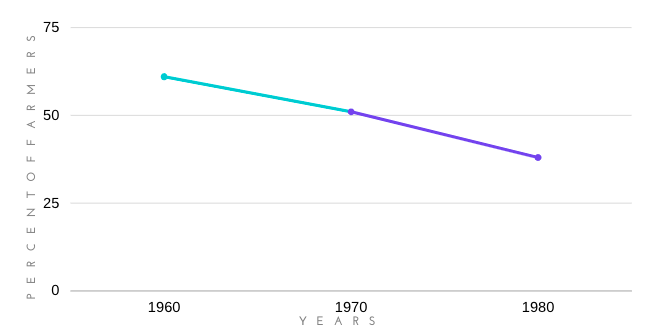
As you can see in the graph down below, the percentage of amount of farmers in South Korea dropped drastically over the years. Where in 1960, 61% of the population was made up of farmers, in 1980 only 38% of the population was a farmer. Many farmers moved to the big cities so that they can send their kids to good school and work in well paying jobs. A lot of farmers suffered during this time due to low profit on their crops. As an attempt to help the farmers, former president Park introduced the New village movement.This movement was to educate farmers on how to modernize their farms and houses. However many famers couldn’t afford to modernize their homes. For example a way to modernize the homes was to replace the roofs with fireproof tiles. These tiles were expensive so farmers resorted to metal roofs painted blue or orange to simulate tiles. In the 1990’s the incomes of the people who lived in the urban areas of South-Korea rose. This lead to prices of crops and other agricultural goods being increased. Farmers were now able to profit more of their crops.


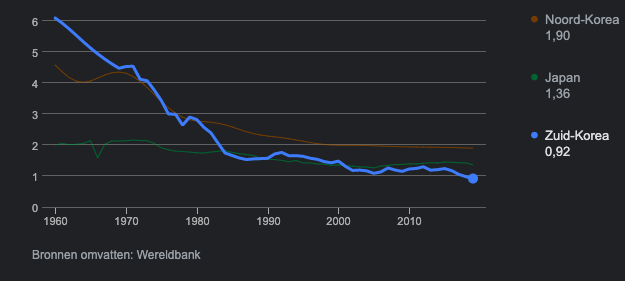
The economic development also had an impact on the birth rate of South Korea. South Korea looked at western countries and noticed that by cutting the birth rate, the economic growth and modernization would grow faster. Together with the International Planned Parenthood Federation, South korea formed the Planned Parenthood Federation of Korea in 1961. In 1968 the government introduced  oral contraceptives. These measurements and other government lead campaign resulted in the birth rate of Korea decreasing. You can see the decrease very well in this graph. Where in 1960 the average birth per woman was around 6, in 2019 this number lowered to 0,9. 

While south korea kept on growing, their education development grew as well. In the period of the 1960’s till the 1990’s South korea reached education levels of developed countries. With secondary education becoming universal and higher education levels that were identical to those in Europe you would think that the labor participation would also be as high as in european countries. This however was not the case, Korea had a much lower labor participation. Consumer growth was lower than the GDP growth. Lack of a social welfare safety net encouraged high rates of savings, as did the bonus system, in which workers received bonuses, usually set aside for savings, up to 400% of the monthly salary. Consumer desire was also constrained by state policies, such as keeping the prices of luxury goods extremely high and restricting foreign travel. The health standards however were improved with infant mortality rates matching those of most European countries

How the Olympics of 1988 led to a social and political change in South Korea.

How the Olympics of 1988 led to a social and political change in South Korea.

Image

The 24th edition of the Olympics was held in South Korea’s capital city, Seoul, in 1988. There were 159 countries competing in 23 different types of sports. In total, 8.453 athletes competed for a gold, silver or bronze medal. Hodori the tiger was the mascot of the Seoul Olympics. The “Ho” of Hodori comes from the Korean word meaning “tiger”, while “Dori” is a common masculine diminutive. Hodori is associated with humour, bravery and nobility. Hodori wears the Olympic rings around his neck. On his head is a typical traditional Korean hat, the sangmo. The ribbon on the hat is in the shape of an “S” for Seoul, and appears in various forms.

The Seoul Olympics and North Korea’s input

Being the hosting country for the Olympics was a big deal for South-Korea. There was a lot of tension between South-Korea and their Northern Neighbors, North-Korea. North-Korea did not like the idea of South-Korea being the host for the Olympics because that would put them in a good light in other countries, which eventually could lead to South-Korea gaining more alliances. North-Korea first tried to negotiate with South-Korea on being a co-host of the Olympics, but after getting declined, North-Korea tried to sabotage the games. One of the most tragic attempts on sabotaging the Olympics was the bombing of Korean Air Flight 858.  In 1987, on November the 29th, two North-Korean spies named Kim Hyon Hui and Kim Sung Il boarded on the Korean Air Flight 858 from Baghdad to Seoul. Armed with a bomb disguised as a radio, the spies blew up the plane while it was in the air again after a layover in Abu Dhabi killing all 115 passengers that were on board. Once the two spies got tracked down by the South-Korean authorities, they tried to commit suicide by smoking cyanide cigarettes. Sung Il’s attempt was successful and died, Hyon Hui however did not succeed and was extradited to South-Korea. South-Korea charged North-Korea for the bombing. North-Korea denied the bombing and tried to gather her allies, the Sovjet Union and China, to call for a boycott. Both countries however did not listen. With the Olympics being a few months away, North-Korea tried to make their own version of the Olympics called the World Festival of Youth and Students. The country put 4 billion US Dollars into this festival. A stadium called the May Day stadium was specially made for this event and can hold up to 150,000 visitors.

Social and Political change

When speaking about the Seoul 1988 Olympics you cannot leave out the social and political change that was happening before and during the time. The Olympics was the country’s attempt to bring a new image of South Korea as a developed and thriving country to the rest of the world. The publicity that would happen from the event would be invaluable hence why it was important to keep a good reputation before and during it. Unfortunately things were not that simple for government leaders. 

On June 10, the military regime of President Chun Doo-hwan announced its choice of Roh Tae-woo as the next president. Although pressure on the regime, in the form of demonstrations by students and other groups, had been building for some time, the announcement finally triggered massive and effective protests. Students and many other parties such as workers and lower class citizens joined the protests. 

The June democratic struggle also known as the June democratic uprising and June democratic movement was a nationwide democracy movement in South Korea that generated mass protests from June 10 to June 29, 1987. It aimed to overthrow the military dictatorship that S.Korea was under at that time and since 1979. Hundreds of people took to the streets in demonstration and they received massive support with women bringing protestors food and water and taxi drivers honking and waving in solidarity. As time went on more and more people joined even white collar workers. (신문방송사, 2020)

Park Jong-chol and Lee-Han yeol were two students whose deaths inspired the voice of a revolution and further bravery to persevere for the cause. Mr. Park, a linguistics student at Seoul National University,died while being questioned by policemen about the whereabouts of a campus radical leader. He died of shock, the authorities initially said. Then, as questions arose in the press and as an attending physician reported contradictory findings, they acknowledged that the young man had been tortured. The policemen had shoved his head several times into a tub of water. In one of those dunkings Mr. Park's throat was crushed against the rim of the tub. He was suffocated and died of his injuries. (Marshall, 2017)

Lee-Han Yeol, was a student during a protest. The military often attempted to control people using tear gas and Lee-Han yeol was unfortunate enough to have been hit directly in the head with a tear gas grenade. Lee Han Yeol suffered a severe impact from the tear gas canister and was taken to Yonsei University hospital in a critical condition. His head suffered massive bleeding that flowed to his face and on 5 July 1987, Lee Han Yeol died. Lee Han Yeol's name is still remembered by the people of South Korea and is enshrined in the 'Lee Han-Yeol' Memorial Museum located in Seoul, South Korea. (Marshall, 2017)

Unwilling to resort to violence before the 1988 Olympic Games, and (correctly) believing that Roh could win competitive elections anyway given divisions within the opposition, Chun and Roh agreed to the demands of direct presidential elections and restoration of civil liberties. Although Roh was elected as president that December the democratic consolidation of South Korea was fully underway. Even though Chun was the one who put forward the bid to have the Olympics in Seoul he was not president during the events. (DBpedia, 2021)

Anti-American sentiment

During the 1988 Seoul Olympics there were elements of anti-American sentiment from the Koreans. Some were seen to be booing into the crowd at American athletes. Americans were very unhappy with this as it can be seen as ungrateful and distasteful given that the US has helped South Korea in the past. But why were Koreans upset? (Yates, 1988)

Well there were reports that Americans were showing coverage of the “dark side” of Korea in news and shows during the Olympics. Topics such as sweatshops, prostitution or foreign adoption of Koreans. As well as that they were mainly focusing on “shocking” incidents that happened such as a disruption during a boxing match when punches and chairs were thrown over a dispute with a referee. All of these things showed South Korea in a very negative light and many citizens felt it was unfair and simply wrong especially during such an important and global event such as the Olympics. Citizens and government officials complained to the American channel NBC about this and the dispute had to be settled. (Kim, 1989)

Even given this situation the general public or the majority did not have a distaste for Americans and it was reported that many South Koreans and Americans had very pleasant interaction during the Olympics showing the continuation of good relations among the two. 

Bibliography

Britannica. (2021, September 10). Seoul 1988 Olympic Games. Retrieved from Britannica: https://www.britannica.com/event/Seoul-1988-Olympic-Games

Chira, S. (1988, September 28). The seoul olympics: U.S olympic reporting hits a raw korean nerve. Retrieved from The New York Times: https://www.chicagotribune.com/news/ct-xpm-1988-09-29-8802030156-story.html

DBpedia (2021,October 10). June Struggle. Retrieved from DBpedia: https://dbpedia.org/page/June_Struggle

Hiatt, F. (1988, October 8). Olympics inflame strain in U.S - Korea relations. Retrieved from The Washington Post: https://www.washingtonpost.com/archive/politics/1988/10/08/olympics-inflame-strain-in-us-korean-relations/a0f3e1ad-abd8-4f09-abfc-e31cab3771ef/

Journal, A. P. (2007, June 04). democracy and Peace in Korea Twenty Years After June 1987: Where Are We Now, and Where Do We Go from Here? Retrieved from Asia Pacific Journal: https://apjjf.org/-Nak-chung-Paik/2440/article.html

Kim, J. (1989). Recent anti-Americanism in South korea. Asian survey, pp. 749-763 .

Lakey, G. (2009, June 10). South Koreans win mass campaign for democracy, 1986-87. Retrieved from Global nonviolent action database: https://nvdatabase.swarthmore.edu/content/south-koreans-win-mass-campaign-democracy-1986-87

Marshall, C. (2017, December 31). Korean Cinema Looks Back at 1987, When students died and democracy was born. Retrieved from LARB Blarb: https://blog.lareviewofbooks.org/the-korea-blog/korean-cinema-looks-back-1987-students-died-democracy-born/

Wikipedia. (2021, September 13). 1988 Summer Olympics. Retrieved from Wikipedia: https://en.wikipedia.org/wiki/1988_Summer_Olympics

Yates, R. E. (1988, September 29). Koreans fan anti U.S feelings at Olympics. Retrieved from Chicago Tribune: https://www.chicagotribune.com/news/ct-xpm-1988-09-29-8802030156-story.html

신문방송사, 국. (2020, 06 01). How the June struggle for democracy ushered in democracy into Korea. Retrieved from Kookmin University: https://press.kookmin.ac.kr/news/articleView.html?idxno=101508


Get into the mood of traveling to Korea by eating Korean food

Get into the mood of traveling to Korea by eating Korean food

Get into the mood of traveling to Korea by eating Korean food

Would you like to see a no-brainer, a sort of slow watching television? Then try one of the Korean romantic series! At the same slow watching, you can experience cultural differences and similarities. 

  • Extraordinary attorney Woo: check her gimbap every breakfast. Notice how the business vibes are in Seoul.
  • Queen of Tears: experience the Samgyeopsal, the family feeling, obligations and deep emotions, also shown by men.
  • Hometown Cha-cha-cha: a lot of eating and drinking soju going on, and it is not a shame to choose rural life over city life.
  • Little women is still on my to watch list. The list of Korean series are unlimited nowadays.

In the meantime: make a snack, savor some kimchi: fermented spicy cabbage with a sour, salty taste. One of the most famous Korean dishes and super healthy! And I discovered you can buy tteobokki in a package (of course only heating up is the process) and the famous Yotam Ottolenghi's sauce advice: Gochujang. It is a versatile cooking essential that is used to make authentic spicy and savoury Korean dishes. The local grocery store has Gochujang on their shelves and you can dip your chips in it.


Recipe: Spicy Korean ramen (vegan)

Recipe: Spicy Korean ramen (vegan)

Image

I absolutely LOVE ramen. It's one of my favorite dishes in Japan, and fortunately more and more vegan ramen places are popping up in the country. While ramen has its roots in China, because of the use of Chinese noodles, the Japanese have turned it into their own traditional dish. Originally the base of the dish consists of Chinese wheat noodles often in a meat or fish broth, but many variations exist throughout the country such as the famous Hakata ramen from Fukuoka, a milky ramen soup made from pork bones. Other popular, and vegetarian, variations of ramen are Shoyu (soy sauce), Shio (salt) and Miso ramen. As toppings, many ingredients can be used. Often used vegetarian toppings are green onions, boiled eggs, bean sprouts, fermented bamboo shoots, nori (dried seaweed), corn, shiitake and wakame. 

Since I was craving spicy food while walking around in our local Asian supermarket, I decided to make my own spicy ramen noodles. I already made miso ramen a couple of weeks ago and while I love it, miso and japanese spicy don't go too well together in my opinion. So I had to think of something new. One thing I'm hooked on is the Korean Gochujang (red chili paste) which is great for bibimbap or spicy Korean rice cakes for example. Since I don't use it too often, one box of paste can last in my fridge for over 6 months, so why not create some more dishes with it!? It probably tastes great as a ramen broth too, right? So I got my veggies and wheat noodles and went home to cook some delicious ramen. I can tell you, it took me by surprise how amazingly tasty (and spicy!) it was :). 

1. Cut the tofu into cubes and add the hoisin sauce, soy sauce, a bit of garlic (powder) and oil to it. Stir and let it sit for a while

2. Cut onion and garlic into tiny pieces and fried the onions for a couple of minutes before I added the garlic. 

3. Add half a can of diced tomatoes and let it simmer for about a minute. 

4. Add the dried shiitake mushrooms and the vegetable stock (don't add too much water since you don't need a huge amount of soup)

5. Combine the gochujang with the soysauce and hoisin (and some broth to make it easier to mix) and add to the broth. Add more soy sauce and/or salt if needed. And more gochujang if you want it more spicy! :)

6. Let it simmer for a while, while you cut the toppings and fry the tofu. 

7. Now add the noodles to the broth and cook until done (follow the instructions on the package). 

8. Put the noodles into a both, cover it with some broth and top with all your amazing toppings! For garnishing you can use some sesame seeds. 

Enjoy! :) 

Ready In: 30 min.

Ingredients:

  • 4 cups vegetable broth
  • 2 tablespoons gochujang
  • 2 tablespoons soy sauce for broth
  • 1 tablespoon hoisin for broth
  • 1 onion for broth
  • 3 cloves of garlic for broth
  • 150-200 grams of ramen noodles
  • 100 grams of tofu
  • 1 tablespoon soy sauce for tofu
  • 1 tablespoon hoising for tofu
  • 1 tablespoon vegetable oil for tofu
  • green onions
  • corn
  • enoki mushrooms
  • 8 dried shiitake mushrooms, cut in half
  • bean sprouts
  • or any other topping of choice!

Image ACTIVITIES

Check courses, jobs, projects, recipes, suggestions and tips related to: 'South Korea'

CHECK MORE ACTIVITIES

Make a selection, to find more tips than you see below

Image Winter sports abroad
Table of content Winter sports abroad: questions and answers about the work and locations What is working as a seasonal worker in mountainous areas where winter sports...
Image Recipe: Spicy Korean ramen (vegan)
My world recipe: Spicy Korean ramen (vegan)
Image Ga aan de slag bij een internationale IT-organisatie met uitgebreide mogelijkheden
Met mogelijkheden op het gebied van o.a. consulting, engineering, financiën, HRM, bouwkunde, IT, communicatie, productie, recht en sales. Ook zijn er vaak...
Image Work in exchange for accommodation at a hostel chain which has several hostels and guesthouses around South Korea
Work in exchange for accommodation at a hostel chain which has several hostels and guesthouses around South Korea
Image Spreek je vloeiend Engels en ben je gediplomeerd docent of heb je ruime lesgeef-ervaring? Ga dan werken op een internationale school die Amerikaans onderwijs aanbiedt voor kinderen van expats
Spreek je vloeiend Engels en ben je gediplomeerd docent of heb je ruime lesgeef-ervaring? Ga dan werken op een internationale school die Amerikaans onderwijs aanbiedt...
Image Werk als vrijwilliger mee op een lokale boerderij in Zuid-Oost Azie en zet je in voor biologische landbouw!
Werk als vrijwilliger mee op een lokale boerderij in Zuid-Oost Azie en zet je in voor biologische landbouw! Dompel je helemaal onder in de Aziatische cultuur door een...
Image Doe ervaring op in het buitenland tijdens een uitdagende stage die aansluit bij jouw studie
Doe ervaring op in het buitenland tijdens een uitdagende stage die aansluit bij jouw studie
Image Dompel je onder in de bijzondere Zuid-Koreaanse cultuur tijdens een taalcurus Koreaans
Dompel je onder in de bijzondere Zuid-Koreaanse cultuur tijdens een taalcurus Koreaans in Seoul of Busan
Image Use your TEFL certificate to work as an English teacher in various countries
Use your TEFL certificate to work as an English teacher in various countries. Depending on your education and experience, there are many opportunities available for...
Image Assisteer bij het geven van Engelse les en naschoolse activiteiten op een basisschool. Beleef deze unieke ervaring!
Assisteer bij het geven van Engelse les en naschoolse activiteiten op een basisschool in Zuid-Korea. Beleef deze unieke ervaring!
Activities abroad: home bundle

Main content and contributions for activities abroad

,,,accommodations, adventure activities, courses, internships, jobs and volunteer projects

...to help another, travel with care, work together , learn to share and inspire with your experience


Activities abroad: home page

Activities abroad: home page

From language courses to gap year abroad, from work experience to volunteering abroad, from paid work to internship abroad, from mountaineering to diving and from backpacking to travel around the world

    What social activities can you do abroad?

    • Opportunities are found in the areas of helping, learning or studying. You can get involved to volunteer in a social project at a school in Africa, Asia or Latin America. You can get involved in nature, in a project with animals or cleaning the sea or beaches. Those who want to learn more can choose for example a language course in Latin America, Spain or South Africa.

    What work related activities can you do abroad?

    • If you want to gain work experience, and/or also earn money, go and work abroad. You can combine backpacking in Australia with temporary work. You can work on campsites in Europe or bush camps in Africa. You can pretty much go all over the world to work in the hospitality industry, hotels and hostels, in the healthcare sector or for example at a diving school.

    What sports activities to do abroad?

    • Have you ever thought of mountain biking, rafting (going down a wild river on a raft or rubber dinghy, climbing or canoeing), survival (which involves building rafts, climbing or canoeing), abseiling (descending a rock face while secured to ropes), zip-lining (whizzing down a cable), canyoning (starting at the top of a river and then climbing, swimming, diving down the bed) or caving (scrambling, wriggling and crawling through caves and crevices)?
    • Maybe you feel more comfortable on a bodyboard (on a half-wave surfboard, you surf the high waves lying down-with flippers), on a hang glider or while paragliding (with a parachute you float down a mountain or dune), hydrospeeding (on a bodyboard with flippers and a wetsuit on you go down a wild river via rapids) or Tiefschneeskiing (racing down through powder snow)?

    Check the pages below for more activities and inspiration and where to go and how to arrange it

      Activities abroad: for experiencing countries and cultures abroad

      Activities abroad: for experiencing countries and cultures abroad

      Bundled content for experiencing countries and cultures during gap year, travel and backpacking abroad

      Access: 
      Public
      Activities abroad: for sports, adventure and outdoor abroad

      Activities abroad: for sports, adventure and outdoor abroad

      Bundled content for sports, adventure and outdoor during travel, gap year and backpacking abroad

      Access: 
      Public

      Image STORIES

      Check blogs, experiences and information related to: 'South Korea'

      CHECK MORE STORIES

      Make a selection, to find more blogs and contributions than you see below

      Image How does healthcare work in South Korea, and what travel insurance, health insurance or expat insurance do you need?
      How does the healthcare system work in South Korea, and which insurance do you need? What is the quality of healthcare in South Korea? How does the public healthcare...
      Image Packing list for South Korea, travel insurance for South Korea, and taking your belongings
      What to take to South Korea: brief What knowledge comes in handy when you go to South Korea? Are there mosquitoes in South Korea? Are there sandflies in South Korea? Can...
      Image Met een Working Holiday visum Zuid-Korea ontdekken
      Nederlanders en Belgen kunnen voor hun verblijf in Zuid-Korea een Working Holiday Visum aanvragen om zo tot maximaal een jaar te reizen en werken in Zuid-Korea. Dit...
      Image Business in South-Korea: The first steps
      With the global market shifting more to Asian countries and with South-Korea having one of the top economies in the world, expanding your business to South Korea can...
      Image How the Olympics of 1988 led to a social and political change in South Korea.
      The 24th edition of the Olympics was held in South Korea’s capital city, Seoul, in 1988. There were 159 countries competing in 23 different types of sports. In total, 8...
      Countries & Destinations: home bundle

      Bundled content, suggestions, stories and tips about the countries and destinations in the world

      ...to help another, travel with care, work together , learn to share and inspire with your experience

      Africa: country bundles

      Africa: country bundles

      Access: 
      Public
      Asia: country bundles

      Asia: country bundles

      Country bundles of Asian countries

      Access: 
      Public
      Europe: country bundles

      Europe: country bundles

      Country bundles of European countries

      Access: 
      Public
      The Caribbean: country bundles

      Image ORGANIZATIONS

      Check sectors and organizations related to: 'South Korea'

      CHECK MORE ORGANIZATIONS

      Make a selection, to find more or other organizations than you see below

      Image Stagelanden
      Stagelanden verzorgt stages in diverse landen in Azië & Oceanië voor studenten die een MBO, HBO of universitaire opleiding volgen.
      Image Kimchee Guesthouse
      Kimchee Guesthouse offers accommodation in different establishments in South Korea.
      Image StudyTravel
      StudyTravel consists of a permanent team of enthusiastic employees, all with experience abroad. You can go there to learn various languages such as Italian, German,...
      Image In Defense of Animals
      In Defense of Animals / IDA Africa is an organization fighting against animal cruelty and tries to protect natural habitats. One of their projects: Sanaga-Yong...
      Organizations & Services: home bundle

      Bundled content, suggestions, stories and tips about organizations and their products and services

      ...to help another, travel with care, work together, learn to share and inspire with your experience

      Organizations: home page
      Organizations for administrative, tax and legal work and consulting

      Organizations for administrative, tax and legal work and consulting

      international law

      Activities, internships, paid work, services or volunteer work in administration, tax and legal consulting

      Administrative, tax and legal consulting abroad: by position

      For job roles and duties related to activities, internships and jobs abroad, see:
      ......Read more on this page
      Organizations: for agriculture, grape picking, farming and vineyards
      Organizations: for animal protection, animal care and working with wildlife abroad
      Organizations: for au pairs, youth work and child care abroad
      Organizations: for bush camping and working at a campsite abroad
      Organizations: for catering, hospitality and entertainment abroad
      Organizations: for civil society and social work abroad
      Organizations for corporate business services

      Organizations for corporate business services

      Image

      Activities, internships, paid work, services or volunteer work in corporate business services

      Corporate business services abroad: by position

      For job roles and duties related to activities, internships and jobs abroad, see:
      ......Read more on this page
      Organizations: for customer services abroad and help desks
      Organizations: for diving, snorkeling and water sports abroad
      Organizations: for education and schools abroad
      Organizations: for expatriate insurances, travel insurances, and emergency call centers
      Organizations: for gap year activities abroad and sabbaticals
      Organizations: for internship placement abroad
      Organizations: for insurances and finance abroad
      Organizations for IT, engineering and construction

      Organizations for IT, engineering and construction

      Image

      Activities, internships, paid work, services or volunteer work in IT, webdevelopment, engineering and construction

      IT, engineering and construction abroad: by position

      For job roles and duties related to activities, internships and jobs abroad, see:
      ......Read more on this page
      Organizations: for language travel and language teaching abroad
      Organizations for marketing, communication and PR abroad

      Organizations for marketing, communication and PR abroad

      Image

      Activities, internships, paid work, services or volunteer work in marketing and communication

      Marketing, communication and PR abroad: by position

      For job roles and duties related to activities, internships and jobs abroad, see:
      ......Read more on this page
      Organizations: for mediation in au pairs, childcare and elderly care in the Netherlands
      Organizations for moving, international relocation and transport abroad

      Organizations for moving, international relocation and transport abroad

      Image

      Activities, internships, paid work, services or volunteer work in transport and international relocation

      Moving abroad and relocation services abroad: by position

      For job roles and duties related to activities, internships and jobs abroad, see:

      Moving abroad and relocation

      ......Read more on this page
      Organizations for nature conservation, environmental protection and working in nature abroad

      Organizations for nature conservation, environmental protection and working in nature abroad

      Costa Rica rain forest - Jungle

      Activities, internships, paid work, services or volunteer work in environmental protection, sustainability and nature conservation

      Nature conservation and environmental protection abroad: by position

      For job roles and duties related to activities, internships and jobs abroad, see:
      ......Read more on this page
      Organizations: for nonprofit projects, development work and international cooperation
      Organizations: for online work as digital nomad, freelancer, or independent entrepreneur from abroad
      Organizations: for outdoor activities and sports
      Organizations: for providing accommodation and hospitality work in hotels, guesthouses, ecolodges and hostels abroad

      Organizations: for providing accommodation and hospitality work in hotels, guesthouses, ecolodges and hostels abroad

      Image

      Activities, internships, paid work, services or volunteer work in hotels, resorts, guesthouses, ecolodges, bed and breakfasts and hostels abroad

      Working in hospitality and tourist accommodations abroad: by position

      For job roles and duties related to activities, internships and jobs abroad, see:
      ......Read more on this page
      Organizations: for providing healthcare and working in medical care abroad

      Organizations: for providing healthcare and working in medical care abroad

      Image

      Activities, internships, paid work, services or volunteer work in healthcare

      Providing healthcare and working in medical care abroad: by position

      For job roles and duties related to activities, internships and jobs abroad, see:
      ......Read more on this page
      Organizations: for psychological assistance and mental health care abroad

      Organizations: for psychological assistance and mental health care abroad

      Image

      Activities, internships, paid work, services or volunteer work in psychological assistance, coaching and mental health care abroad

      Psychological assistance, coaching and mental health care abroad: by position

      For job roles and duties related to activities, internships and jobs abroad, see:
      ......Read more on this page
      Organizations: for real estate, brokerage abroad and property rental abroad
      Organizations: for research and scientific work abroad

      Organizations: for research and scientific work abroad

      Image

      Organizations: for research, R&D, data collection, data analysis and scientific work abroad

      Activities, internships, paid work, services or volunteer work in research and science

      From R&D to data collection and data analysis

      Research and science abroad: by position

      For job roles and duties related to activities, internships and jobs abroad, see:
      ......Read more on this page
      Organizations: for student support and student associations
      Organizations: for tour guidance and adventure tours abroad
      Organizations: for tourism and organized travel and leisure work abroad
      Organizations: for voluntary work mediation and project placement abroad
      Organizations for yacht and shipping crew and working on a cruise ship abroad

      Organizations for yacht and shipping crew and working on a cruise ship abroad

      Image

      Activities, internships, paid work, services or volunteer work on cruise ships, sailing yachts and other ships

      Boat crew, deck hand or working for an international shipping organization

      Working on a yacht or cruise ship abroad: by position

      For job roles and duties related to activities, internships and jobs abroad, see:
      ......Read more on this page

      Image SUMMARIES

      Check summaries and study assistance related to: 'South Korea'

      CHECK MORE SUMMARIES

      No results found.

      Image ALL CONTENT

      Search all related content within the topic: 'South Korea'

      ALL CONTENT WITHIN TOPIC

      Select any filter and click on Apply to see results

      Image

      SPOTLIGHT & FAVORITES

      SPOTLIGHT
      Image

      Introduction With the global market shifting more to Asian countries and with South-Korea having one of the top economies in the world, expanding your business to South Korea can sound very favourable. But are Koreans going to buy your products, and where do you even begin when you're want...
      Park Zuid Korea

      Nederlanders en Belgen kunnen voor hun verblijf in Zuid-Korea een Working Holiday Visum aanvragen om zo tot maximaal een jaar te reizen en werken in Zuid-Korea. Dit visum is bedoeld voor reizigers tussen de 18 en 30 jaar met als hoofddoel reizen en met als bijbedoeling te werken of tijdelijk (bijvoo...

      FAVORITES
      Park Zuid Korea

      Nederlanders en Belgen kunnen voor hun verblijf in Zuid-Korea een Working Holiday Visum aanvragen om zo tot maximaal een jaar te reizen en werken in Zuid-Korea. Dit visum is bedoeld voor reizigers tussen de 18 en 30 jaar met als hoofddoel reizen en met als bijbedoeling te werken of tijdelijk (bijvoo...

      South Korea: Updates & Travel
      • Travel in South Korea?
      • Updates South Korea
      • Travel in South Korea?

        • In South Korea, you are literally and figuratively between China and Japan. Along with influences from both countries (a fierce history story), South Korea has also really developed its own cult...

      Image

      TOPICS : check associated topics and more activities

      Check more: activities in WorldSupporter
      Go abroad!
      Page topic

      Stories, tips and experiences from South Korea

      Submenu & Search

      Search only via club, country, goal, study, topic or sector