Social psychology in Organizations specialization at Leiden University
Lecture 4: Decision Making and Team Conflict
Identity threat: being judged as a bad person
Business week ranking:
If you can convince others of your view you feel legitimized and can accomplish things
-Low ranking means identity threat
-Strategic recategorization:
- Affirm neglected positive aspects (zoom in)
- Explaining the negative evaluation
-Strategic (favorable) social comparison (zoom out)
If you can convince others of your view you feel legitimized and can accomplish things
Self-affirmation
Another strategy when facing identity threat
Self-affirmation is often used to decrease an identity threat
2 step procedure (K.Harber, 1995):
- ranking of personal characteristics and values
- take rank order number 1 and see how well you’re doing in it in your life
Self-affirmation can lead to:
-Higher grades, more abstract thinking, easier to maintain motivation
-More self-control
-More open-mindedness
Value conflict
Aimed at investigating interventions to solve value conflict
Interventions based upon
-decrease of identity threat
-Self-affirmation
-Other-affirmation --> people became more open-minded
General conflict resolution technique?
-values: for non-chosen charity -other-affirmation helped
-resources: for personal profit – other-affirmation didn’t help at all
Overconfidence in decision-making
Overestimation:
Of personal abilities, performance, chances of success or level of control
Overplacement:
The idea that you are better than others
Overprecision:
Certainty of precision of private beliefs
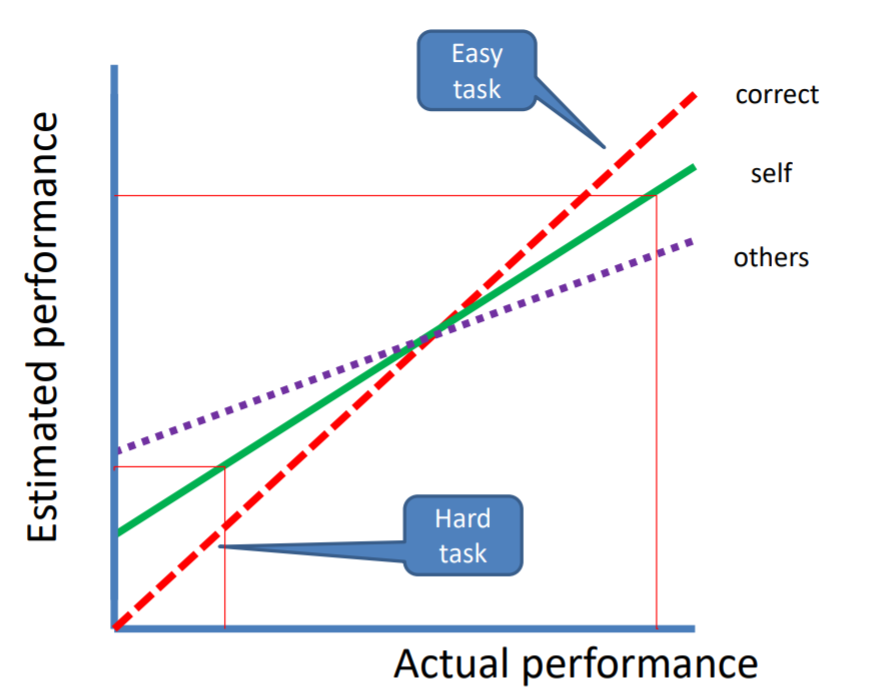
Hard-easy effect
In general: underestimation of performance on easy tasks and overestimate performance on hard tasks
Underplacement also occurs on hard tasks (others are better than you)
Illustartion of hard-easy effect:
More biases:
-Illusion of control: overestimate control over situation
-Planning fallacy: underestimate time needed for things
-Comparative optimism/pessimism: e.g.: overestimate likelihood being struck by lightning
-Pessimism about the future
There seems to be no effect of individual differences for the biases about over and underestimation
Moderators of overestimation
-Controllability
-Observability (e.g.: friendliness is easier to observe than honesty)
-Personal experience with absence of negative outcome (e.g.: smoking for years and still no lung problems --> it’s ok)
Difficult decision making: conflict at the workspace
Negative effects of workplace conflict: stress, burn-out, lower commitment, less innovation, higher turnover etc
Lack of conflict--> groupthink – e.g.: bay of Pigs – US invasion of Cuba, people didn’t speak up when planning
For good decision making we do need conflict to prevent groupthink, enhance creative thinking etc. However, it takes up a lot of energy, time, reduces satisfaction
Jehn – 3 types of intragroup conflict
Task conflict: disagreement among group members about the content and outcomes of the task being performed
Relationship conflict: Disagreement about interpersonal issues
Process conflict: disagreement about logistics
Are process conflicts bad for team performance
Process and relationship conflicts are bad for performance but not task conflict
Task conflict can be good for performance as long as there is no relationship conflict, but when they coexist then task conflict becomes negative
Conflict asymmetry: different perception of how much conflict there is
Why is asymmetry bad for group performance?
-Lack of shared mental models
-Impoverished information exchange
-Negative affect such as frustration and anger
-Negative cognitive effects: uncertainty, confusion, distraction
Beware of faultlines: e.g.: subgroup 1 are low-conflict pereceivers (LCP), and subgroup 2 are high conflict perceivers (HCP). Solution: subgroup 1 has both LCP and HCP perceivers, and so does subgroup 2.




