Travel to Thailand to backpack, study, intern, volunteer, work, or live as a digital nomad, expat or emigrant?

Image

Image
 Thailand

Intro

Backpacking in Thailand?

  • Thailand has been the ultimate backpacker's paradise for many years. From island hopping to jungle tours and from ancient temples to modern cities. 
  • Features: emerging economy, good infrastructure and at the same time very traditional, extraordinary culture, tropical forests and beaches and full of party and relaxation opportunities. 

Traveling in Thailand?

  • When traveling in Thailand, many people think of full moon parties and beach vacations, but there is much more to experience! Explore hidden temples, participate in rituals and enjoy the varied cuisine. Thailand is also known for its wide selection of retreats.
  • City spotting: Bangkok, Chiang Mai, Chiang Rai, Ayutthaya, Krabi.
  • Activities spotting: from visiting beautiful temples, meditating and mountain hiking in the north, to boating, diving and partying in the south.
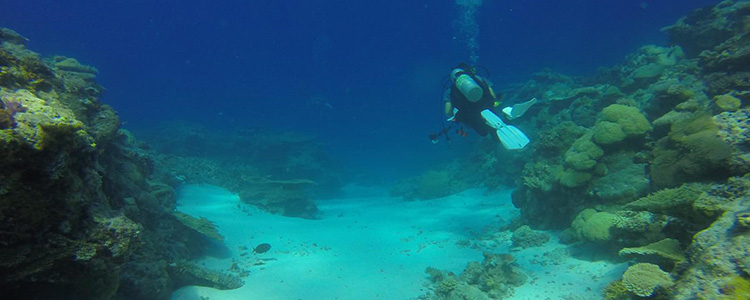
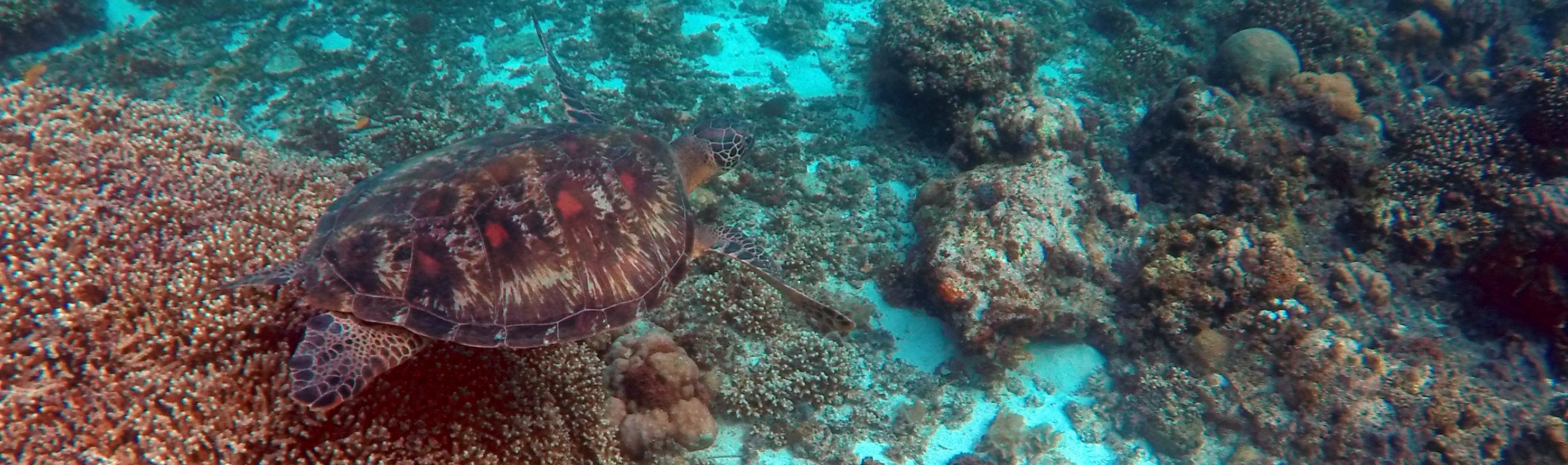
  • Nature spotting: Khao Sok National Park for one of the world's oldest rainforests, Erawan National Park for impressive waterfalls, Similan Islands for their amazing coral reefs and marine life, Khao Yai National Park for wildlife, Ang Thong National Marine Park for a combination of both and much more!
  • Animal spotting: the Asian elephant, Indochinese tiger, Malayan tapir, gaur (bovine), clouded leopard, king cobra, gibbons, hornbills and an awful lot of marine life.

Studying in Thailand?

  • Education in Thailand: Thailand has a number of universities that are of very good quality. There are many different educational institutions, from universities to technological institutes and colleges.
  • Language: the official language is Thai, but many studies can be found in English and the number is increasing every year.
  • Studies: some of the most popular studies among foreigners are business administration, marketing, professional English, Thai and international business management.
  • Study cities: Bangkok offers by far the most options, other study cities include Chiang Mai, Chiang Rai, Pathum Thani, Hat Yai.
  • Language learning: Especially in Bangkok there are many opportunities to learn Thai.

Internship in Thailand?

  • Internships: Thailand offers many internship opportunities, from internships in tech and business administration to conservation and tourism.
  • Internship cities: Bangkok is the hub for most that happens in Thailand. Chiang Mai, Phuket, Pattaya, and Hat Yai are also popular internship cities.
  • Characteristics: combine a cultural experience, with a well-developed country and an international community. Also, a fair number of people speak English and you are in the best place to visit the rest of Asia.

Volunteer in Thailand?

  • Volunteering in Thailand is very popular. Especially in animal protection, but volunteering in community development and education is also common.
  • Animal/nature projects: projects with elephants, stray animals and wildlife are widely offered. Make sure they are ethically sound organizations.
  • Features: many options and locations for volunteering, from short to long. Generally, you have to pay. Just make sure you go to a good organization. 

Working in Thailand?

  • Jobs: popular jobs are diving instructor, (English) teacher, hotel & hospitality work and work for international companies.
  • Work culture: as in other countries in Asia, seniority and hierarchy are highly valued. Formal forms of address and politeness are important, at the same time the work environment can be informal and sociable among colleagues of the same level.
  • Characteristics: formal, hierarchical, collaboration, personal relationships, indirect communication, healthy work-life balance.

Working as a digital nomad in Thailand?

  • Favorite locations: Chiang Mai, Ko Lanta, Bangkok, Ko Phangan.
  • Characteristics: cheap, large digital nomad community, good facilities and lots to do.

Living in Thailand?

  • Language: the main language is Thai, in tourist spots many young people speak English.  
  • Quality of life: in Thailand, the quality of life is high, depending on where you live. The country is relatively safe, there is a lot to do, facilities are good and medical care is of high quality. 
  • Features: you don't have to miss anything in terms of facilities, large international community, cheap living.

Supporting content

Thailand Country Bundle: suggestions, stories and tips

Thailand Country Bundle: suggestions, stories and tips

Image

Main content and contributions about Thailand

Packing list for Thailand, travel insurance for Thailand, and taking your belongings

Packing list for Thailand, travel insurance for Thailand, and taking your belongings

Packing list for Thailand, travel insurance for Thailand, and taking your belongings

To take or not to take to Thailand, leave at home or arrange locally?
Sufficiently insured or not for your activities in Thailand?
Sufficiently insured or not for your trip to Thailand?


What to bring to Thailand: highlighted

Highlighted items:
  • Documents and money: passport that is valid for long enough (>6 months), an extra copy of your passport is also useful, cash for a week.
  • Packing and protection: if you go during the rainy season, don't forget a waterproof cover for your backpack or bag.
  • Insects and animals: a set of anti-mosquito repellents (preferably with DEET, see also DEET anti-mosquito repellent).
  • Clothing and shoes: clothing for both heat and humidity (see also tropical clothing and clothing for warm weather).
  • Lying and sleeping: mosquito net, if it is not already present in your accommodation.
  • Medicines and travel pharmacy: medical kit (self-assembled or not).
  • Outdoor and conveniences: sunglasses.
  • Technology and equipment: don't forget to bring a world plug (see also world plug or travel plug).
  • Safety and theft: money belt.
  • Care and hygiene: sunscreen with a high protection factor & aftersun.
What other options are there to pack:
  • A snorkel set, sometimes you can also rent one on site.
  • Reusable water bottle with filter.
  • Water shoes given the coral and stones in the water at the various locations.
  • UV protective shirt for snorkeling.
  • Hat or cap against the sun and heat.
  • International driving license, this is mandatory if you want to rent a car or scooter.

What knowledge is useful when you go to Thailand?

  • Knowledge about the customs and local habits, especially when you visit temples.
  • Knowledge about the local regulations, especially if you smoke a joint every now and then.

Are there mosquitoes in Thailand?

  • In Thailand, mosquitoes can be found all year round. Although you generally have the most trouble with them in the rainy season (June-October), they can never be completely avoided. Some mosquitoes in Thailand still carry malaria (in a limited number of areas), the other mosquitoes stick to dengue, and partly other mosquito-borne diseases.
  • More about protection against mosquitoes and insects or malaria.

Are there sand flies in Thailand?

  • There are sand flies on some beaches (or in certain seasons), so it is always good to check with the place where you are sleeping what the situation is.
  • What are the favorite islands of sand flies in Thailand: Koh Chang, Koh Mak and Koh Kood.
  • Where else do you encounter a lot of sand flies? East Thailand (Koh Kood, Koh Mak, Koh Chang) Central Thailand (Koh Phayam and Ao Yai).
  • Which islands are not overcrowded with sand flies? Western south coast (Phuket, Koh Lanta, Koh Phi Phi). Eastern south coast (Koh Samui, Koh Phangan, Koh Tao).
  • Your set of mosquito repellents with DEET can provide a solution! More about sand flies and sand fleas.

Can you buy DEET or other mosquito repellents in Thailand?

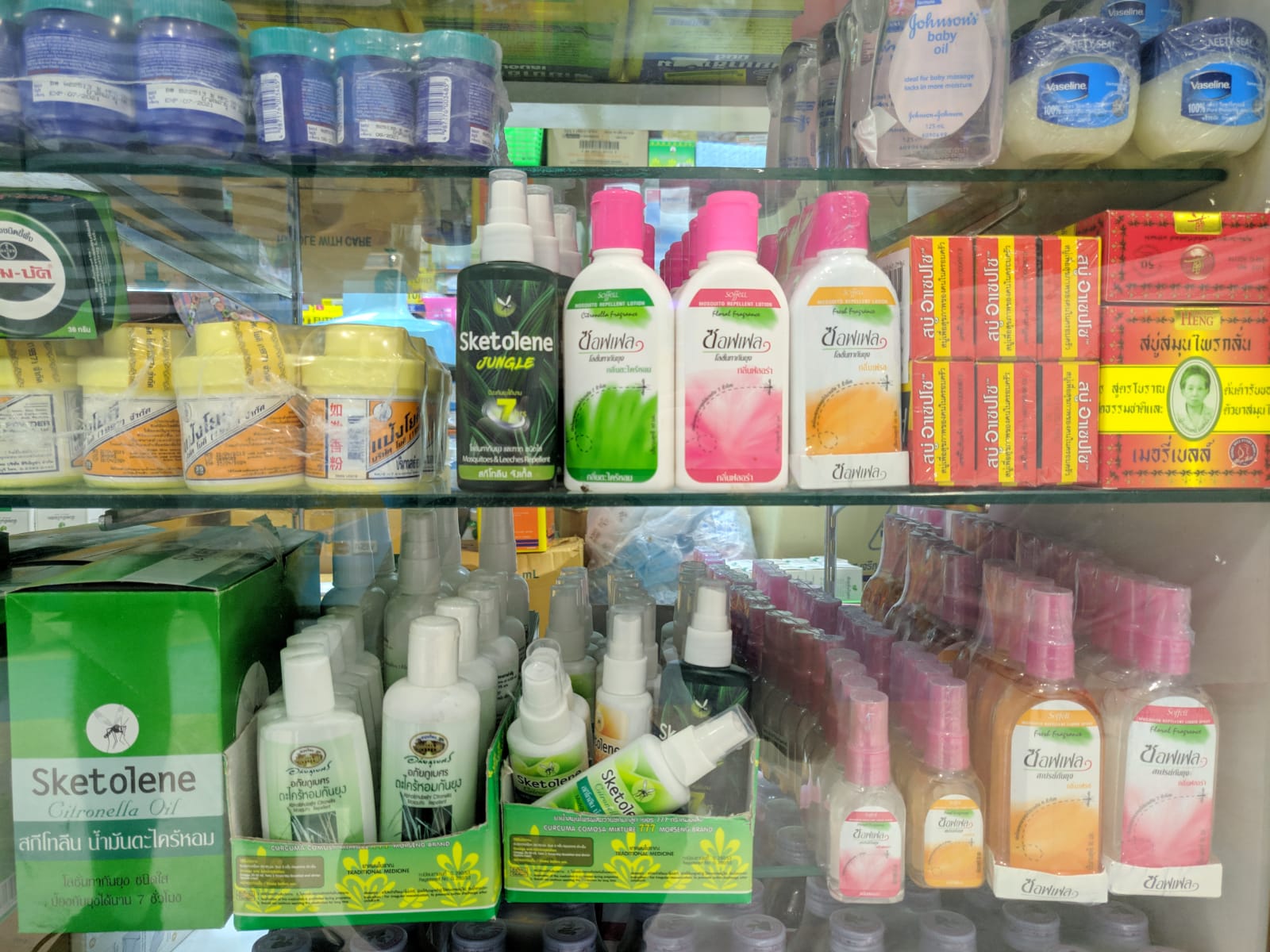
  • In Thailand, you can find both natural mosquito sprays and lotions as well as a variant with DEET. In addition, there is a wide choice of brands (both local and international) and stores where you can buy mosquito repellents.

Where to buy DEET in Thailand

  • The 7-Eleven in Thailand is open 24/7 and sells just about everything you need, including mosquito repellents.
  • Other (large) supermarkets, such as Family Mart, Tesco Lotus and Big C, also sell products with different percentages of DEET.
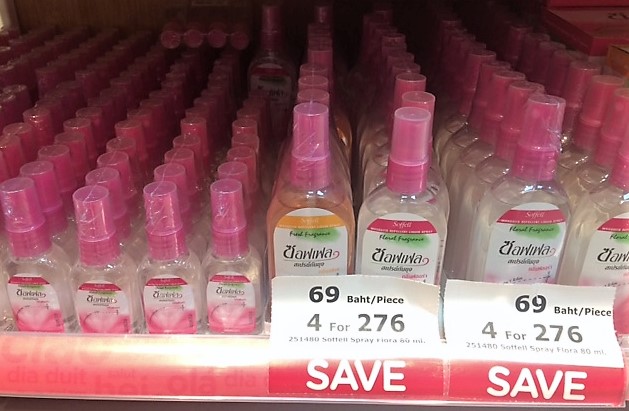
  • In addition to supermarkets, many drugstores sell mosquito repellents. Watsons, a drugstore with a large number of branches in Thailand, sells various brands of mosquito sprays and lotions with DEET. Brands that sell mosquito repellents with DEET in Thailand include Soffell (including a spray and lotion with t 13% DEET) OFF, Sketolene and Merci.
  • Sketolene also sells a ‘jungle’ variant with a percentage of 95% DEET.
  • If you are going to a remote area, make sure you have purchased enough DEET in advance.

Where can you get your food and drinks in Thailand?

  • Supermarkets have large assortments with everything you need.
  • For snacks or last-minute purchases, you can go to the many convenience stores.
  • Street food is delicious and available in many places!
  • Markets are popular for trying all kinds of unique dishes.
  • Of course, you also have local and international restaurants in all shapes and sizes.

Can you buy a joint or weed in Thailand, or take it with you to Thailand?

  • It is forbidden to take weed with you to Thailand. Make sure you do not carry any traces with you at all. No matter how full the prisons are, there always seems to be room for a tourist with a joint.
  • Weed is sold openly in Thailand. Smoking marijuana in public remains tricky.
  • Traveling around (and possessing) cocaine, heroin, ecstasy, LSD, opium, amphetamines, benzodiazepines, ketamine or, for example, magic mushrooms all fall under the strict Thai law.
  • E-cigarettes and vapes are also prohibited.
  • The rules have been adjusted in 2024. Cannabis is supposed to be 'legalized', but the rules are now almost even vaguer than before. In addition, they can be changed at any time without warning.
  • The fines and prison sentences are a lot less vague, by the way.
How does healthcare work in Thailand, and what travel insurance, health insurance or expat insurance do you need?

How does healthcare work in Thailand, and what travel insurance, health insurance or expat insurance do you need?

How does the healthcare system work in Thailand?

What is the quality of healthcare in Thailand?

  • Thailand generally provides good quality healthcare. There are many hospitals, of which about 80% are public hospitals.
  • There are two types of pharmacies (indicated by the green cross logo); type 1 and type 2. Type 1 are the more extensive pharmacies with a license where you can buy prescribed and over-the-counter medicines. Usually there is also a medical expert on staff. These pharmacies are usually found at hospitals and health centers. Type 2 pharmacies only sell over-the-counter medicines and usually cannot provide advice.
  • If you do not work in Thailand, you pay for your own insurance. You can opt for private coverage with the choice between private and public hospitals.
  • Strict rules apply to insurance for foreigners, if you stay in Thailand for a longer period and are going to apply for a long-term visa, health insurance is mandatory. Specific rules apply here with regard to cost coverage from the insurance. Check this well in advance.
  • You must show the insurance coverage and it must be legible (in English) when applying for your visa. When extending your visa, you are even required to have a Thai certified local insurance, with all the paperwork that goes with it. Arrange this on time and check this well in advance.
  • If you want to be helped, at the hospital (GP), dentist, midwife, maternity care or consulate, you often have to pay the bills yourself before (or after) the consultation.
  • In contrast to physical health care, mental health care is lagging behind in Thailand. There have been leaps and bounds, but there is still a huge shortage of mental health care services.
  • Traditional Thai medication is available everywhere and is very popular among locals. Most Thai hospitals and health centres also offer forms of traditional health care. It is fully regulated and used as complementary care.
  • In case of medical emergencies, call 1669. As a foreigner, you can also call 1155 for advice in case of emergencies.
  • Always take your passport with you when visiting a healthcare institution. This is mandatory in Thailand.

How does the public healthcare system work in Thailand?

  • The Department of Medical Services of the Ministry of Public Health (MOPH) funds public health services and government hospitals. Apart from the long waiting times, you will find good medical services here.
  • The first line of care is the health centres. The MOPH runs almost 10,000 health centres, where you will find nurses, doctors, general practitioners, dentists and pharmacists.
  • Through your work, you are covered for your social security and you can use the public healthcare institutions. Please note that your family is not always covered. In that case, make sure you have private health insurance for them.
  • The cost of most medicines is also covered by the public insurance. Private insurance can help you cover other costs if you regularly need expensive medicines.

How does the private healthcare system work in Thailand?

  • Private healthcare is of very high quality and also attracts many foreigners every year. Thailand is a hotspot for medical tourism.
  • There are many more private clinics than public health centres.
  • The best healthcare can be found in Bangkok. In higher areas, private healthcare is not always of the quality that meets the expectations of Westerners.
  • The advantage of private healthcare is shorter waiting times, but not necessarily more space in hospital beds.
  • Always check with your international private insurance company which private institutions are covered before you go somewhere.

How is the general practitioner arranged in Thailand?

  • Visits to a general practitioner are not as common as in some western countries. But you can find general practitioners in private or family clinics.
  • The general practitioners that are there als often have offices in hospitals and work with consultation hours, but it is more common to go directly to a specialist in the hospital if something is wrong with your health. The specialists also have walk-in consultation hours and often also have an office in the hospital.

How is the dentist arranged in Thailand?

  • There are different types of dentists to be found in private and public clinics, hospitals and health centres.
  • About half of the dentists work in the private sector.
  • The public health insurance covers basic dental care up to a certain amount per year. With private insurance you can increase your coverage and ensure that you are fully covered for costs. In general, there are good dentists available, who follow international standards, and for a reasonable price. And if you are unsure about a particular procedure, ask for a second opinion or a price indication from another provider.
  • Most expats choose more expensive, private clinics because of the modern facilities and English-speaking dentists.

How is pregnancy care arranged in Thailand?

  • Pregnant women have access to good prenatal care in both public and private hospitals. Public hospitals are the cheapest. Prenatal care is free for those insured and a standard birth usually costs around 800 euros and a caesarean section double that. The care is generally good, but waiting times can be long and you usually cannot choose your doctor. Private hospitals are even more personal.
  • Every private hospital offers “Childbirth Delivery Packages” which, depending on the type of birth, includes a number of nights in the hospital. These packages cover routine costs, but not the costs of possible complications.
  • In public hospitals you also have Premium Clinics, which offer more comfort and better care.
  • English-speaking doctors are mainly available in private hospitals.
  • Most expats choose private hospitals. Make sure you check with your insurance whether the hospital of your choice is covered by them.
  • Breastfeeding in public is accepted, but most women cover themselves with a cloth.

How safe or unsafe is a trip or stay in Thailand?

What should you pay attention to in terms of safety in Thailand?

  • Thailand is generally safe, but pickpockets and petty theft occur in busy tourist areas.
  • Avoid demonstrations and political gatherings, especially in Bangkok.
  • In rural areas and national parks you can encounter poisonous snakes, scorpions and other animals.
  • Thailand has a rainy season (May-October) with a risk of flooding and landslides.
  • Tropical storms also occur, especially in the south.
  • Drug use and possession is strictly prohibited in Thailand, punishable by stiff prison sentences. Note that many medicines are also considered drugs (prescription drugs). You are required to carry a medicine passport or a statement from a doctor for your use of these drugs, otherwise you can get into trouble with them.

What should you look out for in terms of diseases in Thailand?

  • There are several mosquito-borne diseases that you can contract in Thailand. It is therefore wise to protect yourself well against mosquitoes.
  • In large cities such as Bangkok and Chiang Mai (during the “burn season”) air pollution can be a major problem, especially for people with respiratory problems.
  • Tap water is not safe to drink.
  • Street food is popular and the quality is improving, but be careful about the hygiene of what you eat. It may also be wise to avoid undercooked and raw foods such as raw seafood.

What should you pay attention to when it comes to traffic in Thailand?

  • In Thailand, people drive on the left side of the road.
  • Traffic in Thailand is chaotic, especially in Bangkok. Many local drivers ignore traffic rules.
  • Scooters and motorbikes are popular means of transport, but riding them can be dangerous. Many accidents involving tourists occur every year.
  • Always wear a helmet when riding a scooter.
  • Insurance often does not cover accidents if you do not have a valid motorcycle license.
  • Tuk-tuks, songthaews (shared taxis) and motorbike taxis are convenient, but agree on a price before you get in.
  • The BTS Skytrain in Bangkok is reliable and fast.

What work and travel insurance policies are suitable for short and long stays in Thailand?

  • Is the trip to and your return sufficiently covered? Are you sufficiently covered before, during and after your activities? Which insurance best suits your trip and your activity? Read more about insurances for abroad on JoHoinsurances.org.

What emigration and expat insurance can you take out for Thailand if you are going to live there for a while?

  • Expats are required to have health insurance, especially if they work in Thailand. Thai employers are often responsible for offering basic insurance, but if you do not work for a Thai employer, you must take out private insurance yourself.
  • Make sure your insurance covers medical evacuation as well as coverage in neighboring countries. Read more about insurances for abroad on Expatinsurances.org.
What are typical Asian habits, food customs and Asian philosophies?

What are typical Asian habits, food customs and Asian philosophies?

Image

Why this blog about habits and philosophies in Asia

I love Asia. I feel at home in Asia. I am half chinese and half dutch. I feel more at ease in filipino culture than chinese culture. I have a good friend from Japan. Throughout the years, I have tried to be open to everything Asia has to offer. To embrace Asia in my being, in my core and to understand and learn more of this continent in the world. Some of the things that really caught me...  Any Asian habits that particulary interest you? 

    What are the habits in China?

    • Don't scoop food in your bowl for yourself, but wait for your host or hostess to do so.
    • It is impolite to eat everything in your bowl; leave a small amount as a sign of respect.
    • Slurping while eating is not rude in China, but rather a sign that you like the food. Let's slurp.
    • Never refuse an offer to have some food or drinks.
    • Red is the color of happiness, do not wear it at funerals.
    • When you have tea, make sure the teapot points at the other tables, not at a person on your table, that doesn't bring luck.
    • Squat toilets, yes they are still widely used all over China.
    • Public spitting is still a habit for some people. 
    • Drinking hot water is normal and considered healthy.
    • Early rising is a habit for many chinese people and to practice tai chi.

    What are the habits in Indonesia?

    • Gotong royong is the spirit of communal cooperation and mutual assistance. It's a deeply ingrained value in Indonesian society and is often seen in neighborhood clean-up efforts or helping neighbors in need.
    • When having a meal together it is customary to wait for the host to start eating before you dig in. It is also considered impolite to refuse food that is offered to you. If you are full, you can take a small portion and say thank you.
    • Eating together is a time for families and friends to connect and socialize. Rice is a staple food in Indonesia and is usually eaten with every meal without rice it is not considered a meal. It's not uncommon for Indonesians to eat with their hands.
    • Life Cycle Ceremonies happen around various stages of life. Tedak Siten, a Javanese ceremony, celebrates a baby's first steps. Metatah, a Balinese ritual, involves the filing of a child's teeth to mark their passage into adulthood.
    • Batik - is an Indonesian fabric with cultural significance. Different patterns have different meanings and are worn for different occasions.

    What are the habits in Japan?

    • Cultural customs: Instead of shaking hands, people in Japan bow. The deeper, the more respectful. Respect for elders and superiors is deeply rooted in Japanese culture. Kawaii means “cute” and is an important part of Japanese culture, especially among young people.
    • Social norms & mutual communication: Everything is about respect and harmony. Order, punctuality and cleanliness are key words. There are a number of expressions for this. Kurashi - means “way of life” or “the ideal way to spend our time,” but like many words that get lost in translation, it means more than that. If you have not yet tidied up according to the KonMari Method, focusing on your kurashi will motivate you to start. Kirei - is an activity. You look at all your possessions and decide what you want to keep and what can go. It is an emotional literal clearing and cleaning activity. By cleaning up, you reflect on your past and future.
    • Etiquettes & traditions: Onsen are public Japanese baths, there are many rules how to bathe. Like about chanoyu, the Japanese tea ceremony, is full of traditions and etiquettes. It is an art form, a very formal event where every movement and action has a meaning. It is about creating a moment of calm and harmony.
    • Eating and drinking habits: Eating with chopsticks is the standard way of eating. There are several etiquette rules associated with using chopsticks. The most important are that you never place your chopsticks upright in the rice (similar to incense sticks at a funeral), or pass things from chopstick to chopstick. This happens at funerals and not in everyday life. In addition, eating on the street or public transportation is not-done among locals. Ramen you may slurp, but don't burp! Fish is often eaten first, and then the rice. If you go to an “izakaya” with friends or colleagues, you often share dishes. Here it is customary to use the back of your chopsticks to place the food from the plates on your own plate, or you use clean chopsticks. 
    • Bonsai - Japanese people recreate nature in miniature, this specific horticulture is called bonsai. 
    • Hogejagu - The Japanse art of letting go.
    • Ikigai - What is worth living? What is it worth coming out of bed for? What drives you? What inspires you?
    • Kintsugi (golden joinery) - is the Japanese art of repairing broken pottery with lacquer dusted or mixed with powdered gold, silver, or platinum, As a philosophy, it treats breakage and repair as part of the history of an object, rather than something to disguise. You can buy Kintsugi kits in the Netherlands, it is in my opinion a very nice way to glue broken things, with golden glue. 
    • Kirei - is an activity. You look at all your possessions and decide what you want to keep and what can go away. It is an emotional literal clean-up and clean-up action. By cleaning up, you reflect on your past and future.
    • Kurashi - translates to “way of life” or “the ideal way of spending our time,” but like many words lost in translation, it means more than that. If you haven’t tidied using the KonMari Method, focusing on your kurashi will motivate you to start.
    • Mottainai - (もったいない or 勿体無い) It is a term of Japanese origin that has been used by environmentalists. The term in Japanese conveys a sense of regret over waste; the exclamation "Mottainai!" can translate as "What a waste!" Mottainai is the feeling of sadness you have when something hasn't reached its full potential. Recycle and repair. It's all about the love you have for your old stuff.
    • O-hanami - In april are the cherry blossom viewing parties.
    • Omikuji - These are slips of paper that tell your fortune, divided into kichi (good luck) and kyo (bad luck). Depending on the shrine there are various grades of good and bad luck in between. One theory says if you read it without showing anyone else and then tie it to the branch of a tree in the shrine grounds before going home, even bad luck is converted into good luck.
    • Omoiyari - Omoi is thinking, memories and emotion. Yaru is doing. It is empathy, freely translated, it is on the other hand more ordinary and special. It's just because it's part of everyday life in Japan, not just an empathetic reaction. It is special because it makes compassion a part of the community. How do you master omoi? Start with yourself, focus inwards. If you recognize and understand your own feelings, you can translate that into compassion for others. The essence of omoiyari is that you are aware, of other people in life. You behave in a way that is pleasant for others.
    • Shintoism - Shinto is the early religion of Japan. It is a combination of two chinese characters, which means: "The way of the gods." In Shintoism the Kami are being worshipped. Kami are gods of nature. Some kami are bound to be found in certain places, others are united with bigger objects and phenomena. Amaterasu is for example the god of the sun. Marie Kondo the "spark-joy guru of tidying" and her method, the KonMari method, is based on Shintoism. Keeping the house tidy is part of the practice.
    • Shinrin-yoku - I have sent my japanese friend once a photo of me snow bathing (in a bathing suit swimming in the snow) and asked her the japanese term for snow bathing. There is no japanese term for it. And I thought there was! The Japanese have a term for forest bathing: Shinrin-yoku. To be in the forest with the trees, will make sure you will be re-energized and that you can feel your own core.
    • Sumo, Judo and Karate
    • Tea ceremony - The aim of the tea ceremony (in a small space) is to reduce daily life to the barest essentials and idealize form. Behind this idea is to intensify the brief time spent together as a moment to be cherished. Tea utensils, the preparation of tea and the tea ceremony etiquette is all very important. When you will experience a true tea ceremony it is advised to prepare yourself to understand more beforehand of this Japanese ceremony.
    • Tenei- It is about patience and respect of the daily things. Try to find harmony in the day to day activities, to be correct and punctual towards others and to be persistent of the things which are important to you, even when it is not easy. 
    • Tokimeki - As explained by the latest Marie Kondo on Netflix or in her book, do what you like and what you think is important in your life…
    • Tsukumogami - According to Shinto animism, some inanimate objects could gain a soul after 100 years of service, a concept know as tsukumogami.
    • Omiyage and Temiyage - Omiyage and Temiyage are Japanese names for two kinds of gifts. Omiyage are souvenirs you bring home from a trip. Temiyage are thank-you gifts you bring when you visit someone. Japanese people have the habit of buying plenty of gifts for their friends. As a foreigner it is appreciated when you bring Omiyage and Temiyage.
    • Wabisabi 侘 寂 - A lot of things around me are Wabisabi, especially when you try to use things as long as possible. And when you are open to see things in the light they are, and not everything has to be perfect around you. Life in it's imperfection.
    • Zakka - is to be grateful for the normal, simple things that make life special. For example your favorite sweater of coffee cup.

    What are the habits in Laos?

    • Cultural habits: Lao people generally prioritize balance and well-being over material possessions. Lao people are known for their patience and laid-back attitude. Stress in uncommon. This is reflected in their daily lives and business interactions.
    • Boh penyang means "never mind". It is a way of life and considers the slow pace the best. 
    • Social habits & communication: Wai - This is a traditional greeting where people press their palms together in front of their chest and slightly bow their head. The higher the hands, the more respect shown.
    • Sabai-dee- A common greeting that translates to "Are you well?" This reflects the Laotian emphasis on well-being and politeness.
    • Showing anger or disappointment in public is inappropriate. It causes everyone to lose face, better to keep smiling and keep your voice low, speak softly.
    • Pointing and gesturing with hands is frowned upon. 
    • Lao people are not big on waiting in line. They often push and shove to get to the head of the line.
    • Etiquettes & traditions: Spirit worship - Alongside Buddhism, many Lao people also believe in spirits and engage in traditional rituals to honor them.
    • Women should avoid touching a monk, the robes and not sit besides a monk. Almsgiving can be done directly in the bowl, not handed directly to the monk.
    • Never point your feet or soles towards people, a buddha, a temple or statues. That is considered disrespecfull.
    • Eating & drinking habits: Lao people eat with spoon and fork, not with chopsticks. It is common to sit on the floor while eating.

    What are the habits in Mongolia?

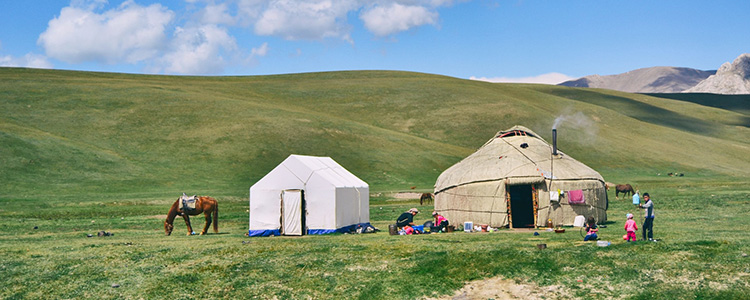
    • There are certain habits in the ger, the yurt.
    • Sleep - Always sleep with your feet facing the door, never toward the altar.
    • Whistling - Whistling in a ger is considered rude.
    • Be aware that fire is sacred to Mongolians. Do not throw garbage into the fire.
    • Elders - Always let elders lead the way and do not sit with your back or feet to the altar.
    • Hospitality - When you are offered food or drink, accept it, even if it is just a little. Use your right hand, with your left hand for support. It is customary to give small gifts to your hosts, such as fruit, candy or alcohol.
    • Holding a cup - Hold a cup underneath, not by the rim.
    • Say no in an indirect way, that is polite.
    • Tsagaan Sar - From late January to mid-February, Mongolians celebrate the New Year. It is the most joyous occasion for the country's nomadic herders because Tsagaan Sar marks the arrival of spring after the long and harsh winter in which hundreds of their animals can freeze to death. Tsagaan Sar has been celebrated for more than 2,000 years. The festival is essentially intertwined with numerous deeply symbolic rituals. The festival is celebrated throughout the country and is still a holiday that Mongolians most look forward to with renewed hope for happiness and prosperity. Around the New Year, families burn candles at the altar, symbolizing Buddhist enlightenment. Mongolians also visit their friends and relatives (at the home of the eldest in the family) on this day and exchange gifts. Many people dress in full Mongolian national costumes.

    What are the habits in the Philippines?

    • Use of 'face' in communication - Briefly raise eyebrows to confirm or to mean yes to a question and also used as a brief greeting (all silent).
    • Indicating direction by pursing lips and turning head in direction, all silent as well.
    • Baon - refers to the monetary allowance or food normally provided by the parent to a child who goes to school.
    • Bayanihan - When a house is broken, the whole community helps fixing the house. You might have seen the pictures of a group of people carrying a hut, when it needs to be transferred. It is a true community spirit. You talk, you help and protect the people around you. It is team effort, only possible when done with a group. It is truly a beautiful thing. 
    • Cockfighting is a popular national sport in big and small arenas all over the country. Goal is to gamble (win money) and eat the roosters who lost the game.
    • Finding your spot - Recently I was back in the Philippines, taking public transportation. When you would like to take your window seat, be reminded you have to climb over other peoples lap. Squeeze in between the seat in front of you and the seat with the passenger on it. Enough space, a little intimate but do-able, it has something about it.
    • Pacquiao - Filipinos adore boxer (and politician) Manny 'Pagman' Pacquiao.
    • Pagmamano - Children take your hand, put it on their forehead, as a way of greeting you. It is an act of respect. The child says mamo po, can I have your hand please? Most of the time, they say God bless (you), when put on their forehead.
    • Pasalubong -In the Philippines it is common when you have been on a trip, that you bring a token of love back to the people who stayed home. It is a filipino tradition of travellers bringing gifts from their destination to people back home. It can be anything, something to eat or to drink is always a welcoming gift, since filipinos love eating! It is actually not about what you bring, it is something that you have brought, so the other person knows you thought about them while away. The first time, I heard bring pasalubong, from multiple people, and didnt know how to act. When you see souvenir stores in the Philippines, it has the sign pasalubong. So now you are prepared.... just bring something back... 
    • Noise and music - Filipinos are crazy about high volumes and karaoke (called videoke) and music from the 70s like The Carpenters. There was one big world hit: Anak by Freddie Aguilar in 1978.
    • Remedio - Is fixing things, even though you dont know how to fix it. The filipinos use remedio. Remedio used to drive me crazy. It is fixing things with what you have, in a creative way, and if it works again... that will be clear in the near future. You have to be flexible to embrace remedio.
    • Squeeze - Squeeze your but, in the jeepney, also when you think it is already full. There will be place, when you squeeze. When you are for example sitting at the window in an airplane and you have two filipinos beside you, you squeeze your body in and out going to the aile. It is not a habit to stand up, when you can squeeze, when used to it, it works perfectly fine.
    • Volume - Pump up the jam, pump up the volume. Filipinos love loud music, loud talking, as long as it is lively. The high amounts of volume makes you feel festive and alive, even when there is not a party.
    • 'Whitening' products such as soap, make-up, deodorant are very popular, to stimulate white skin.

    What are the habits in South Korea?

    • In South Korea, and other places I have seen it in Asia, they brush their teeth, three times a day after a meal. People bring portable toothbrushes and you often see people brushing their teeth in the washroom in their office.
    • Family is everything and the eldest son carries the responsibility of the family.
    • Kimchi is a national dish. People make kimchi at home. In the supermarkets a lot of dark bordeau red buckets can be found, so you don't see the stains of the herbs going to be fermented with the vegetables.
    • I personally love banchan. When you order Korean food it is likely you get a lot of different small bowls, (most of the time vegetarian) side dishes. For me as a dutch person, I can do without the maindish, since banchan is so delicious.

    What are the habits in Taiwan?

    • Politeness - Taiwanese people are very polite and respectful. It is customary to bow when greeting someone and to say “thank you” and “please.”
    • Respectfulness - Taking off shoes when entering a house: In Taiwan, it is customary to take off your shoes before entering someone's house. This is done as a sign of respect and to keep the house clean.
    • Respect for elders is considered vital, as is loyalty toward the family.
    • Leave some food on your plate - It shows appreciation for the amount of food served and is considered polite.
    • Cleanliness - Using toilet paper with the right hand: In Taiwan, toilet paper is used with the right hand, while the left hand is considered unclean.
    • Bubble tea is a Taiwanese invention, same like stinky tofu. That stinks.
    • KTV – Karaoke is a popular waste of time or night.
    • Convenience stores – Open 24/7, with a variety of food, drinks and everyday items available.
    • Gifts – Knives and scissors are not appreciated and will be seen as severing a relationship. Clocks and handkerchiefs are best avoided, that will be connected to death and funerals. Check the label: made in Taiwan is not an interesting gift and the recipient from Taiwan already has (all) things made in Taiwan.

    What are the habits in Thailand?

    • Thai people will talk about architecture, dance, festivals and food when you ask about their culture. 
    • Sanuk is a term to express that everything should have something sanuk. Something which is worth doing. The sense or approach with a little playfulness. Even work can be sanuk, singing while working, cracking jokes in combination with the thai smile. 
    • Saving face is important as is in many Asian countries. The habit is to avoid confrontation, and not to embarrass yourself or others.
    • Social rank plays an important part in society. It goes with obligations, obedience, caring for, respect, sharing of wealth. The "big person or senior" pays the bill when dining or entertaining. The person with the most social rank pays for everyone.

    Did you know that.... 

    Asia is the biggest continent in the world. It is huge, this is the list of most Asian countries (including the Middle East)


    Supporting content:
    Thailand: selection of contributions of WorldSupporters

    Thailand: selection of contributions of WorldSupporters

    Selection of contributions of WorldSupporters

    "Happy family; No worries and luxurious resorts in Thailand!"

    "Happy family; No worries and luxurious resorts in Thailand!"

    A hell of a ride – in total 26 hours by night bus – took me to Bangkok to see my family again! Really great to see Bonnie, Heleen and Nienke again after more than four months traveling in Asia. No worries anymore, all resorts and transportation between the cities was already arranged beforehand. Last ten days relaxing and not thinking that much, only the “day trips” we could decide by ourselves. My role was to play a little bit for “tour guide”. Let’s do it, off to northern Thailand with our happy family!

    First of all, it was time for Bon, Leentje and Nien to get used of the craziness in Bangkok. Especially they needed to get used to the different style of driving, temperature and culture of the Thai people. After five months, I was not shocked anymore, but still enjoying it. On our first night we got a good impression of the Thai culture, by visiting a cultural show about the history and habits of the Thai people. A show with more than fifty participants, impressive to see! Impressive as well, was the Royal Palace of the King. Golden temples everywhere and they were decorated with a lot of colorful paintings and statues. In the late afternoon we went to Ko San Road for a rough Thai Massage.

    Our next destination was Kenchi Buri, famous for the Bridge over the River Kwai. In the past, many  prisoners of the world war two were deported here to build the railway between Thailand and Myanmar. During this project, a lot of workers died because of diseases and exhaustion, including a lot of Dutch people. In the afternoon we had some time for relaxing in a beautiful resort. Ayutthaya, the old kingdom of Thailand, was our next destination. Once, this was a palace, and we saw there old ruins of the big temples. By night train we went to Chiang Mai, a train ride of twelve hours.

    Chiang Mai is an enjoyable city in North Thailand. The city, way smaller than Bangkok has a lot of touristic sights, nightlife and activities. In our first day we went to visit the village of the Black Hmong, a hill tribe living just out of Chiang Mai. Before our visit to the hill tribe we was Wat Phrathat Doi Suthep, one of the famous golden temple around Chiang Mai. One of the best experiences we had the second day in Chiang Mai. In the early morning we went to a elephant sanctuary. After a two hour drive through the jungle we reached the village where they kept the elephants. We could feed the elephants, hug them and a small baby elephant gave us a kiss with his trunk. Finally we went for a swim and we could wash the elephants. All elephants were treated very well and they could enjoy their natural environment. This was a very special experience.

    Famous in Thailand is the street food, so we went to a night market for special Thai dishes. In the beginning my parents were a bit afraid to eat all these “new dishes”, but the food was delicious and well prepared. We ate spring rolls, pad thai and other delicious delicates. In the evening Nien and I visited a boxing game between international and Thai boxers. The skills of the fighters were excellent and we even saw a few K.O.’s. Especially the audience was great to see, everyone was encouraging their favorite fighters.

    Our last three days we spend in Chiang Rai, in the north of Thailand. In two days we saw the white temple Wat Rong Khun and the black house Baan Dam. Temples in a total different order, the white temple was more looking like a citadel, waiting for the white wizzard to walk out of the building. The black house was created by an artist and had only a art purpose. The other day we hired a taxi driver who brought us to the hill tribe village of the Long Necks. All women in this tribe are wearing neck rings, another part of their culture. These rings can have a weight of five kilograms and every year the number of rings increases. We continued to the golden triangle (borders of Myanmar, Laos and Thailand) and the opium museum. Finally we saw a tea plantation in Mae Salong, located in the mountains.

    Happy new year, Thai new year was celebrated between 13 and 15 April. This celebration is called Songkran and is the start of the rainy season. Everyone in the streets has water guns super soakers and buckets with ice water. During these three days, nobody keeps their clothes dry. A huge “splash battle” on the streets, everywhere in town. Pick-up trucks with bunches of people are driving around and throwing water on the audience (and other way around). People are partying everywhere and there is a lot of music around and people are drinking beers and whiskey on the streets. Why spoiling water? Rainy season is coming.

    On the 13th of April we flew back to Amsterdam Schiphol. Five months ago I started my journey in Myanmar and continued to 7 other countries including Laos, Philippines, Vietnam, Indonesia, Singapore, Cambodia and Thailand. Today, at Songkran festival, I have my #20 flight back to Amsterdam! It was a real adventure and I am thankful for all the amazing new friends I have met during my journey, you made this experience unforgettable...


    "The Dutch" Working & Living Abroad: Roos Tieges & Ingrid van der Straaten - Thailand

    "The Dutch" Working & Living Abroad: Roos Tieges & Ingrid van der Straaten - Thailand

    Image

    Who?

    • Roos Tieges
    • Ingrid van der Straaten

    Where?

    • Thailand

    Which Initiative?

    • TCDF, Thai Child Development Foundation
    • Eco-Logic, the 'Resort for Charity'

    What?

    • The Thai Child Development Foundation (TCDF) supports local children in their development by making sure that customized medical care and education is also available to underprivileged children and children with disabilities or learning disorders.
    • Local Thai team members provide social support programs (medical care, education) together with daily life caregivers to underpriviledged children in their own village/community
    • Other projects where TCDF team and local+international volunteers work hands-on: emergenct funds, physiotherapy, nutrition programs, scholarships, occupational training center and perma culture farm, community learning center

    Something special?

    • At TCDF they believe that the social outreach work can only be done well by working with local people who can develop a long-term bond of trust with the children and their caregivers through constant communication.
    • TCDF take care of children in their own community, without taking them out of their homes and never longer than needed
    • International and Thai volunteers open up the worlds of the children and the members of the forest community by sharing their (often unique!) skills and knowledge within the community learning center, yoga center and/ or on the organic farm.
    • TCDF try to limit damage to the environment. They are strict in handling garbage, reusing garbage, and recycling.
    • Eco-Logic, Resort for Charity with tourist accommodation, workshops, and tour packages, is on the same property of the Foundation. This sister company of TCDF is a Thai for profit company and is TCDF's main sponsor.

    And last but not least...a little insight in 'Why'

    TCDF is founded by a charitable Thai/Dutch family and has supported children in need on a direct and day to day base in Thailand since 2004. Ingrid van der Straaten has been TCDF’s full time volunteer and ambassador since the very beginning when she, and Rosalie decided to make a difference and dedicate their lives to this initiative! The other TCDF's directing founder, Rosalie Tieges, lives with her Thai family within walking distance of the Foundation; other Dutch board members live in Holland.The TCDF Community is a global network of people that believe in acting local and contributing to make a difference. The Thai board members are all people from the village including the village headman and active parents of children in the social programs.

    "The Dutch" Working & Living Abroad: Frans Betgem - Thailand

    "The Dutch" Working & Living Abroad: Frans Betgem - Thailand

    Image

    Who?

    • Frans Betgem

    Where?

    • Thailand

    Which Initiative?

    • Green Trails

    What?

    • Green Trails: 1-2-3-+4 day(s) trekking tours, trails and exploration tours with an emphasis on and respect for local culture
    • Chiang Mai a la Carte: "umbrella" website about Chiang Mai with a focus on festivals, traditions, architecture, culture and meaningful encounters
    • Tong Bai Elephant Tour: elephant friendly day tour about the issue of the involvement of captive elephants in tourism
    • Chiang Mai on Three Wheels: Chiang Mai tours by samlor (bicycle taxi)

    Something special?

    • Chiang Mai on Three Wheels, a social tourism enterprise, aims to preserve the samlor, a Chiang Mai heritage, as a means of transportation in the future. With these samlor tours they try to improve the livelihood of the taxi drivers by offering them jobs and (extra) education. In the old days, before the age of the automobile, there were hundreds of samlors in Chiang Mai. Nowadays there are less than 70.
    • Family Tours: these tours include trekking but also interactive and educational elements, with several trekking itineraries in the Chiang Dao area. This area is very suitable for family tours; there are lots of villages and lots of children.

    And last but not least...a little insight in 'Why'

    • Frans Betgem is a Dutch national who has been living in Chiang Mai for more than 20 years. Frans' travels brought him to Southeast Asia in 1987. In 1990 he started working for Baobab Travel as a tourleader in Thailand. Frans worked for this company in Thailand, Vietnam, Indonesia, Philippines and Australia from 1990 until 1998. In 2012 he started his own business in Chiang Mai, Tiger Trail, nowadays re-branded as Green Trails. Green Trails commit to offer the best and most innovative cultural, outdoor and trekking tours in North Thailand. Green Trails believes in sustainable and responsible travel and always tries to create meaningful experiences, both for visitors and for the host communities. 


    Recipe: Pad See Ew - Thai noodle dish

    Recipe: Pad See Ew - Thai noodle dish

    Image

    In Thailand you can find the popular Pad Thai on every street corner. Pad See Ew is a bit less well-known, but evenly delicious. It is a simple noodle dish, recognisable by the wide and thin rice noodles that are being used. If you can't find the wide noodles, you can also use another type of noodles.

    Recipe:

    • Heat oil in a frying pan/wok and fry the garlic over low heat.
    • Add the chicken and stir for about one minute
    • Then add the kale, carrot, noodles, sugar and sauces and mix. Stir for about 2 minutes
    • Make room on one side of the wok and crack an egg on the empty side.
    • Sramble the egg and mix with the noodles. Then turn up the heat and fry for about 30 seconds.
    • To top off the noodles. Sprinkle a bit of ground pepper, chili flakes or lime on top. 
    • Enjoy!

    Ready In: 30 min.

    Ingredients:

    • 200 g wide rice noodle
    • 1 egg
    • 2 pieces of chopped garlic
    • 1 stalks kale
    • 4-5 pieces of sliced carrots
    • 50 g chicken (or tofu)
    • 1 tsp sugar
    • 2 tsp fish sauce
    • 2 tsp dark soy sauce
    • 3 tsp oyster sauce
    Recipe: Pad Thai

    Recipe: Pad Thai

    making pad thai

    1. Heat the oil in the wok, add garlic, shallot, chicken, tofu.

    2. Add radish, follow with dried shrimp. Stir to combine.

    3. Put egg down let them cook then scramble it and mix it well with other ingredient.

    4. Pull everything up to one side of the wok, and then pour chicken stalk or water.

    5. Put rice noodle then stir well then add sauce to combine until it cook.

    6. Finally, add bean sprouts and chive down mix it well. Finish and ready to serve.


    Serve with:

    - Roasted peanuts
    - Chili powder
    - Lime
    - Sugar

    Succes!!

    Ready In: 30 min.

    Ingredients:

    • 70 g. rice noodle
    • 50 g. chicken breast sliced
    • 3 tbsp firm tofu (1cm thick dice)
    • 1 egg
    • 3-5 clove. garlic
    • 0.5 tbsp. shallot
    • 2 tbsp. dried shrimp
    • 1-2 stalks. garlic shave
    • 0.5 tbsp. minced pickle radish
    • 1 cup bean sprout
    • 1 cup chicken stalk or water
    • 1.5 tbsp. oyster sauce
    • 0.5 tbsp. fish sauce
    • 0.5 tbsp. palm sugar
    • 1 tbsp. tamarind sauce
    • 1 tbsp. oil

    Image ACTIVITIES

    Check courses, jobs, projects, recipes, suggestions and tips related to: 'Thailand'

    ACTIVITIES
    Image

    Een ieder die in Thailand is geweest is hoogst waarschijnlijk verliefd geworden op de Thaise keuken. Of heeft op zijn minst genoten van die overheerlijk Pad Thai of Stir Fried Chicken. Toen ik in Thailand kwam wist ik al vrij snel: Ik wil hier een kookcursus volgen, dit wil ik ze thuis ook laten pro...

    Image
    • Bangkok heeft twee luchthavens: Suvarnabhumi Airport (BBK) en Don Muang Airport (DMK).
    • Alle intercontinentale vluchten landen op Suvarnabhumi Airport, maar voor binnenlandse en regionale vluchten wordt vaak gebruik gemaakt van het oude Don Muang Airport. 
    • Hoewel beide...
    CHECK MORE ACTIVITIES

    Select any filter and click on Apply to see results

    Activities abroad: home bundle

    Main content and contributions for activities abroad

    ,,,accommodations, adventure activities, courses, internships, jobs and volunteer projects

    ...to help another, travel with care, work together , learn

    ........Read more
    Activities abroad: home page

    Activities abroad: home page

    From language courses to gap year abroad, from work experience to volunteering abroad, from paid work to internship abroad, from mountaineering to diving and from backpacking to travel around the world

      What social activities can you do abroad?

      • Opportunities are found in the areas of helping, learning or studying. You can get involved to volunteer in a social project at a school in Africa, Asia or Latin America. You can get involved in nature, in a project with animals or cleaning the sea or beaches. Those who want to learn more can choose for example a language course in Latin America, Spain or South Africa.

      What work related activities can you do abroad?

      • If you want to gain work experience, and/or also earn money, go and work abroad. You can combine backpacking in Australia with temporary work. You can work on campsites in Europe or bush camps in Africa. You can pretty much go all over the world to work in the hospitality industry, hotels and hostels, in the healthcare sector or for example at a diving school.

      What sports activities to do abroad?

      • Have you ever thought of mountain biking, rafting (going down a wild river on a raft or rubber dinghy, climbing or canoeing), survival (which involves building rafts, climbing or canoeing), abseiling (descending a rock face while secured to ropes), zip-lining (whizzing down a cable), canyoning (starting at the top of a river and then climbing, swimming, diving down the bed) or caving (scrambling, wriggling and crawling through caves and crevices)?
      • Maybe you feel more comfortable on a bodyboard (on a half-wave surfboard, you surf the high waves lying down-with flippers), on a hang glider or while paragliding (with a parachute you float down a mountain or dune), hydrospeeding (on a bodyboard with flippers and a wetsuit on you go down a wild river via rapids) or Tiefschneeskiing (racing down through powder snow)?

      Check the pages below for more activities and inspiration and where to go and how to arrange it

        Image STORIES

        Check blogs, experiences and information related to: 'Thailand'

        STORIES
        Image

        De Thai zijn erg vriendelijk; het land wordt dan ook vaak ‘het land van de glimlach’ genoemd. Hoewel de Thaise cultuur op het eerste gezicht misschien niet zo lijkt te verschillen van de westerse cultuur, is deze wezenlijk anders. Bepaald gedrag dat bijvoorbeeld in Nederland als ‘n...

        Image

        Wil je langer dan zes maanden (maar korter dan twee jaar) in Thailand verblijven en niet verplicht om de paar maanden het land uit hoeven te reizen? Dan biedt het Thai Education Visa (Non-Immigrant ED Visa) mogelijkheden. Dit visum is bedoelt voor mensen die een stage, opleiding of trainingsprogramm...

        Image

        Je hebt besloten om naar Bangkok te verhuizen. Een van de eerste (en meteen ook één van de belangrijkste) punten op je to-do list is waarschijnlijk het vinden van een woning. In een stad die qua oppervlakte zeven keer zo groot is als Amsterdam, en is opgedeeld in vijftig districten, ka...

        CHECK MORE STORIES

        Select any filter and click on Apply to see results

        Countries & Destinations: home bundle

        Bundled content, suggestions, stories and tips about the countries and destinations in the world

        ...to help another, travel with care, work together , learn to share and inspire........Read more

        Africa: country bundles

        Africa: country bundles

        Access: 
        Public
        Asia: country bundles

        Asia: country bundles

        Country bundles of Asian countries

        Access: 
        Public
        Europe: country bundles

        Europe: country bundles

        Country bundles of European countries

        Access: 
        Public
        The Caribbean: country bundles

        Image ORGANIZATIONS

        Check sectors and organizations related to: 'Thailand'

        ORGANIZATIONS
        ECPAT

        ECPAT is a worldwide network active in almost 100 countries, dedicated to end sexual exploitation of children.

        Ajarn

        This American organization offers paid work opportunities in the field of teaching English in Thailand.

        Sapph School

        Sapphawitthaykhom School is een openbare high school, in Mae Sot in Thailand, provincie Tak.

        SEE TEFL course Thailand

        SEE TEFL offers onsite TEFL courses in Chiang Mai, Thailand, available on level 3 and level 5. The 120 hour level 3 TEFL course includes a set of observed teaching practices at local schools and a Thai language instruction and a comprehensive Thai cultural awareness training. During your SEE TE...

        CHECK MORE ORGANIZATIONS

        Select any filter and click on Apply to see results

        Organizations & Services: home bundle

        Bundled content, suggestions, stories and tips about organizations and their products and services

        ...to help another, travel with care, work together, learn to share and inspire with

        ........Read more
        Organizations: home page
        Organizations: for administrative, tax and legal work and consulting
        Organizations: for agriculture, grape picking, farming and vineyards
        Organizations: for animal protection, animal care and working with wildlife abroad
        Organizations: for au pairs, youth work and child care abroad
        Organizations: for bush camping and working at a campsite abroad
        Organizations: for catering, hospitality and entertainment abroad
        Organizations: for civil society and social work abroad
        Organizations: for corporate business services
        Organizations: for customer services abroad and help desks
        Organizations: for diving, snorkeling and water sports abroad
        Organizations: for education and schools abroad
        Organizations: for expatriate insurances, travel insurances, and emergency call centers
        Organizations: for gap year activities abroad and sabbaticals
        Organizations: for internship placement abroad
        Organizations: for insurances and finance abroad
        Organizations: for IT, engineering and construction
        Organizations: for language travel and language teaching abroad
        Organizations: for marketing, communication and PR
        Organizations: for mediation in au pairs, childcare and elderly care in the Netherlands
        Organizations: for moving, international relocation and transport abroad
        Organizations: for nature conservation, environmental protection and working in nature abroad
        Organizations: for nonprofit projects, development work and international cooperation
        Organizations: for online work as digital nomad, freelancer, or independent entrepreneur from abroad
        Organizations: for outdoor activities and sports
        Organizations: for providing accommodation and hospitality work in hotels, guesthouses, ecolodges and hostels abroad
        Organizations: for providing healthcare and working in medical care abroad
        Organizations: for psychological assistance and mental health care abroad
        Organizations: for real estate, brokerage abroad and property rental abroad
        Organizations: for research and scientific work abroad
        Organizations: for student support and student associations
        Organizations: for tour guidance and adventure tours abroad
        Organizations: for tourism and organized travel and leisure work abroad
        Organizations: for voluntary work mediation and project placement abroad
        Organizations: for yacht and shipping crew and working on a cruise ship abroad

        Image SUMMARIES

        Check summaries and study assistance related to: 'Thailand'

        CHECK MORE SUMMARIES

        Select any filter and click on Apply to see results

        Image

        SPOTLIGHT & FAVORITES

        SPOTLIGHT
        House for spirits

        Im Felipe, from Chile, here i will explain my first experience in Asia,specifically in Thailand, and I really hope to help and encourage people to keep travelling and living amazing life experiences & unforgettables. March 2018  (€1 = 37,20 Baht) My flight from Köln (Cologne, Germ...

        Image

        Je hebt besloten om naar Bangkok te verhuizen. Een van de eerste (en meteen ook één van de belangrijkste) punten op je to-do list is waarschijnlijk het vinden van een woning. In een stad die qua oppervlakte zeven keer zo groot is als Amsterdam, en is opgedeeld in vijftig districten, ka...

        FAVORITES
        Image

        Wil je langer dan zes maanden (maar korter dan twee jaar) in Thailand verblijven en niet verplicht om de paar maanden het land uit hoeven te reizen? Dan biedt het Thai Education Visa (Non-Immigrant ED Visa) mogelijkheden. Dit visum is bedoelt voor mensen die een stage, opleiding of trainingsprogramm...

        Image
        • Bangkok heeft twee luchthavens: Suvarnabhumi Airport (BBK) en Don Muang Airport (DMK).
        • Alle intercontinentale vluchten landen op Suvarnabhumi Airport, maar voor binnenlandse en regionale vluchten wordt vaak gebruik gemaakt van het oude Don Muang Airport. 
        • Hoewel beide...
        Image

        Een ieder die in Thailand is geweest is hoogst waarschijnlijk verliefd geworden op de Thaise keuken. Of heeft op zijn minst genoten van die overheerlijk Pad Thai of Stir Fried Chicken. Toen ik in Thailand kwam wist ik al vrij snel: Ik wil hier een kookcursus volgen, dit wil ik ze thuis ook laten pro...

        Image

        Thailand is al jaren een populaire vakantiebestemming. Maar wat zijn de aandachtspunten als je besluit om voor langere tijd in 'the land of smiles' te gaan wonen en werken? Daarover lees je binnen deze omgeving meer! 

        Safety, insurances and packing list for Thailand

        How does healthcare work in Thailand, and what travel insurance, health insurance or expat insurance do you need?

        How does healthcare work in Thailand, and what travel insurance, health insurance or expat insurance do you need?

        How does the healthcare system work in Thailand?

        What is the quality of healthcare in Thailand?

        • Thailand generally provides good quality healthcare. There are many hospitals, of which about 80% are public hospitals.
        • There are two types of pharmacies (indicated by the green cross logo); type 1 and type 2. Type 1 are the more extensive pharmacies with a license where you can buy prescribed and over-the-counter medicines. Usually there is also a medical expert on staff. These pharmacies are usually found at hospitals and health centers. Type 2 pharmacies only sell over-the-counter medicines and usually cannot provide advice.
        • If you do not work in Thailand, you pay for your own insurance. You can opt for private coverage with the choice between private and public hospitals.
        • Strict rules apply to insurance for foreigners, if you stay in Thailand for a longer period and are going to apply for a long-term visa, health insurance is mandatory. Specific rules apply here with regard to cost coverage from the insurance. Check this well in advance.
        • You must show the insurance coverage and it must be legible (in English) when applying for your visa. When extending your visa, you are even required to have a Thai certified local insurance, with all the paperwork that goes with it. Arrange this on time and check this well in advance.
        • If you want to be helped, at the hospital (GP), dentist, midwife, maternity care or consulate, you often have to pay the bills yourself before (or after) the consultation.
        • In contrast to physical health care, mental health care is lagging behind in Thailand. There have been leaps and bounds, but there is still a huge shortage of mental health care services.
        • Traditional Thai medication is available everywhere and is very popular among locals. Most Thai hospitals and health centres also offer forms of traditional health care. It is fully regulated and used as complementary care.
        • In case of medical emergencies, call 1669. As a foreigner, you can also call 1155 for advice in case of emergencies.
        • Always take your passport with you when visiting a healthcare institution. This is mandatory in Thailand.

        How does the public healthcare system work in Thailand?

        • The Department of Medical Services of the Ministry of Public Health (MOPH) funds public health services and government hospitals. Apart from the long waiting times, you will find good medical services here.
        • The first line of care is the health centres. The MOPH runs almost 10,000 health centres, where you will find nurses, doctors, general practitioners, dentists and pharmacists.
        • Through your work, you are covered for your social security and you can use the public healthcare institutions. Please note that your family is not always covered. In that case, make sure you have private health insurance for them.
        • The cost of most medicines is also covered by the public insurance. Private insurance can help you cover other costs if you regularly need expensive medicines.

        How does the private healthcare system work in Thailand?

        • Private healthcare is of very high quality and also attracts many foreigners every year. Thailand is a hotspot for medical tourism.
        • There are many more private clinics than public health centres.
        • The best healthcare can be found in Bangkok. In higher areas, private healthcare is not always of the quality that meets the expectations of Westerners.
        • The advantage of private healthcare is shorter waiting times, but not necessarily more space in hospital beds.
        • Always check with your international private insurance company which private institutions are covered before you go somewhere.

        How is the general practitioner arranged in Thailand?

        • Visits to a general practitioner are not as common as in some western countries. But you can find general practitioners in private or family clinics.
        • The general practitioners that are there als often have offices in hospitals and work with consultation hours, but it is more common to go directly to a specialist in the hospital if something is wrong with your health. The specialists also have walk-in consultation hours and often also have an office in the hospital.

        How is the dentist arranged in Thailand?

        • There are different types of dentists to be found in private and public clinics, hospitals and health centres.
        • About half of the dentists work in the private sector.
        • The public health insurance covers basic dental care up to a certain amount per year. With private insurance you can increase your coverage and ensure that you are fully covered for costs. In general, there are good dentists available, who follow international standards, and for a reasonable price. And if you are unsure about a particular procedure, ask for a second opinion or a price indication from another provider.
        • Most expats choose more expensive, private clinics because of the modern facilities and English-speaking dentists.

        How is pregnancy care arranged in Thailand?

        • Pregnant women have access to good prenatal care in both public and private hospitals. Public hospitals are the cheapest. Prenatal care is free for those insured and a standard birth usually costs around 800 euros and a caesarean section double that. The care is generally good, but waiting times can be long and you usually cannot choose your doctor. Private hospitals are even more personal.
        • Every private hospital offers “Childbirth Delivery Packages” which, depending on the type of birth, includes a number of nights in the hospital. These packages cover routine costs, but not the costs of possible complications.
        • In public hospitals you also have Premium Clinics, which offer more comfort and better care.
        • English-speaking doctors are mainly available in private hospitals.
        • Most expats choose private hospitals. Make sure you check with your insurance whether the hospital of your choice is covered by them.
        • Breastfeeding in public is accepted, but most women cover themselves with a cloth.

        How safe or unsafe is a trip or stay in Thailand?

        What should you pay attention to in terms of safety in Thailand?

        • Thailand is generally safe, but pickpockets and petty theft occur in busy tourist areas.
        • Avoid demonstrations and political gatherings, especially in Bangkok.
        • In rural areas and national parks you can encounter poisonous snakes, scorpions and other animals.
        • Thailand has a rainy season (May-October) with a risk of flooding and landslides.
        • Tropical storms also occur, especially in the south.
        • Drug use and possession is strictly prohibited in Thailand, punishable by stiff prison sentences. Note that many medicines are also considered drugs (prescription drugs). You are required to carry a medicine passport or a statement from a doctor for your use of these drugs, otherwise you can get into trouble with them.

        What should you look out for in terms of diseases in Thailand?

        • There are several mosquito-borne diseases that you can contract in Thailand. It is therefore wise to protect yourself well against mosquitoes.
        • In large cities such as Bangkok and Chiang Mai (during the “burn season”) air pollution can be a major problem, especially for people with respiratory problems.
        • Tap water is not safe to drink.
        • Street food is popular and the quality is improving, but be careful about the hygiene of what you eat. It may also be wise to avoid undercooked and raw foods such as raw seafood.

        What should you pay attention to when it comes to traffic in Thailand?

        • In Thailand, people drive on the left side of the road.
        • Traffic in Thailand is chaotic, especially in Bangkok. Many local drivers ignore traffic rules.
        • Scooters and motorbikes are popular means of transport, but riding them can be dangerous. Many accidents involving tourists occur every year.
        • Always wear a helmet when riding a scooter.
        • Insurance often does not cover accidents if you do not have a valid motorcycle license.
        • Tuk-tuks, songthaews (shared taxis) and motorbike taxis are convenient, but agree on a price before you get in.
        • The BTS Skytrain in Bangkok is reliable and fast.

        What work and travel insurance policies are suitable for short and long stays in Thailand?

        • Is the trip to and your return sufficiently covered? Are you sufficiently covered before, during and after your activities? Which insurance best suits your trip and your activity? Read more about insurances for abroad on JoHoinsurances.org.

        What emigration and expat insurance can you take out for Thailand if you are going to live there for a while?

        • Expats are required to have health insurance, especially if they work in Thailand. Thai employers are often responsible for offering basic insurance, but if you do not work for a Thai employer, you must take out private insurance yourself.
        • Make sure your insurance covers medical evacuation as well as coverage in neighboring countries. Read more about insurances for abroad on Expatinsurances.org.
        Packing list for Thailand, travel insurance for Thailand, and taking your belongings

        Packing list for Thailand, travel insurance for Thailand, and taking your belongings

        Packing list for Thailand, travel insurance for Thailand, and taking your belongings

        To take or not to take to Thailand, leave at home or arrange locally?
        Sufficiently insured or not for your activities in Thailand?
        Sufficiently insured or not for your trip to Thailand?


        What to bring to Thailand: highlighted

        Highlighted items:
        • Documents and money: passport that is valid for long enough (>6 months), an extra copy of your passport is also useful, cash for a week.
        • Packing and protection: if you go during the rainy season, don't forget a waterproof cover for your backpack or bag.
        • Insects and animals: a set of anti-mosquito repellents (preferably with DEET, see also DEET anti-mosquito repellent).
        • Clothing and shoes: clothing for both heat and humidity (see also tropical clothing and clothing for warm weather).
        • Lying and sleeping: mosquito net, if it is not already present in your accommodation.
        • Medicines and travel pharmacy: medical kit (self-assembled or not).
        • Outdoor and conveniences: sunglasses.
        • Technology and equipment: don't forget to bring a world plug (see also world plug or travel plug).
        • Safety and theft: money belt.
        • Care and hygiene: sunscreen with a high protection factor & aftersun.
        What other options are there to pack:
        • A snorkel set, sometimes you can also rent one on site.
        • Reusable water bottle with filter.
        • Water shoes given the coral and stones in the water at the various locations.
        • UV protective shirt for snorkeling.
        • Hat or cap against the sun and heat.
        • International driving license, this is mandatory if you want to rent a car or scooter.

        What knowledge is useful when you go to Thailand?

        • Knowledge about the customs and local habits, especially when you visit temples.
        • Knowledge about the local regulations, especially if you smoke a joint every now and then.

        Are there mosquitoes in Thailand?

        • In Thailand, mosquitoes can be found all year round. Although you generally have the most trouble with them in the rainy season (June-October), they can never be completely avoided. Some mosquitoes in Thailand still carry malaria (in a limited number of areas), the other mosquitoes stick to dengue, and partly other mosquito-borne diseases.
        • More about protection against mosquitoes and insects or malaria.

        Are there sand flies in Thailand?

        • There are sand flies on some beaches (or in certain seasons), so it is always good to check with the place where you are sleeping what the situation is.
        • What are the favorite islands of sand flies in Thailand: Koh Chang, Koh Mak and Koh Kood.
        • Where else do you encounter a lot of sand flies? East Thailand (Koh Kood, Koh Mak, Koh Chang) Central Thailand (Koh Phayam and Ao Yai).
        • Which islands are not overcrowded with sand flies? Western south coast (Phuket, Koh Lanta, Koh Phi Phi). Eastern south coast (Koh Samui, Koh Phangan, Koh Tao).
        • Your set of mosquito repellents with DEET can provide a solution! More about sand flies and sand fleas.

        Can you buy DEET or other mosquito repellents in Thailand?

        • In Thailand, you can find both natural mosquito sprays and lotions as well as a variant with DEET. In addition, there is a wide choice of brands (both local and international) and stores where you can buy mosquito repellents.

        Where to buy DEET in Thailand

        • The 7-Eleven in Thailand is open 24/7 and sells just about everything you need, including mosquito repellents.
        • Other (large) supermarkets, such as Family Mart, Tesco Lotus and Big C, also sell products with different percentages of DEET.
        • In addition to supermarkets, many drugstores sell mosquito repellents. Watsons, a drugstore with a large number of branches in Thailand, sells various brands of mosquito sprays and lotions with DEET. Brands that sell mosquito repellents with DEET in Thailand include Soffell (including a spray and lotion with t 13% DEET) OFF, Sketolene and Merci.
        • Sketolene also sells a ‘jungle’ variant with a percentage of 95% DEET.
        • If you are going to a remote area, make sure you have purchased enough DEET in advance.

        Where can you get your food and drinks in Thailand?

        • Supermarkets have large assortments with everything you need.
        • For snacks or last-minute purchases, you can go to the many convenience stores.
        • Street food is delicious and available in many places!
        • Markets are popular for trying all kinds of unique dishes.
        • Of course, you also have local and international restaurants in all shapes and sizes.

        Can you buy a joint or weed in Thailand, or take it with you to Thailand?

        • It is forbidden to take weed with you to Thailand. Make sure you do not carry any traces with you at all. No matter how full the prisons are, there always seems to be room for a tourist with a joint.
        • Weed is sold openly in Thailand. Smoking marijuana in public remains tricky.
        • Traveling around (and possessing) cocaine, heroin, ecstasy, LSD, opium, amphetamines, benzodiazepines, ketamine or, for example, magic mushrooms all fall under the strict Thai law.
        • E-cigarettes and vapes are also prohibited.
        • The rules have been adjusted in 2024. Cannabis is supposed to be 'legalized', but the rules are now almost even vaguer than before. In addition, they can be changed at any time without warning.
        • The fines and prison sentences are a lot less vague, by the way.
        Supporting Content:
        Thailand: selectie van blogs en bijdragen van WorldSupporters - Bundel

        Thailand: selectie van blogs en bijdragen van WorldSupporters - Bundel

        Selectie van blogs en bijdragen van WorldSupporters over Thailand

        10 aandachtspunten binnen de Thaise cultuur

        10 aandachtspunten binnen de Thaise cultuur

        Image

        De Thai zijn erg vriendelijk; het land wordt dan ook vaak ‘het land van de glimlach’ genoemd. Hoewel de Thaise cultuur op het eerste gezicht misschien niet zo lijkt te verschillen van de westerse cultuur, is deze wezenlijk anders. Bepaald gedrag dat bijvoorbeeld in Nederland als ‘normaal’ wordt gezien, kan in Thailand juist ongepast of onbeleefd zijn. Je zal het niet snel zien wanneer een Thai zich beledigd of ongemakkelijk voelt, maar met onderstaande tips kun je dit in ieder geval proberen te voorkomen.

        1. Toon geen affectie in het openbaar

        • Het is in Thailand niet gebruikelijk om affectie te tonen in het openbaar. Je zal Thaise geliefden niet zien zoenen of knuffelen. Ook hand in hand lopen is iets wat je vrijwel niet ziet.
        • Wanneer mensen elkaar begroeten raken ze elkaar niet aan. (Drie) kussen, een knuffel of een hand geven is dus niet nodig. In plaats daarvan begroeten mensen elkaar met de wai. Dit is een traditionele Thaise groet waarbij je de handen tegen elkaar legt en tegelijkertijd een lichte buiging maakt met je hoofd. De wai is ook een teken van respect; hoe hoger je de handen plaatst, hoe meer respect je toont voor de persoon die je begroet.

        2. Wijs niet

        • In Nederland zijn we gewend om te wijzen; we doen het de hele dag door en vaak onbewust. In Thailand wijzen mensen niet. Dit wordt namelijk als onbeleefd beschouwd. Wil je iets duidelijk maken en weet je niet hoe zonder te wijzen? Gebaar dan naar hetgeen dat je wilt laten zien door alle vier de vingers uitgestrekt te houden en de duim plat tegen de handpalm te plaatsen.

        3. Draag gepaste kleding

        • Thai dragen over het algemeen nette kleding en besteden aandacht aan hun uiterlijk. In toeristische gebieden en grote steden als Bangkok zijn Thai gewend dat buitenlanders (en soms ook Thai zelf) korte rokjes of broeken dragen en tanktops. In de meeste andere gebieden is dit echter minder gebruikelijk en wordt dit, vooral bij vrouwen, niet gewaardeerd. Draag daarom kleding die de knieën en schouders bedekt, vooral als je tempels of koninklijke gebouwen bezoekt. Je wordt hier namelijk geweigerd als je niet voldoet aan de kledingvoorschriften.

        4. Word niet boos

        • Confrontaties en ruzies worden in de Thaise cultuur als onbeschoft gezien en daarom over het algemeen vermeden. Als dingen niet gaan zoals je hoopt of verwacht, probeer dan vooral rustig te blijven en je stem niet te verheffen. Je bereikt hier namelijk weinig mee in Thailand en daarnaast breng je de ander in een vervelende positie. Zo is gezichtsverlies een van de ergste dingen die een Thai kan overkomen. In plaats van ruzie zal er doorgaans dan ook naar een compromis gezocht worden.

        5. Doe je schoenen uit

        • De voeten worden gezien als het laagste een vieste lichaamsdeel in Thailand. Logischerwijs worden daarom ook de schoenen die je draagt als vies beschouwd. Wanneer je bij iemand thuiskomt, of een tempel bezoekt, wordt verwacht dat je je schoenen uitdoet. In supermarkten, winkels en shopping malls kun je je schoenen overigens gewoon aanhouden.

        6. Houd je voeten op de grond

        • Gezien je voeten als vies worden gezien in Thailand, wordt het niet gewaardeerd als je je voeten op een stoel of tafel plaatst. Als je op de grond zit, probeer je voeten dan onder je benen of aan de zijkant van je lichaam te plaatsen en voorkom dat anderen de onderkant van je voeten zien. Als je je in een tempel bevindt, wijs dan nooit met je voeten naar een Boeddhabeeld. Alle Boeddhabeelden zijn namelijk heilig in Thailand. Stap daarnaast niet over de voeten of benen van andere mensen, maar loop er omheen. En nog een laatste aandachtspuntje voor je voeten: wijs of schop niet met je voeten. Dit wordt als erg onbeleefd gezien.

        7. Raak niemands hoofd aan

        • In tegenstelling tot de voeten, wordt het hoofd in Thailand als het hoogste en meest belangrijke lichaamsdeel beschouwd. Thai waarderen het daarom niet als je hun hoofd of haar aanraakt; dit geldt ook voor kinderen.

        8. Toon respect voor ouderen en monniken

        • Hiërarchie speelt een belangrijke rol binnen de Thaise cultuur. Zo hebben Thai onder andere veel respect voor ouderen en monniken. Hoe kun bijvoorbeeld respect tonen naar ouderen? Laat ouderen voorgaan, onderbreek ze niet wanneer ze praten en groet ouderen met een wai.
        • Monniken kun je ook begroeten met de wai. Plaats hierbij je handpalmen ter hoogte van je neus wanneer je een lichte buiging maakt. Deze wai gebruik je in principe alleen voor monniken; je toont er veel respect mee. Voor vrouwen is het verder belangrijk om te weten dat zij een monnik nooit aan mogen raken. Als je op straat een monnik passeert maak je als vrouw plaats om te voorkomen dat er per ongeluk fysiek contact kan plaatsvinden.

        9. Toon respect voor het koningshuis

        • Dit is misschien wel een van de belangrijkste aandachtspunten als je in Thailand bent. De koninklijke familie wordt vereerd door de Thaise bevolking. Kritiek leveren op het koningshuis is niet alleen beledigend naar Thai toe, maar kan zelfs leiden tot een gevangenisstraf. Laat je dus niet negatief uit over het koningshuis en behandel voorwerpen waar de koning op staat afgebeeld, zoals bankbiljetten en munten, met respect. Ga bijvoorbeeld nooit met je voet op een bankbiljet of munt staan.

        10. Sta stil voor het volkslied

        • Het volkslied is erg belangrijk in Thailand. Dagelijks wordt om 08.00 uur ’s ochtends en 18.00 uur ’s avonds het volkslied ten gehore gebracht in onder andere publieke parken, metrostations en op scholen. Als je het volkslied hoort, dien je stil te staan en te stoppen waar je mee bezig bent. Het volkslied duurt minder dan een minuut; een kleine moeite dus om even stil te staan die zeker gewaardeerd wordt.


        Maar onthoud vooral...

        Bovenstaande aandachtspunten zijn bedoeld als suggesties om rekening mee te houden als je in Thailand bent. Wat vooral belangrijk is om te onthouden is dat Thai het enorm waarderen als je je probeert aan te passen aan de lokale cultuur en gebruiken. Wees dus niet bang om fouten te maken. En vergeet vooral niet te lachen!

        Hoe je binnen twee weken een woning in Bangkok vindt

        Hoe je binnen twee weken een woning in Bangkok vindt

        Image

        Je hebt besloten om naar Bangkok te verhuizen. Een van de eerste (en meteen ook één van de belangrijkste) punten op je to-do list is waarschijnlijk het vinden van een woning. In een stad die qua oppervlakte zeven keer zo groot is als Amsterdam, en is opgedeeld in vijftig districten, kan het op het eerste gezicht een uitdaging lijken om een geschikte woning te vinden. Waar begin je met zoeken en waar moet je op letten tijdens je zoektocht? 

        1. Kies een wijk
        Gezien de grootte van Bangkok, is het van belang om eerst te bepalen in welke wijk je wilt gaan wonen. Wil je in het oude centrum van de stad wonen, dichtbij populaire bezienswaardigheden en de toeristische Khao San Road (Bang Lamphu, Phra Nakhon District), of woon je liever in een opkomende, hippe buurt waar genoeg koffietentjes en restaurants te vinden zijn (Ari, Chatuchak District)? De huurprijzen kunnen tussen wijken nogal verschillen; zo zijn de huurprijzen in centraal gelegen wijken als Sukhumvit (Watthana District) en Silom (Bang Rak District) over het algemeen hoog. Als je wat verder uit het centrum gaat wonen, kun je vaak voor minder geld een woning vinden.

        2. Oriënteer online
        Er zijn verschillende websites waarop je je kunt oriënteren op het aanbod aan woningen in Bangkok. Een handige site is bijvoorbeeld hipflat.com, waar je veel verschillende huur- en koopopties kunt vinden. Door online te kijken naar woningen krijg je een idee van de prijzen, het particuliere aanbod en het aanbod via makelaars, en de faciliteiten die je kunt verwachten bij verschillende type woningen. Gebruik websites echter vooral om je te oriënteren; woningen zien er op foto’s vaak mooier uit dan in het echt en ze geven geen informatie over de directe omgeving, zoals het aanbod aan restaurants en eventuele geluidsoverlast. Anders dan in veel Nederlandse steden zijn er genoeg woningen beschikbaar in Bangkok. Je kunt je dus rustig oriënteren voordat je een keuze maakt.

        3. Bezoek appartementen
        Voor je eerste dagen in Bangkok is het handig om een ho(s)tel boeken, bijvoorbeeld in de wijk waar je eventueel zou willen wonen. Vanuit daar kan het bezichtigen van woningen vervolgens van start gaan. Je hoeft doorgaans geen afspraak te maken als je een woning wilt bekijken. Zo is het gebruikelijk om een appartementencomplex binnen te lopen en te vragen of er woningen te huur zijn. Meestal kun je verschillende woningen in een complex bezichtigen en met elkaar vergelijken. Handig om te checken is bijvoorbeeld of: de airco werkt, er een wasmachine aanwezig is, wifi inbegrepen is, er eventueel een zwembad en fitnessruimte zijn, en of er een goede verbinding is met het metro- en treinnetwerk. Als je interesse hebt in een woning kun je het Line ID van de verhuurder vragen om contact te houden. Line is vergelijkbaar met Whatsapp, met als belangrijke verschil dat er via Line vooral gecommuniceerd wordt met stickers. Kijk dus niet raar op als je een zwaaiend beertje van de verhuurder ontvangt!

        4. Teken het contract
        Als je eenmaal een keuze hebt gemaakt, volgt het tekenen van het contract en het betrekken van de woning vaak snel daarna. Houd er rekening mee dat de minimale huurperiode in veel wijken in Bangkok in principe één jaar is. Wil je voor een kortere periode huren, dan is dit vaak (via een niet-Thaise verhuurder) wel mogelijk tegen een hogere huurprijs. Thai zullen echter niet snel ‘nee’ zeggen, dus als je niks meer hoort van de verhuurder of makelaar kun je er vanuit gaan dat het niet mogelijk is om de woning voor een kortere periode te huren. Is het contract eenmaal (in het Engels) opgemaakt? Neem de inhoud dan door met de verhuurder, zodat er later geen miscommunicaties kunnen ontstaan. Bij het tekenen van het contract wordt er over het algemeen gevraagd om een kopie van je paspoort, één of twee maanden borg, en een maand huur. Het is vaak niet nodig om een Thaise rekening of een specifiek visum te hebben om een woning te huren. Contract getekend? Dan kan het Bangkok avontuur beginnen!

        ED-visum (studievisum) Thailand: aanvragen en aandachtspunten

        ED-visum (studievisum) Thailand: aanvragen en aandachtspunten

        Image

        Wil je langer dan zes maanden (maar korter dan twee jaar) in Thailand verblijven en niet verplicht om de paar maanden het land uit hoeven te reizen? Dan biedt het Thai Education Visa (Non-Immigrant ED Visa) mogelijkheden. Dit visum is bedoelt voor mensen die een stage, opleiding of trainingsprogramma volgen in Thailand. Hoewel het officieel niet is toegestaan om te werken met een ED-visum, is het visum al jaren populair onder digital nomads die zich voor langere tijd in Thailand willen vestigen. Één van de opties om in aanmerking te komen voor een ED-visum is door je in te schrijven bij een Thaise taalschool. In dit artikel lees je stapsgewijs hoe je dit doet.

        Stap 1: Oriënteer je op scholen

        Er is een groot aanbod aan taalscholen die Thaise lessen aanbieden en een ED-visum voor je kunnen verzorgen. Oriënteer je online en zoek bijvoorbeeld naar scholen die zich in de buurt van je woning bevinden of die makkelijk te bereiken zijn met het openbaar vervoer. Verder kunnen ervaringen van anderen nuttig zijn bij het maken van een selectie en je uiteindelijke keuze; check online reviews of vraag naar ervaringen van mensen in je netwerk die Thaise les volgen. Bij de meeste taalscholen is het overigens ook mogelijk om een proefles te volgen. Op deze manier kun je zelf direct een indruk krijgen van de lesmaterialen en de lesmethode die wordt gebruikt.

        Stap 2: Kies een taalschool

        Let er bij de keuze voor een taalschool op hoeveel uur Thaise les je per week dient te volgen. Het minimum om in aanmerking te komen voor het ED-visum is acht uur per week. Bij sommige scholen kun je deze uren wekelijks zelf indelen van maandag t/m zondag (zie o.a. Language Express), en bij andere scholen volg je van maandag t/m vrijdag les op een bepaald tijdstip (zie o.a. Union Language School en Duke Language School). De prijzen voor Thaise les zijn afhankelijk van het aantal uur dat je les volgt per week, de grootte van de klas (krijg je één-op-één les of in een groep) en de school. Voor een intensieve cursus waarbij je vijf dagen per week drie tot vier uur Thaise les per dag volgt betaal je gemiddeld tussen de 200 en 300 euro per maand.

        Stap 3: Vul de visumaanvraagformulieren in 

        Als je eenmaal een taalschool hebt gekozen, maak je een afspraak bij de school voor je visumaanvraag. Hiervoor dien je in ieder geval je paspoort en twaalf pasfoto’s mee te nemen. Verder kan het zijn dat jouw taalschool aangeeft dat ze nog aanvullende documenten nodig hebben. Samen met een medewerker van de taalschool vul je de visumaanvraagformulieren van het Ministerie van Onderwijs in. Na twee tot vier weken ontvang je -als alle documenten in orde zijn- een goedkeuringsbrief van het Ministerie van Onderwijs. Met deze brief, en de andere formulieren die door je taalschool worden verzorgd, ga je naar een consulaat of ambassade buiten Thailand om het ED-visum aan te vragen.

        Stap 4: Kies een Thais consulaat om je visum aan te vragen

        Je taalschool kan je waarschijnlijk adviseren over een land waar je het beste je ED-visum kunt aanvragen. Als je nog in Nederland bent of je in een ander land bevindt waar een Thaise ambassade of consulaat aanwezig is, kun je het visum daar aanvragen. Bevind je je al in Thailand? Dan kun je naar één van de omliggende landen afreizen met de visumaanvraagformulieren en andere documenten die de taalschool je meegeeft.

        In Vientiane, Laos gaat de visumaanvraag snel; als je in de ochtend je visum aanvraagt kun je je paspoort (met ED-visum) twee dagen later in de middag ophalen. Je kunt de visumkosten in cash (Thai baht) betalen wanneer je je paspoort ophaalt. De kosten zijn rond de 2000 baht. Voor een visumaanvraag in Vientiane moet je altijd online een afspraak maken via de website van de Thaise ambassade in Vientiane. Zonder afspraak word je niet geholpen.

        Stap 5: Reis terug naar Thailand en begin met Thaise les

        Als je visumaanvraag is goedgekeurd, ontvang je in eerste instantie een visum voor 90 dagen. Bij terugkomst in Thailand dien je met je paspoort en departure card (die je ontvangt bij aankomst in Thailand) binnen zeven dagen na aankomst naar de taalschool te gaan. De taalschool is namelijk verplicht om kopieën van je paspoort en het ED-visum in te dienen bij het Ministerie van Onderwijs voor de voorbereiding van de verlenging van je visum.
        Je kunt nu beginnen met Thaise les!

        Stap 6: Verleng je visum

        Wanneer je bijna de 90 dagen van je visum hebt bereikt, dien je het ED-visum te verlengen bij een immigratiekantoor in Thailand. De kosten per verlenging zijn rond de 1900 baht. Je kan ervan uitgaan dat de immigratieambtenaar vragen zal stellen in het Thais om te kijken of je daadwerkelijk Thaise les volgt. Het zijn eenvoudige vragen (hoe heet je, waar kom je vandaan, etc.) dus als je lessen hebt gevolgd zal het geen probleem zijn om hier antwoord op te geven. Als alles in orde is, word je visum verlengd met 60 dagen. Na 60 dagen dien je opnieuw naar een immigratiekantoor te gaan om je visum te verlengen. Als je het maximum van acht maanden van je huidige visum hebt bereikt, kun je opnieuw een ED-visum aanvragen voor zes maanden en doorloop je nogmaals de hierboven genoemde stappen.

        Aandachtspunten

        • Als je Thailand wilt verlaten terwijl je een ED-visum hebt, moet je altijd een re-entry permit aanvragen. Je kunt het re-entry permit aanvragen op de luchthaven (zowel Suvarnabhumi als Don Muang) of bij een immigratiekantoor. De kosten voor een single-entry re-entry permit zijn ongeveer 1000 baht, voor een multiple re-entry permit betaal je rond de 3800 baht. Het re-entry permit is alleen geldig voor je huidige visumlooptijd; na een verlenging dien je opnieuw een re-entry permit aan te vragen als je Thailand wilt verlaten. Vergeet je een re-entry permit aan te vragen? Dan vervalt je ED-visum wanneer je weer aankomt in Thailand.
        • Bij Thaise immigratie kantoren is het altijd druk. Voor het verlengen van je visum is het daarom aan te raden om vroeg in de ochtend te gaan (het liefst voor openingstijd, zodat je redelijk vooraan in de rij staat). Trek voor het verlengen van je visum in ieder geval een halve dag uit.
        • Zoals in de introductie al aangegeven, is het niet toegestaan om te werken met een ED-visum. Dit visum wordt echter wel veel gebruikt door mensen die in of vanuit Thailand werken en niet in aanmerking komen voor een werkvisum. Ben je van plan te werken op een ED-visum? Wees je er dan van bewust dat dit officieel niet is toegestaan en dat je het risico loopt om het land uitgezet te worden.
        • Houd er verder rekening mee dat visumregels continu aan verandering onderhevig zijn. Check dus altijd verschillende bronnen wanneer jij van plan bent een ED-visum in Thailand aan te vragen. Je taalschool kan je waarschijnlijk al veel relevante en up-to-date informatie geven. Daarnaast hebben zij vaak ervaring met verschillende situaties en kunnen ze advies geven met betrekking tot jouw specifieke situatie.

        Deel je ervaringen

        • Heb je ervaringen met een taalschool of het aanvragen van een ED-visum in Thailand? Deel deze dan in een reactie op deze post of schrijf je eigen blog!
           
          • Hoe heb jij een keuze voor een taalschool gemaakt?
          • Hoe verliep het aanvraagproces voor je ED-visum?
          • Waar liep je tegenaan tijdens het aanvragen of verlengen van je visum?
          • Welke aanvullende aandachtpunten en tips heb je?
        Thaise massage op een bijzondere plek
        Toeristenvisum Thailand: aandachtspunten bij lang verblijf

        Toeristenvisum Thailand: aandachtspunten bij lang verblijf

        Image

        Als je voor een kortere periode dan 30 dagen naar Thailand gaat en een retourticket hebt, hoef je vooraf geen visum te regelen. Je ontvangt bij aankomst in Thailand een 'visa on arrival', oftewel een stempel in je paspoort, waarmee je maximaal 30 dagen in Thailand mag verblijven. Ben je echter van plan om voor een langere periode in Thailand te zijn, dan dien je van tevoren altijd een visum aan te vragen. Waar je op moet letten als je met een toeristenvisum voor een langere periode dan 30 dagen in Thailand wilt verblijven, lees je hieronder.

        Single en multiple entry visa

        • Een single entry visum is een eenmalig visum dat geldig is vanaf het moment dat je het land in reist tot en met de datum die op de visumstempel staat.
        • Een multiple entry visum is een visum waarmee je meerdere keren het land in en uit kunt reizen. Hoewel dit visum vaak duurder is, geeft het je wel meer flexibiliteit.

        Toeristenvisum: single entry

        Als je langer dan 30 dagen in Thailand verblijft, moet je van tevoren een visum regelen. Met het single entry toeristenvisum mag je 60 dagen aaneengesloten in Thailand verblijven.

        • Je vraagt het single entry toeristenvisum aan bij het Thaise consulaat in Amsterdam of de Thaise ambassade in Den Haag. De kosten bedragen 30 euro (alleen contant betalen mogelijk).   
        • De geldigheid van het visum gaat in op de dag dat je het visum aanvraagt bij het consulaat of de ambassade en is vanaf dat moment 90 dagen geldig. Na aanvraag dien je dus binnen 90 dagen Thailand in te reizen.
        • Je hebt in principe geen retourticket nodig (een enkele reis is voldoende) als je voor aankomst in Thailand een single entry toeristenvisum hebt geregeld.
        • Je kunt het toeristenvisum voor 60 dagen in Thailand eenmalig met 30 dagen verlengen bij een immigratiekantoor (kosten zijn ongeveer 50 euro). Immigratiekantoren vind je onder andere in Bangkok, Phuket, Chiang Mai en Koh Samui.
        • In totaal kun je 90 dagen aaneengesloten in Thailand verblijven met het single entry toeristenvisum. Als je langer wilt blijven, kun je een zogeheten ‘visa run’ ondernemen. Door Thailand in en uit te vliegen, of de grens met een buurland over te steken, krijg je een nieuw 'visa on arrival' voor 30 dagen. Het is ook mogelijk om opnieuw een visum voor 60 dagen aan te vragen bij de Thaise ambassade of het consulaat, mits je dit buiten Thailand doet. Dit kan bijvoorbeeld in Vientiane, de hoofdstad van Laos.  

        Benodigdheden:

        • Geldig paspoort (minimaal 6 maanden vanaf de dag van aankomst)
        • Kopie paspoort
        • Kopie vliegticket of vluchtgegevens
        • Één recente pasfoto (kleur of zwart/wit)
        • Volledig ingevuld aanvraagformulier

        Toeristenvisum: multiple entry

        Met het multiple entry visum mag je drie keer 60 dagen aaneengesloten in Thailand verblijven.

        • Je kunt het multiple entry visum alleen aanvragen bij de Thaise ambassade in Den Haag en de kosten bedragen 150 euro (alleen contant betalen mogelijk).
        • Net zoals bij het single entry visum gaat de geldigheid van het visum in op de dag dat je deze aanvraagt bij de ambassade. Je hebt vanaf dat moment 180 dagen de tijd om Thailand binnen te reizen, na deze periode verloopt het visum.
        • Per visumperiode van 60 dagen kun je je visum één keer verlengen met 30 dagen bij een immigratiekantoor in Thailand. Na 90 dagen dien je Thailand even te verlaten, door bijvoorbeeld naar een buurland te gaan, om vervolgens Thailand weer in te reizen en een nieuwe visumperiode van 60 dagen te activeren.
        • In totaal kun je, door twee keer het land uit te reizen, met het multiple entry visum 270 dagen (negen maanden) in Thailand verblijven.

        Benodigdheden:

        Voor het aanvragen van het multiple entry visum dien je te voldoen aan dezelfde eisen als voor het single entry visum. Aanvullend heb je nodig:

        • Kopie van een uitreisticket (vliegtuig/trein/bus)
        • Kopie van de eerste hotelovernachting in Thailand
        • Kopie van je bankafschrift met minimaal 200.000 baht (ongeveer 5500 euro)

        Algemene aandachtspunten & tips

        • Bij aankomst in Thailand moet je een ‘arrival/departure card’ invullen. Dit formulier krijg je in het vliegtuig naar Thailand en vind je ook bij de immigratiedienst op het vliegveld. Bewaar je ‘departure card’ goed, want hier wordt naar gevraagd wanneer je het land verlaat.
        • De wachttijden bij immigratiekantoren zijn vaak lang, vooral na het weekend. Probeer dan ook zo vroeg mogelijk op de dag te gaan en de maandag te mijden.
        • Zorg ervoor dat je je visum verlengd voordat deze verloopt, zodat je een boete voorkomt. De boete voor het overschrijden van je visumdagen is namelijk 500 baht per dag, wat kan oplopen tot 20.000 baht bij een overschrijding van 40 dagen of langer! Daarnaast kan het langdurig overschrijden van je visumdagen ervoor zorgen dat je Thailand niet meer in mag reizen voor één of meerdere jaren en je riskeert een gevangenisstraf.
        • Je mag Thailand maximaal twee keer per jaar over land binnen reizen. Er zit geen maximum aan het aantal keer dat je Thailand per vliegtuig binnen kunt reizen in een jaar. Wees je er wel bewust van dat de immigratiemedewerker welllicht vragen zal stellen over de reden van je verblijf als je tientallen visumstempels van Thailand in je paspoort hebt staan. Met het toeristenvisum mag je namelijk niet werken in Thailand.
        • Visumregels en procedures veranderen regelmatig. Neem daarom altijd contact op met het consulaat of de ambassade als informatie en berichtgeving onduidelijk voor je is.

        Handige websites


        Heb je zelf ervaring met lang verblijf in Thailand op een toeristenvisum en/of handige tips? Laat dit dan vooral weten via een contribution onder deze post!

        Vliegen op Bangkok: Suvarnabhumi of Don Muang?

        Vliegen op Bangkok: Suvarnabhumi of Don Muang?

        Image
        • Bangkok heeft twee luchthavens: Suvarnabhumi Airport (BBK) en Don Muang Airport (DMK).
        • Alle intercontinentale vluchten landen op Suvarnabhumi Airport, maar voor binnenlandse en regionale vluchten wordt vaak gebruik gemaakt van het oude Don Muang Airport. 
        • Hoewel beide luchthavens ongeveer 30 km van het centrum liggen, is het een stuk voordeliger (en vaak ook sneller) om vanaf Suvarnabhumi Airport naar het centrum te gaan. 
        • Vanaf Suvarnabhumi Airport kun je de trein (Airport Rail Link) naar het centrum nemen, wat ongeveer 1 euro kost. De trein vertrekt elke 10 á 15 minuten tussen 06.00 uur 's ochtens en 24.00 uur. 
        • Vanaf Don Muang kun je alleen met een taxi naar het centrum reizen. Dit kost je, afhankelijk van je bestemming, rond de 8-10 euro. 

        Reis je alleen en met een klein budget? Dan is het dus voordeliger om een ticket te boeken met bestemming Suvarnabhumi Airport.

        Waar koop je antimuggenmiddelen met DEET in Thailand?

        Waar koop je antimuggenmiddelen met DEET in Thailand?

        Image

        In Thailand zijn -helaas- het hele jaar door muggen te vinden. Hoewel je er in het regenseizoen (juni-oktober) over het algemeen het meeste last van hebt, zijn ze nooit helemaal te vermijden. Om te voorkomen dat je wordt geprikt, kun je een antimuggenmiddel met DEET gebruiken. Maar wat als je DEET op is of je deze vergeten mee te nemen bent uit Nederland? Dat is in Thailand geen probleem!

        Je kunt in Thailand zowel natuurlijke muggensprays en lotions vinden als een variant met DEET. Daarnaast is er een ruime keuze uit merken (zowel lokaal als internationaal) en winkels waar je antimuggenmiddelen kunt kopen.

        Verkooppunten voor DEET

        • Een altijd redder in nood is de 7-Eleven in Thailand. Deze supermarkt is 24/7 open en verkoopt zo’n beetje alles wat je nodig hebt, waaronder antimuggenmiddelen. Een spray en lotion die je hier bijvoorbeeld kunt kopen is van het merk Soffell en bevat 13% DEET (ongeveer 2 euro voor 80 ml).
        • Bij andere (grote) supermarkten, zoals Family Mart, Tesco Lotus en Big C,  kun je ook terecht voor producten met verschillende percentages DEET.
        • Naast supermarkten verkopen veel drogisterijen antimuggenmiddelen. Watsons, een drogisterij met een groot aantal vestigingen in Thailand, verkoopt verschillende merken muggensprays en lotions met DEET.

        Merken die antimuggenmiddelen met DEET verkopen in Thailand zijn o.a. Soffell, OFF, Sketolene en Merci. Sketolene verkoopt zelfs een ‘jungle’ variant met een percentage van 95% DEET (ongeveer 8 euro voor 80 ml)!


        Mocht je dus geen DEET mee hebben genomen uit Nederland of na een aantal weken/maanden reizen zonder DEET komen te zitten, dan zijn er in Thailand voldoende plekken waar je dit product alsnog kunt kopen. Ga je naar een afgelegen gebied? Zorg dan wel dat je van tevoren voldoende DEET hebt aangeschaft.
         

        Meer lezen en voorbereiden?
        Waar koop je een geïmpregneerde klamboe in Thailand?

        Waar koop je een geïmpregneerde klamboe in Thailand?

        Image

        “Zuidoost-Azië kampt met uitzonderlijk veel gevallen van dengue” en “Tientallen Nederlandse toeristen doodziek in ziekenhuis met dengue”, zo luidden de titels van twee artikelen van respectievelijk het NRC en RTL Nieuws die in augustus verschenen.

        In een aantal landen in Zuidoost-Azië, waaronder Thailand, is het aantal besmettingen met het dengue virus in 2019 aanzienlijk hoger dan in het jaar daarvoor. Besmetting met het virus kan leiden tot ziektes, waaronder knokkelkoorts. Tijdens het regenseizoen, dat in Thailand van juni t/m oktober plaatsvindt, kan de ziekte zich snel verspreiden. De tijgermug, die het dengue virus verspreid, steekt met name overdag. Daarnaast zijn er echter ook nog een heleboel muggen die juist in de avond en nacht actief zijn. Belangrijk dus om je zowel overdag als ’s nachts goed te beschermen tegen muggen als je in Thailand bent. Maar… waar koop je een geïmpregneerde klamboe in Thailand?

        Eerder schreef ik over antimuggenmiddelen met DEET en waar je die kunt aanschaffen in Thailand. Er zijn, als je je niet in de middle of nowhere bevindt, voldoende verkooppunten te vinden waar je lotions en sprays met DEET kunt kopen. Het vinden van een geïmpregneerde klamboe is echter een ander verhaal. Grote ketens, zoals Decathlon en Big C, hebben een klein assortiment aan klamboes. Je vindt deze winkels met name in grotere plaatsen verspreid over Thailand. Er is over het algemeen echter weinig keuze qua model of grootte. Daarnaast heb ik geen winkels kunnen vinden waar geïmpregneerde klamboes worden verkocht.

        Mocht je dus geen geïmpregneerde klamboe hebben meegenomen vanuit Nederland, dan zal het erg lastig worden om er in Thailand nog een te vinden. Ik zou dan ook zeker aanraden om voor je vertrek naar het buitenland een geschikte klamboe aan te schaffen. Zo kun je niet alleen een geïmpregneerde variant kopen, maar ook zelf het gewenste model, de grootte en de dichtheid van het gaas (‘mesh’) bepalen. Voor advies over een geschikte klamboe voor jouw reis kun je bijvoorbeeld terecht bij één van de JoHo support centers of de JoHo webshop.

        Deel je ervaringen

        • Hoe heb jij jezelf zo goed mogelijk beschermd tegen muggen in Thailand?
        • Deel jouw ervaringen via een reactie hieronder, of schrijf zelf een blog.
        Waarom geld pinnen in Thailand met je Nederlandse bankpas geen goed idee is

        Waarom geld pinnen in Thailand met je Nederlandse bankpas geen goed idee is

        Image

        In Thailand kun je in vrijwel alle dorpen en steden pinautomaten (ATM’s) vinden. In grote steden zoals Bangkok vind je er vaak zelf meerderen naast elkaar. Dit is natuurlijk fijn als je een Thaise bankrekening hebt. Wanneer je echter geld opneemt in Thailand met je Nederlandse bankpas kan pinnen je veel geld kosten. Zo is het door een standaard pintoeslag bij elke transactie en een ongunstige wisselkoers duur om in Thailand te pinnen met je Nederlandse bankpas of creditcard. Lees hieronder hoe je hoge pinkosten kunt voorkomen en geld kunt besparen tijdens je verblijf in Thailand!

        Geld opnemen met je Nederlandse bankpas

        Als je door je contanten heen bent en nog geen lokale bankrekening hebt, is pinnen een makkelijke oplossing. Hoewel pinnen snel en makkelijk is, is het in Thailand vooral duur. Zo betaal je voor elke geldopname (ongeacht het bedrag) een standaard pintoeslag van rond de 6 euro en krijg je een slechte wisselkoers. Ga je toch geld pinnen in Thailand met je Nederlandse bankpas? Maak dan gebruik van onderstaande tips om geld te besparen.

        Tips

        • Kies altijd voor ‘withdrawal without conversion’. Bij deze optie rekent je Nederlandse bank de lokale valuta (Thaise baht) om naar euro’s. ‘Withdrawal without conversion’ is voordeliger dan ‘dynamic currency conversion’ of ‘withdrawal with conversion, waarbij de wisselkoers door de lokale bank wordt berekend.
        • Pin in één keer een groot bedrag, zodat je vaste pinkosten zo laag mogelijk houdt. Bij Bangkok Bank en Krungsri Bank kun je bijvoorbeeld 20.000 baht (ongeveer 550 euro) opnemen per transactie.

        Contant geld wisselen

        Het omwisselen van euro’s naar Thaise baht is een stuk voordeliger dan pinnen bij een geldautomaat. Je krijgt een goede wisselkoers, waardoor je weinig geld ‘verliest’. Hoewel het afhankelijk is van de hoogte van het bedrag dat je wisselt, verlies je over het algemeen niet meer dan één tot twee euro voor het wisselen van je geld.

        Tips

        • Bij grotere eurobiljetten krijg je een betere wisselkoers. Neem dus vooral briefgeld mee van 50 euro of hoger.
        • Wisselkantoren waar je een goede wisselkoers krijgt zijn onder andere Super Rich, met een groot aantal wisselkantoren in Thailand, en Siam Exchange.

        Het gemak van TransferWise

        Als je een bedrag moet overmaken naar een Thaise bankrekening, rekent je Nederlandse bank hier (hoge) kosten voor. De kosten verschillen per bank; vaak betaal je een vast bedrag (variërend van 6 tot 15 euro) of een percentage van het bedrag dat je overboekt (rond de 0,1 procent). Daarnaast verwerkt de bank vaak nog extra kosten in de wisselkoers.

        Een voordelig en veilig alternatief is TransferWise voor internationale overboekingen. Via TransferWise betaal je een vast bedrag (afhankelijk van de valuta) voor het overmaken van geld en wordt de daadwerkelijke wisselkoers berekend. Op de website van TransferWise kun je, door het gewenste bedrag in te vullen, precies zien hoeveel je betaalt en wanneer het geld op de rekening van de ontvanger staat.

        Tips

        • Je kunt bij TransferWise het bedrag invullen dat de ontvanger krijgt in de lokale valuta. Zo weet je zeker dat je het juiste bedrag overmaakt.
        • Door voor ‘low cost transfer’ te kiezen, betaal je minder voor je overboeking. Het bedrag staat vaak alsnog binnen 5 werkdagen op de rekening van de ontvanger.
        • Heb je een kennis/vriend/familielid met een Thaise bankrekening? Wellicht dat deze persoon dan geld voor je pinnen vanaf zijn of haar rekening. Jij kunt het bedrag vervolgens overmaken via TransferWise en zo hoge bijkomende kosten voorkomen.

        Deel je ervaringen

        • Heb jij aanvullende tips om geld te besparen tijdens je verblijf in Thailand? Laat dit dan weten in een reactie!
        Welk visum regelen voor een reis, werk, vrijwilligerswerk of stage naar Thailand?

        Welk visum regelen voor een reis, werk, vrijwilligerswerk of stage naar Thailand?

        Image

        Toeristenvisum

        Als je via een luchthaven Thailand binnenkomt en korter dan 30 dagen in het land verblijft, krijg je een visa on arrival. Kom je via land Thailand binnen? Dan krijg je ook een visa on arrival voor 30 dagen, voorheen was dit 15 dagen. Je paspoort moet hiervoor langer dan 6 maanden geldig zijn. Let op dat je in theorie een bewijs nodig hebt dat je Thailand ook weer verlaat binnen deze 30 dagen. Hier kan, vooral door vliegtuigmaatschappijen, naar gevraagd worden.

        Wil je langer dan deze periodes als toerist in Thailand verblijven, dan heb je wel een toeristenvisum nodig. Dit visum kun je regelen in Nederland voordat je naar Thailand vertrekt. Dit visum kun je van tevoren aanvragen bij het consulaat in Amsterdam. Met het single entry visum kan je 60 dagen aaneengesloten in Thailand verblijven. Je kunt dit visum eenmalig verlengen met 30 dagen bij een immigratiekantoor. Dit geldt ook voor het multiple entry visum waarmee je in totaal (waarbij je meerdere keren het land in en uit mag reizen) ook 60 dagen aaneengesloten in Thailand mag zijn. 

        Voor alle visumaanvragen gelden de volgende standaardbenodigdheden:

        • Ingevuld en ondertekend aanvraagformulier
        • Paspoort (nog minimaal 6 maanden geldig op het moment dat je Thailand inreist)
        • Kopie van het paspoort
        • Twee recente pasfoto's in kleur/ zwart-wit
        • Kopie van de vluchtreservering
        • Reservering bij een hotel/verblijf

        Werkvisum

        Om te werken in Thailand voor een korte periode moet je het visum Non-immigrant type B aanvragen.

        Benodigdheden voor Non-immigrant type B visum:

        • Paspoort (ten minste 6 maanden geldig)
        • Kopie van het paspoort
        • Kopie van je vliegticket
        • Twee pasfoto's genomen in de laatste 6 maanden (4x6 cm)
        • Ingevuld en ondertekend aanvraagformulier
        • Bewijs van voldoende financiën (bankafschrift)
        • Uitnodigingsbrief van het bedrijf met de taken en werkzaamheden 
        • Kopie van het ID-bewijs van degene die de uitnodigingsbrief heeft ondertekend
        • Toestemmingsbrief van het Ministry of Labour in Thailand, je werkgever moet hiervoor documenten inleveren bij het ministerie.
        • Bewijs van inschrijving bij de Kamer van Koophandel (als Nederlands bedrijf) of het Ministry of Commerce (als het een Thais bedrijf is)
        • Kopie van de bedrijfsdocumenten, je werkgever moet hier voor zorgen

        Als je een eigen bedrijf op wil starten zijn er nog andere documenten nodig. Kijk hiervoor op de website van Ministry of Foreign Affairs of The Kingdom of Thailand. 

        Stage

        Voor een stage in Thailand heb je een ED (education) visum nodig. Dit zijn de documenten die je naast de standaardbenodigdheden nodig hebt:

        • Het bedrijf moet ingeschreven staan bij de Ministry of Commerce
        • Uitnodigingsbrief van het stagebedrijf
        • Kopie paspoort of ID-bewijs van degene die de uitnodigingsbrief heeft ondertekend
        • Kopie van bedrijfsdocumenten
        Vrijwiligersvisum

        Voor vrijwilligerswerk in Thailand heb je waarschijnlijk het visum Non-immigrant type O nodig.

        Naast de standaardbenodigdheden heb je de volgende documenten nodig:

        • Bewijs van inschrijving van de organisatie bij Kamer van Koophandel
        • Uitnodiging van de organisatie met overzicht van de werkzaamheden en periode dat je vrijwilligerswerk gaan doen
        • Kopie van het ID van de persoon die de uitnodigingsbrief heeft ondertekend
        • Kopie paspoort of ID-bewijs

        Voor alle (niet-toeristen) visa zou het mogelijk moeten zijn om een aanvraag tot verlenging van het betreffende visum te doen bij de Thaise immigratiedienst. Trek voor zo'n bezoek aan de immigratiedienst een dag uit, want vooral aan het einde van de maand is het vaak enorm druk!

        Actuele informatie

        De meest actuele informatie check je op: https://royalthaiconsulateamsterdam.nl/

        Zo pin je Thaise baht zonder fee te betalen

        Zo pin je Thaise baht zonder fee te betalen

        Image
        • Als je in Thailand geld opneemt bij een pinautomaat betaal je standaard een pintoeslag van rond de 6 á 7 euro.
        • Wanneer je meerdere keren pint tijdens je vakantie, of voor langere tijd in Thailand verblijft, kunnen de kosten zo al snel hoog oplopen.
        • Er is echter een manier om geld op te nemen zonder een fee te hoeven betalen!
        • Als je bij de bank naar binnen gaat, geef je aan dat je Thaise baht wilt opnemen ('foreign remittance').
        • Met je paspoort en creditcard kun je vervolgens Thaise baht pinnen en betaal je over het algemeen geen fee.
        • Vraag van tevoren altijd even aan de medewerker van de desbetreffende bank of je inderdaad geen fee betaalt. 
        Voorbereiding vrijwilligerswerk in Thailand

        Voorbereiding vrijwilligerswerk in Thailand

        Hallo reisverslaafden! Nu ik dit bericht typ is het half 2 's nachts... Of ik niet kon slapen? Jawel, maar nu niet meer..van opwinding! Ik heb afgelopen week de stoute schoenen aangetrokken en heb besloten dat ik mijn droom ga waarmaken. Vrijwilligerswerk in Thailand. Dat staat al jaaaaaren op mijn to do slash wishlist en alhoewel ik er nog veel voor moet doen om het financieel rond te krijgen heb ik er het volle vertrouwen in dat dit moet gaan lukken. Dus...ik heb deze hele dag, avond en inmiddels nacht achter mijn laptopje gezeten (terwijl ik normaal op zaterdagavond in de kroeg zit, maar dit sloeg ik vandaag graag over) om uit te zoeken hoe dat nou precies zit. Best nog een geregel! Visums, vergunningen, vaccinaties, tickets, accomodaties, projecten...en ga zo nog maar even door. Genoeg te doen dus! Wil je op de hoogte blijven over de ontwikkelingen? Blijf mij de komende tijd dan vooral volgen! Of heb je vragen over vrijwilligerswerk? Voel je vrij om mij te benaderen want ik weet er inmiddels een hele hoop over! Slaap lekker! laura.

        Image ALL CONTENT

        Search all related content within the topic: 'Thailand'

        ALL CONTENT WITHIN TOPIC

        Select any filter and click on Apply to see results

        Check or search within: topics, countries and studies only

        Search only via club, country, goal, study, topic or sector

        Image

        TOPICS : check associated topics and more activities

        Selected Worldsupporter pages in relation with the topic
        Crossroads in the field of:
        More crossroad and side roads:
        Bless the Children Foundation

        Bless the Children Foundation Bless strives for a better future for Filipino children. The better future will be offered to selected families of the poorest of the poor in Metro Manila. The method being used is to give power back to the families, mothers specifically. The mothers are becoming t...

        Themes: main theme pages for activities abroad (intern, study, travel, volunteer, work or emigrate)

        WorldSupporter Theme pages for activities abroad

        Intern, study, travel, volunteer, work or emigrate

        Activities Abroad - Theme
        Best travel time for weather, climate and activities abroad, and the worst time to go!
        Backpacking and travel your way around the world - Theme
        Emigration and moving abroad - Theme
        Gap Year, Time out and Sabbatical - Theme
        Internship Abroad - Theme
        Learning languages and language courses abroad - Theme
        Remote working abroad and digital nomads - Theme
        Study Abroad - Theme
        Teaching Abroad and Working in Education - Theme
        Travel insurances and insurances for long term abroad - Theme
        Travel gear and packing lists for going abroad - Worldsupporter Theme
        Volunteer abroad - Theme
        Work abroad and working holidays - Theme
        Stay safe and insured
        Go abroad!